
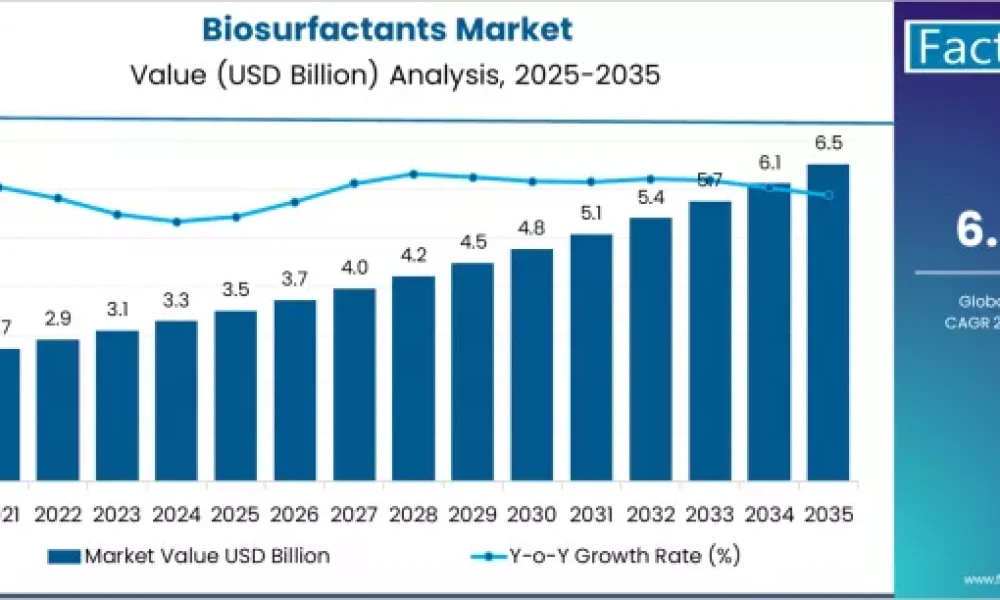
The global biosurfactants market is expected to witness strong expansion, growing from USD 3.5 billion in 2025 to approximately USD 6.5 billion by 2035, advancing at a CAGR of 6.4%. The market will record an absolute increase of USD 3.0 billion over the forecast period — reflecting total growth of nearly 86% and an overall market expansion of about 1.9 times by 2035.
Biosurfactants — biodegradable surface-active compounds produced from microbial fermentation or renewable plant feedstocks — are gaining widespread industry recognition. Their low toxicity, renewable sourcing, and superior environmental profile position them as an essential alternative to conventional petroleum-based surfactants across consumer and industrial sectors.
Key Market Drivers
Rising Demand for Green and Biodegradable Ingredients
Growing environmental concerns, increasing regulatory restrictions on synthetic chemicals, and brand commitments to sustainable product portfolios are rapidly accelerating the global shift toward bio-based surfactants. Biosurfactants are increasingly becoming the solution of choice for manufacturers targeting biodegradability, safety, and ecological compatibility.
To access the complete data tables and in-depth insights, request a Discount On The Report here: https://www.factmr.com/connectus/sample?flag=S&rep_id=11905
Expanding Use Across Household, Personal Care and Industrial Applications
Biosurfactants are being integrated into household detergents, fabric care solutions, liquid dishwash formulations, cosmetics, skincare products, shampoos, soaps, and industrial cleaning agents. The household detergents segment remains the dominant consumption category, while personal care and institutional/industrial cleaning sectors are emerging as major long-term growth engines due to rising demand for skin-friendly and naturally derived functional ingredients.
Microbial Surfactants Gaining Commercial Scale
Microorganism-derived biosurfactants, particularly rhamnolipids, are expected to witness the fastest adoption rates globally, supported by increasing interest in natural formulations, performance-based cleaning solutions, and next-generation sustainable chemistries.
Supply Chain Diversification & Resilient Raw Material Sourcing
Rising industry focus on sustainable feedstocks — including plant oils and agro-industrial waste as fermentation inputs — is helping brands lower environmental impact while improving supply chain resilience in an era of growing raw material uncertainty.
Market Segmentation Insights
By Product Type
- Methyl Ester Sulfonates (MES): Currently holds the largest share due to cost efficiency and strong commercial penetration in household cleaning products.
- Rhamnolipids: Poised for the highest growth, driven by demand in natural cleaning, personal care, and specialty formulations.
By Application
- Home Care & Cleaning: Largest consumption segment.
- Personal Care & Cosmetics: Growing rapidly with increasing brand reformulations.
- Industrial & Institutional Cleaning: Expected to scale significantly due to sustainability mandates.
Regional Market Trends
- North America and Europe continue to lead demand, supported by strong regulatory frameworks and rapid adoption of bio-based chemistry in consumer brands.
- Asia-Pacific and Latin America present emerging high-growth opportunities driven by expanding manufacturing capacity for bio-derived ingredients and increasing green-product penetration in domestic markets.
- Countries with strong fermentation infrastructure and access to renewable lipid feedstocks are establishing themselves as production and export hubs for biosurfactant supply.
Market Challenges
Despite commercial acceleration, the industry still faces key constraints including:
- Higher production costs compared to synthetic surfactants
- Fermentation yield limitations
- Need for improved quality consistency and purification standardization
- Scaling supply to meet high-volume industrial adoption
Continued investments in feedstock optimization, microbial strain enhancement, and production scale-up are expected to reduce these barriers over time.
Competitive Landscape
The biosurfactants market remains moderately fragmented, with companies focusing on:
- Sustainable fermentation processes
- Low-carbon and circular feedstocks
- Supply chain traceability
- Strategic partnerships between bio-ingredient producers and global consumer brands
Leading manufacturers are also expanding commercial distribution and launching biosurfactant-based formulation blends to replace synthetic surfactants without compromising performance.
Future Outlook
Over the next decade, biosurfactants are expected to become a mainstream component of global surfactant demand, transitioning from specialty bio-alternatives to core sustainable raw materials across industries including home care, personal care, environmental remediation, and industrial cleaning solutions.
With sustainability now driving product innovation, brands that invest early in biosurfactant adoption, supply chain integration and fermentation scalability stand to gain the strongest competitive advantages as this industry expands toward 1.9× growth by 2035.
Have a specific Requirements and Need Assistant on Report Pricing or Limited Budget please contact us – [email protected]
About Fact.MR
Fact.MR is a global market research and consulting firm, trusted by Fortune 500 companies and emerging businesses for reliable insights and strategic intelligence. With a presence across the U.S., UK, India, and Dubai, we deliver data-driven research and tailored consulting solutions across 30+ industries and 1,000+ markets. Backed by deep expertise and advanced analytics, Fact.MR helps organizations uncover opportunities, reduce risks, and make informed decisions for sustainable growth.



