
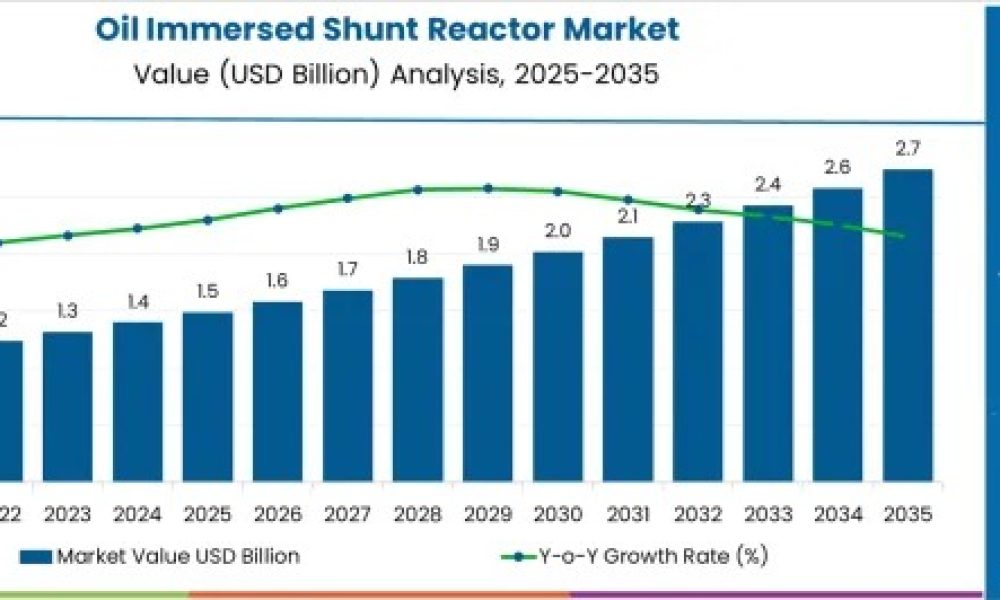
The global Oil Immersed Shunt Reactor Market is entering a high-growth phase as nations modernize transmission infrastructure and integrate large volumes of renewable energy. Valued at USD 1.5 billion in 2025, the market is projected to reach USD 2.7 billion by 2035, expanding at a steady CAGR of 6.3%. This surge reflects the growing requirement for reactive power compensation, voltage regulation, and long-distance transmission efficiency—capabilities that oil-immersed shunt reactors consistently deliver with high durability and stable thermal performance.
Subscribe for Year-Round Insights → Stay ahead with quarterly and annual data updates:
https://www.futuremarketinsights.com/reports/sample/rep-gb-25878
Between 2021 and 2025, the market moved from USD 1.1 billion to USD 1.5 billion, supported by predictable grid expansion projects and rising utility investments in high-voltage equipment. From 2026 to 2030, investments deepen across Asia-Pacific, North America, and Europe, accelerating market value from USD 1.5 billion to USD 2.0 billion. By 2035, heightened renewable integration and grid reliability mandates push the market to USD 2.7 billion.
Key Market Drivers: Grid Expansion, Renewable Integration, and Efficiency Mandates
Oil immersed shunt reactors are essential for absorbing excess reactive power, mitigating voltage fluctuations, and preventing overvoltage conditions across transmission networks. As electricity demand increases and power grids diversify with solar, wind, and distributed energy resources, maintaining voltage stability becomes mission-critical.
Aging infrastructure in the United States and Europe is being upgraded with modern high-voltage equipment, while emerging markets such as China and India are rapidly extending transmission corridors to meet rising industrial and residential power consumption. These parallel trends are fueling sustained demand for shunt reactors through 2035.
Segmental Performance: Three-Phase & Fixed Reactors Lead
The three-phase reactor segment, commanding 61.5% market share, remains the preferred configuration for bulk power transmission due to its balanced operation and strong insulation performance. Utilities rely heavily on three-phase reactors to stabilize high-voltage lines, especially those connecting remote renewable assets.
The fixed shunt reactor segment, representing 57.2% market share, continues to dominate due to its reliability, simplicity, and cost-efficiency. As countries expand high-voltage lines and interconnect regional grids, fixed reactors are deployed extensively to prevent voltage rise during low-load periods.
On the end-use front, electric utilities hold 62.9% share, underscoring their pivotal role in adopting shunt reactors to enhance grid stability and reduce transmission losses. Utility-led modernization programs in Asia-Pacific, Latin America, and the Middle East are expected to drive the next wave of deployments.
Regional Insights: Asia-Pacific Leads Global Growth
China remains the fastest-growing market with an 8.5% CAGR, supported by rapid urbanization, rural electrification, and multi-gigawatt renewable installations. India follows closely at 7.9% CAGR, driven by long-distance transmission line expansion and renewable corridor development.
Germany (7.2%) and France (6.6%) continue to lead European adoption, supported by energy transition initiatives and grid digitization mandates. Meanwhile, the U.S. market grows at 5.4% as utilities replace aging infrastructure with advanced voltage regulation systems to improve resilience and reduce outage risks.
Market Trends: Digitalization and High-Efficiency Reactor Designs
Manufacturers are integrating IoT-enabled sensors for real-time thermal monitoring, oil condition analysis, and predictive maintenance—extending asset life and reducing operational risk. Improved magnetic core materials and optimized coil designs are also reducing losses, increasing power efficiency, and lowering total cost of ownership.
Competitive Landscape
Key industry players—including CG Power & Industrial Solutions, Fuji Electric, GE, Hitachi Energy, Hyosung Heavy Industries, Nissin Electric, SGB SMIT, Siemens Energy, and Toshiba Energy Systems—compete through innovation in insulation materials, advanced cooling techniques, and digitally enabled maintenance systems. Their product strategies emphasize reliability, minimal leakage, high-load tolerance, and extended operational life.
Strategic Guidance for Buyers and Utilities
Utilities and large industrial operators are prioritizing solutions that enhance grid reliability, reduce losses, and support renewable integration. As regulatory pressure intensifies around efficiency and operational transparency, investment in high-performance shunt reactors becomes increasingly aligned with long-term strategic planning.
Get data that aligns with your strategic priorities — ask for report customization today:
https://www.futuremarketinsights.com/customization-available/rep-gb-25878
Have a specific Requirements and Need Assistant on Report Pricing or Limited Budget please contact us – [email protected]
About Future Market Insights (FMI)
Future Market Insights, Inc. (FMI) is an ESOMAR-certified, ISO 9001:2015 market research and consulting organization, trusted by Fortune 500 clients and global enterprises. With operations in the U.S., UK, India, and Dubai, FMI provides data-backed insights and strategic intelligence across 30+ industries and 1200 markets worldwide.
Contact Us:
Future Market Insights Inc.
Christiana Corporate, 200 Continental Drive,
Suite 401, Newark, Delaware – 19713, USA
T: +1-347-918-3531



