
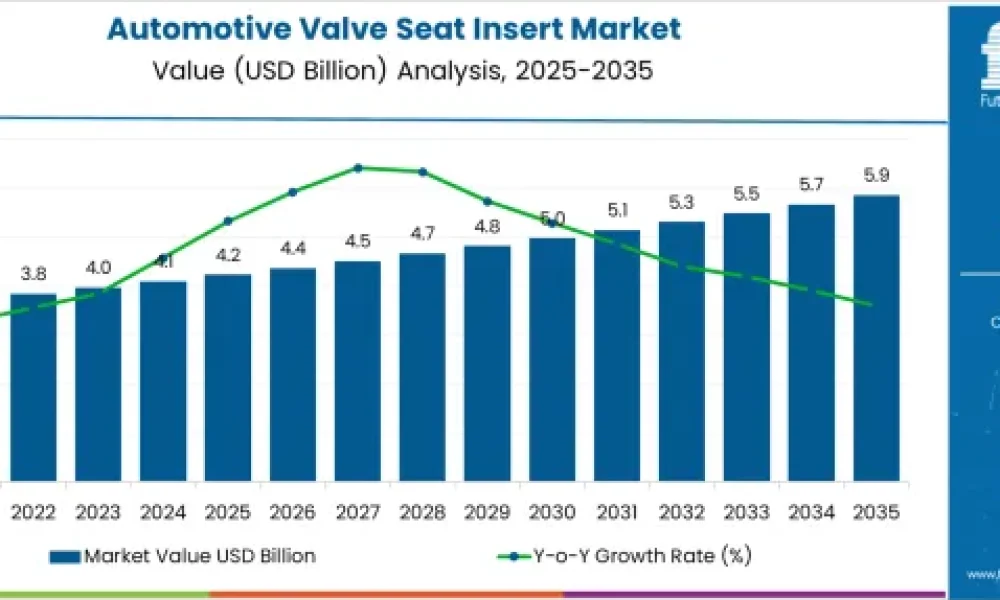
The global Automotive Valve Seat Insert Market, valued at USD 4.2 billion in 2025, is projected to reach USD 5.9 billion by 2035, expanding at a CAGR of 3.3% over the forecast period, according to the latest industry assessment. The market is witnessing stable yet essential growth driven by rising internal combustion engine (ICE) production, material advancements, and sustained aftermarket demand across passenger, commercial, and alternative-fuel vehicle categories.
Engine Performance Demands Drive Steady Global Expansion
The market’s upward trajectory is supported by intensifying requirements for reducing emissions, enhancing fuel efficiency, and extending engine durability. Valve seat inserts, critical to ensuring precise valve operation and maintaining combustion chamber integrity, have become increasingly important as engines operate at higher temperatures and compression ratios.
Growing passenger vehicle production—especially in India, China, Germany, and the U.S.—along with the ongoing dependence on gasoline engines, continues to anchor the industry. Gasoline engines alone are expected to contribute 42.1% of global market revenue in 2025, driven by their dominance in passenger and light commercial segments. These engines demand high-performance inserts capable of withstanding thermal loads and resisting valve face erosion.
Subscribe for Year-Round Insights → Stay ahead with quarterly and annual data updates
https://www.futuremarketinsights.com/reports/sample/rep-gb-22879
Steel Emerges as the Leading Material with 39.7% Market Share
Among materials, steel remains the top choice for OEMs and engine rebuilders due to its strength, dimensional stability, and heat resistance. Accounting for 39.7% of market share in 2025, steel valve seat inserts continue to outperform alternatives in cost-to-performance ratio. Advancements in alloying, heat treatment, and precision machining have further strengthened steel’s leadership, making it ideal for both mass-market and hybrid engine applications.
Nickel-based and cobalt-based alloys are gaining attention as premium options for turbocharged, downsized, and high-compression engines, but their higher cost and supply fluctuations are restraining widespread adoption.
Passenger Vehicles Lead with 46.8% Market Share
Passenger vehicles remain the largest end-user segment, contributing 46.8% of global revenue in 2025. This dominance is driven by rising vehicle sales, improved disposable incomes in emerging markets, and the need for engine components that enhance fuel economy and reduce emissions. The shift toward more compact, high-efficiency engines further reinforces demand for precision-engineered valve seat inserts.
Regional Outlook: Asia-Pacific Leads Growth Momentum
The market expands across all major regions, with Asia-Pacific, North America, and Europe representing the top growth territories.
China (4.5% CAGR) – World’s Fastest Growing Market
China continues to lead the global market with a 4.5% CAGR, fueled by extensive ICE production in Shanghai, Guangzhou, and Changchun. High adoption of alloy-based and powder-metal valve seat inserts reflects the country’s evolving focus on high-performance engines, dual-fuel platforms, and large-scale OEM operations.
India (4.1% CAGR) – Rising Demand in Two-Wheelers & Compact Cars
India’s market benefits from robust engine manufacturing, especially for motorcycles, small cars, and LPG/CNG vehicles. Machining hubs in Tamil Nadu and Maharashtra show strong demand for sintered steel and hardened alloy inserts optimized for mixed combustion cycles.
Germany (3.8% CAGR) – Precision Engineering Drives Adoption
Germany’s premium automotive manufacturing ecosystem fuels the adoption of low-porosity, powder-forged inserts, especially for high-performance, turbocharged, and multi-valve engines. Surface-treated inserts (nitrided and chrome-coated) remain in high demand for both OEM and remanufacturing applications.
United Kingdom (3.1% CAGR) – Strong Aftermarket & Legacy Engine Needs
The UK market is shaped by demand from engine rebuilders, light-duty truck segments, and motorsport applications. Pre-sized, grind-ready inserts streamline operations for component centers and restoration workshops.
United States (2.8% CAGR) – Mature Market with Heavy-Duty Focus
The U.S. market is sustained by requirements for V6, V8, and straight-six engines used in pickups, SUVs, off-highway machinery, and crate engines. Induction-hardened and sintered inserts dominate due to compatibility with ethanol-blended fuels and high-torque applications.
Drivers, Restraints & Market Trends
Key Growth Drivers
- Rising global ICE production and aftermarket rebuild activities
- Improved alloy technologies for high-temperature applications
- Growing vehicle longevity and engine refurbishment demand
- Increased adoption of downsized, turbocharged, and hybrid engines
Key Restraints
- Raw material price volatility for nickel, cobalt, and ceramic powders
- High testing and validation costs for multi-fuel engines
- Extended certification cycles with OEMs
Key Trends
- Adoption of advanced materials such as nickel- and cobalt-based alloys
- Precision machining using powder metallurgy, laser welding & additive manufacturing
- Surface engineering techniques to improve heat dissipation and wear life
- Rising demand for inserts compatible with hybrid and dual-fuel engines
Personalize Your Experience: Ask for Customization to Meet Your Requirements
https://www.futuremarketinsights.com/customization-available/rep-gb-22879
Competitive Landscape: Innovation at the Core
The global market is moderately consolidated, led by companies with advanced metallurgical capabilities:
- MAHLE: Leading in high-performance alloy-based inserts for emission-compliant engines
- Eaton: Strong OEM presence with inserts tailored for hybrid powertrains
- Federal-Mogul (Tenneco): Innovations in powder metallurgy and thermal coatings
- GKN Automotive: Precision-forged inserts for fuel-efficient platforms
- Mitsubishi Materials: High-purity alloy inserts dominant in Asian OEMs
- Nippon Piston Ring & TPR: Integrated piston–valve solutions for high-RPM engines
- Goodson Tools & Supplies: Aftermarket-focused insert solutions
- Kavya International: Competitive offerings for cost-sensitive markets
Material innovation, dimensional accuracy, and long-term thermal performance remain the defining competitive factors for suppliers through 2035.
Future Outlook
With the global automotive sector continuing its transition toward higher engine efficiency and emission compliance, the automotive valve seat insert market is expected to sustain robust demand. Hybrid engines, alternative-fuel powertrains, and long-lifecycle commercial fleets will create significant opportunities for advanced insert materials and precision manufacturing technologies in the decade ahead.
Why Choose FMI: Empowering Decisions that Drive Real-World Outcomes:
https://www.futuremarketinsights.com/why-fmi
About Future Market Insights (FMI)
Future Market Insights, Inc. (FMI) is an ESOMAR-certified, ISO 9001:2015 market research and consulting organization, trusted by Fortune 500 clients and global enterprises. With operations in the U.S., UK, India, and Dubai, FMI provides data-backed insights and strategic intelligence across 30+ industries and 1200 markets worldwide.



