
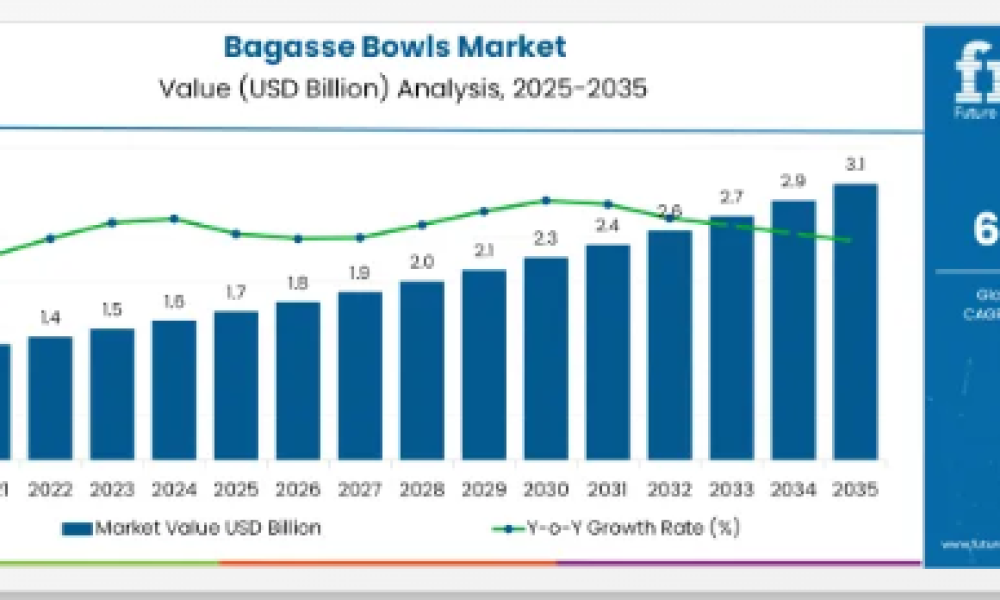
The global bagasse bowls market is witnessing a transformative shift, poised to nearly double from an estimated US$ 1.7 billion in 2025 to US$ 3.1 billion by 2035, with a projected compound annual growth rate of 6.4 percent. This momentum reflects growing environmental consciousness, regulatory pressure on single-use plastics, and a robust move by foodservice players toward compostable alternatives.
Key Market Insights at a Glance
In 2025, more than 40 percent of market revenue is expected to originate from large-capacity bowls, specifically the “more than 16 oz.” segment — driven by demand in quick-service restaurants, meal kits, and institutional catering where portion size matters. Indirect sales channels — including distributors, wholesalers, and food-service aggregators — account for around 60 percent of total revenues, reflecting the strength of B2B procurement networks. On the end-use front, the commercial sector (restaurants, catering, QSRs) contributes as much as 45 percent of the market, underlining that foodservice operators are leading the charge for compostable packaging.
Segment Overview
By product type, the market is divided into three key categories: less than 12 oz, 13–16 oz, and more than 16 oz, with the latter dominating due to its suitability for large meals. In sales channels, the distinction between direct and indirect sales drives how companies reach their buyers — with indirect channels (distributors, specialty stores, e-commerce) serving the bulk of demand. For end-use, commercial applications (including food vendors, cafes, restaurants, catering) are joined by institutional sectors (like hospitals, schools, offices) and residential use.
Regional Overview
Geographically, the market is led by North America, Europe, and the Asia-Pacific region. North America’s strong regulatory climate against single-use plastics, combined with mature foodservice infrastructure, makes it a key battleground. In Europe, tightening environmental policy and consumer preference for sustainable alternatives accelerate adoption. Meanwhile, Asia-Pacific stands out as a fast-growing market, buoyed by rising urbanization, sugarcane production (making bagasse more accessible), and scaling demand from QSRs and cloud kitchens.
Competitive Landscape
Major players exert significant influence in shaping the direction of the bagasse bowls market. Tier-1 firms such as Huhtamaki Oyj, Genpak LLC, and Eco-Products command over a quarter of global market share — leveraging scale, advanced molded-fiber technologies, and sustainability credentials. Tier-2 players (for example, World Centric and Green Paper Products) capture another 35 percent by focusing on customizable, cost-effective offerings. Smaller, regional or niche manufacturers (Tier-3) make up roughly 38 percent of the pie by serving specialized end-markets and emphasizing eco-certifications.
Market Outlook: Powering the Next Decade
Sustainability is not just a trend — it’s becoming a baseline requirement. Over the next ten years, bagasse bowls are expected to solidify their role as a preferred choice in foodservice packaging, driven by regulatory bans on plastics, consumer demand for green dining, and the green procurement strategies of large institutions. Innovation will further help: expect to see enhanced heat resistance, leak-proof designs, and automation in production to lower costs while maintaining quality. As food operators standardize on compostable solutions, bagasse bowls could become a core part of their built-in sustainable practices.
Key Players of the Sustainable Label Industry
The leading companies shaping this movement include Huhtamaki Oyj, Eco-Products, Nature-Ware, Natural Tableware, Genpak LLC, Duni AB, Pactiv LLC, Gold Plast S.p.A., Vegware, Dart Container Corporation, Meshline Manufacturing Inc., and Wasara Co. Ltd. They are investing in capacity expansion, eco-certifications, and differentiated product lines (like high-volume bowls and compartment designs) to capture a growing share of the sustainable packaging market.
Recent Strategic Developments
Key players are moving aggressively on multiple fronts. Some are scaling up production to meet surging demand from institutional buyers, while others are investing in R&D for improved molded-fiber technologies that enhance durability, heat resistance, and moisture stability. Strategic partnerships between manufacturers and green distribution networks are also emerging, boosting availability across new geographies. At the same time, companies are aligning with governmental and NGO sustainability initiatives, securing eco-labels and certifications that help reinforce buyer trust and regulatory compliance.
Subscribe for Year-Round Insights → Stay ahead with quarterly and annual data updates: https://www.futuremarketinsights.com/reports/sample/rep-gb-13995
Have a specific Requirements and Need Assistant on Report Pricing or Limited Budget please contact us – [email protected]
About Future Market Insights (FMI)
Future Market Insights, Inc. (ESOMAR certified, recipient of the Stevie Award, and a member of the Greater New York Chamber of Commerce) offers profound insights into the driving factors that are boosting demand in the market. With a vast team of over 400 analysts worldwide, FMI provides global, regional, and local expertise on diverse domains and industry trends across more than 110 countries.



