
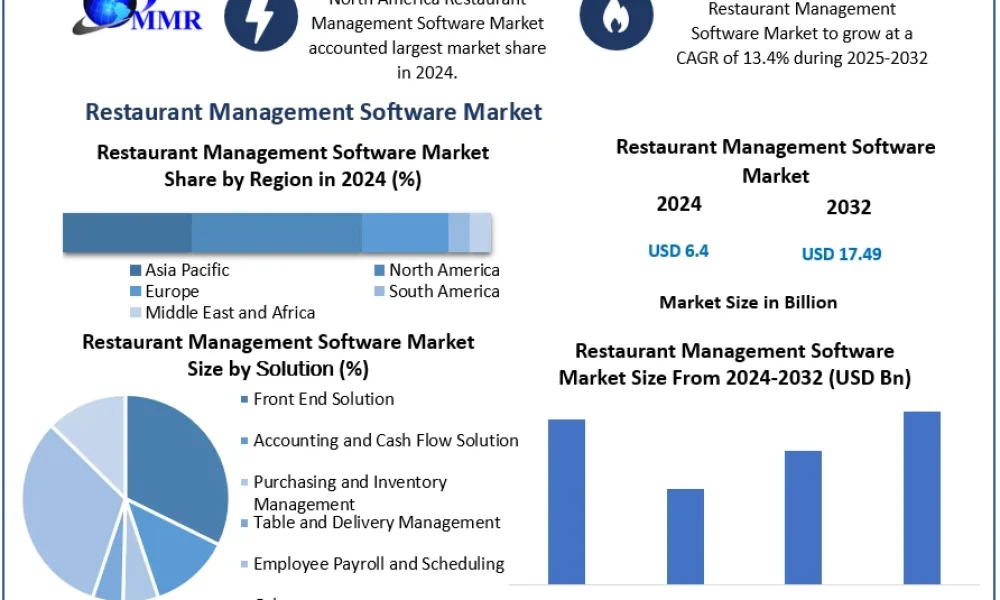
Restaurant Management Software Market Overview:
Restaurant Management Software Market is set to experience robust growth, projected to expand from USD 6.4 billion in 2024 to USD 17.49 billion by 2032, at an impressive CAGR of 13.4%. This growth is fueled by rapid digitalization, rising demand for automation in restaurant operations, and consumer preferences for seamless dining experiences, with North America leading market adoption.
Key Highlights & Insights
Market Size & Growth: Expected to jump from USD 6.4 billion in 2024 to USD 17.49 billion by 2032 (CAGR: 13.4%).
Dominating Region: North America holds the largest market share (35%, 2024), driven by early technology adoption, advanced foodservice infrastructure, and widespread use of integrated restaurant management solutions.
Leading Segment: Billing & order management dominates (approx. 35% market share), followed by inventory management (20%) and table/reservation management (15%). Customer engagement and analytics are growing at a CAGR of over 12%.
Key Drivers: Demand for automation, the rise of cloud-based solutions, increased smartphone use, and contactless dining preferences post-pandemic are key market drivers.
► Get a sample of the report:https://www.maximizemarketresearch.com/request-sample/23421/
Recent Developments
2024–2025: Toast, Square, and Lightspeed released new feature-rich POS and restaurant management solutions focused on cloud adoption and mobile integration.
TouchBistro and Oracle MICROS launched AI-powered analytics modules, enhancing business intelligence and predictive inventory management.
Partnerships between software providers and major quick-service restaurant chains have resulted in broader adoption of reservation, loyalty, and digital payment solutions.
North American brands have accelerated integration with third-party delivery and reservation platforms for a unified customer experience.
Market Dynamics
Growth Drivers:
Increased automation and digitization are allowing restaurants to optimize operations, reduce errors, and enhance customer experiences.
Rising competition in the restaurant sector, especially from quick-service restaurants, has sparked investment in management software for client engagement and operational efficiency.
Cloud-based and mobile solutions offer scalability, ease of use, and lower upfront costs, making them attractive for both large chains and independent restaurants.
Challenges:
Initial implementation and integration costs may deter small businesses.
Data privacy, cyber security, and regulatory compliance remain essential concerns.
Fragmented restaurant market creates complexity in scaling and customizing solutions for various business models.
Opportunities:
Growth of the quick-service and casual dining sectors worldwide, particularly in Asia Pacific.
Advances in AI, IoT, and machine learning are enabling predictive analytics, dynamic pricing, and enhanced personalization.
Regional Analysis
North America: Dominates with early adoption, extensive presence of QSRs, and innovation in POS and operational solutions.
Asia Pacific: Fastest-growing region (forecast CAGR: 18.25%), driven by rapid digital transformation in China, Japan, and India; mobile ordering and payment features are especially popular.
Europe: Steady growth, propelled by regulatory initiatives supporting digital payments and consumer data protection.
Middle East & Africa / South America: Expanding markets, benefitting from investments in hospitality infrastructure and premium dining experiences.
Product Segmentation
By Solution: Front-end (POS, order management, table management, delivery coordination), back-end (accounting, inventory, payroll, scheduling).
By Deployment Model: On-premise, cloud-based, hybrid.
By End User: Full-service restaurants, quick-service restaurants, institutional food services, cafes, bars, bakeries, food trucks.
Key Trends
Adoption of next-gen POS systems featuring mobile access, contactless payments, analytics, and loyalty programs.
Integration of AI-driven business intelligence, optimizing inventory, staff scheduling, and customer engagement.
Mobile-first solutions enabling table-side ordering, payment, and personalized promotions.
Expansion of smart kitchen display systems and order trackers for operational transparency and efficiency.
FAQ’s
What is restaurant management software?
A digital tool that streamlines restaurant operations—ordering, billing, reservations, inventory, and staff scheduling.What drives market growth?
Automation demand, smartphone/tablet use, increased cloud deployment, and post-pandemic contactless dining needs.Which regions lead adoption?
North America leads globally, with Asia-Pacific seeing rapid growth; Europe maintains steady expansion.Key features of modern restaurant software?
POS, CRM, inventory, scheduling, reservations, analytics/reporting, mobile access, and loyalty programs.Who are major players?
Toast, Square, Lightspeed, TouchBistro, Oracle MICROS, Clover, Restaurant365, OpenTable.
Conclusion
The global restaurant management software market is set for transformative growth, propelled by rapid digitalization, evolving customer expectations, and expanding restaurant sectors across the globe. As the industry embraces cloud-based, mobile, and AI-powered platforms, restaurants are poised to benefit from enhanced efficiency, deeper customer relationships, and greater competitiveness—redefining how dining establishments operate and engage with patrons worldwide.
◉ Get Market Research Latest Trends
♦ Maximize Market Research is launching a subscription model for data and analysis in the MMR Statistics
Contact Maximize Market Research:
3rd Floor, Navale IT Park, Phase 2
Pune Bangalore Highway, Narhe,
Pune, Maharashtra 411041, India
[email protected]
+91 96071 95908, +91 9607365656
About Maximize Market Research:
Maximize Market Research is a multifaceted market research and consulting company with professionals from several industries. Some of the industries we cover include medical devices, pharmaceutical manufacturers, science and engineering, electronic components, industrial equipment, technology and communication, cars and automobiles, chemical products and substances, general merchandise, beverages, personal care, and automated systems. To mention a few, we provide market-verified industry estimations, technical trend analysis, crucial market research, strategic advice, competition analysis, production and demand analysis, and client impact studies.




