
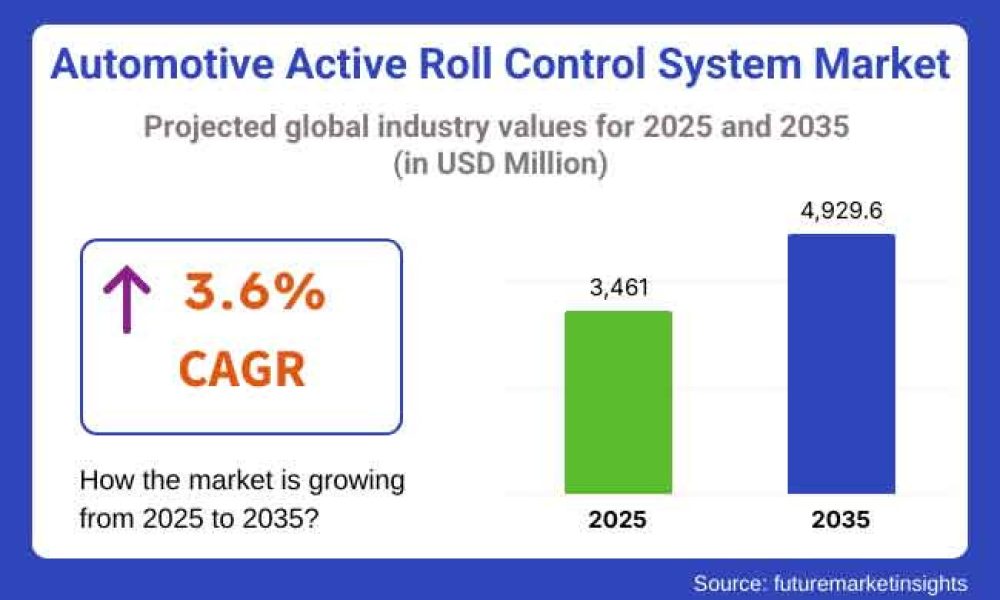
The automotive active roll control (ARC) system market is on track to expand from USD 3,461 million in 2025 to USD 4,929.6 million by 2035, advancing at a CAGR of 3.6%. Growth will be driven by rising consumer expectations for advanced safety, superior ride comfort, dynamic vehicle handling, and rapid technological evolution in mechatronics, ECUs, and electromechanical actuators.
ARC systems are engineered to minimize vehicle body roll during cornering and uneven road conditions, significantly improving stability and comfort. Their adoption is accelerating across premium passenger cars, electric vehicles (EVs), hybrid platforms, and performance-oriented SUVs, aligning with global trends of electrification, intelligent chassis control, and regulatory compliance for enhanced road safety.
Advanced Safety, Electrification, and Luxury Vehicle Growth Accelerate ARC Adoption
The automotive sector is witnessing rapid integration of ARC systems as part of next-generation chassis design. Key factors driving demand include:
- Growing penetration of luxury SUVs, premium sedans, and high-performance cars
- Rising need for stability-enhancing systems in EVs and hybrids
- OEM focus on improved cornering stability and predictive vehicle control
- Growth of AI-enabled chassis systems and smart electromechanical actuation
Modern ARC systems now work in sync with ADAS, real-time sensor input, and predictive algorithms—helping vehicles maintain optimal balance and reducing rollover risks under demanding driving conditions.
Subscribe for Year-Round Insights → Stay ahead with quarterly and annual data updates
https://www.futuremarketinsights.com/reports/sample/rep-gb-8575
Personalize Your Experience: Ask for Customization to Meet Your Requirements!
Regional Market Outlook: USA and Europe Lead, APAC Emerges as Fastest-Growing Hub
North America
North America is expected to remain a leading market through 2035 owing to a strong automotive manufacturing base and advanced safety innovation. The USA’s rising demand for luxury SUVs, high-performance EVs, and comfort-oriented vehicles is significantly boosting ARC penetration.
Regulatory initiatives from the National Highway Traffic Safety Administration (NHTSA) supporting active safety technologies are further accelerating OEM integration. Technological partnerships between automakers and Tier-1 suppliers continue to strengthen adoption across midsize and premium vehicle platforms.
Europe
Europe represents one of the most mature and innovation-oriented ARC markets. High adoption is driven by:
- Strong presence of German, UK, Scandinavian, and French automakers
- Increasing application in luxury, performance, and EV models
- EU’s stringent safety and emissions regulations
- Continued development of electromechanical roll control systems for hybrid and electric vehicles
The region’s rapid transition to plug-in hybrid and battery electric vehicles is expected to stimulate significant long-term demand for lightweight, energy-efficient ARC technologies.
Asia-Pacific
Asia-Pacific is projected to record the fastest CAGR due to expanding vehicle production and technological advancement in China, Japan, South Korea, and India.
- China leads ARC adoption across EVs and premium models as automakers compete in performance dynamics.
- Japan and South Korea, home to Toyota, Nissan, Hyundai, and Kia, are accelerating development of next-generation ride-control systems.
- India’s growing premium vehicle segment and rising awareness of vehicle stability are opening new opportunities for ARC implementation in compact EVs and high-end passenger cars.
Challenges and Opportunities: Cost Barriers Offset by EV and Autonomous Integration
Challenge: High System Cost and Complex Integration
ARC components—actuators, sensors, ECUs—require advanced engineering, making systems expensive for mass-market vehicles. Complex mechanical and electronic integration raises manufacturing and maintenance costs, limiting adoption primarily to premium segments.
Opportunity: Electrification and Autonomous Vehicle Platforms
Electrification and autonomous driving are reshaping chassis development. ARC systems provide:
- Enhanced stability for heavy battery-integrated EV platforms
- Smoother ride quality for autonomous vehicles
- Seamless pairing with ADAS, AI-driven suspension, and predictive dynamics
OEMs investing in modular, software-defined chassis architectures are well-positioned to drive the next phase of ARC innovation.
Market Evolution: From 2020–2024 to the High-Tech Future of 2025–2035
Between 2020 and 2024, ARC adoption grew steadily as premium automakers embraced hydraulic and electromechanical roll control systems to improve high-speed handling and reduce body roll.
Between 2025 and 2035, market growth will accelerate due to:
- Widespread use of AI-powered predictive ARC control systems
- Deeper integration with ADAS, EV platforms, and autonomous driving modules
- Lightweight actuator designs optimized for range efficiency
- Greater adoption in mid-range vehicles as cost drops
- Advanced machine learning for real-time, adaptive roll stabilization
These advancements signal a transformative decade in vehicle dynamics technology.
United States, United Kingdom, EU, Japan, and South Korea Lead Global Country-Level Growth
Country-level outlook (CAGR 2025–2035):
- USA: 3.9% — Driven by luxury SUV demand and active safety regulations
- UK: 3.3% — Adoption led by EVs and high-precision ride control technologies
- EU: 3.6% — Strong automotive production base and strict Euro NCAP standards
- Japan: 3.7% — Rapid advances in electromechanical ARC for hybrids and EVs
- South Korea: 3.8% — Strong OEM innovation from Hyundai and Kia, rising SUV sales
Segmentation Outlook: Passenger Vehicles and Rotary Actuators Dominate
By Vehicle Type (2025)
Passenger vehicles hold the largest market share due to:
- Growing adoption in luxury sedans and SUVs
- Center-of-gravity stabilization needs in EVs
- Consumer preference for premium ride comfort
By Actuator Type (2025)
Rotary actuators lead the market owing to:
- High torque precision
- Compact design for EV architectures
- Superior real-time roll correction
- Seamless integration with ADAS and electronic suspension systems
Competitive Landscape: Leading Suppliers Invest in Next-Gen ARC Platforms
The market is moderately consolidated, dominated by global Tier-1 suppliers:
Company Market Share (Estimated)
- Continental AG: 18–22%
- Robert Bosch GmbH: 15–19%
- ZF Friedrichshafen AG: 12–16%
- Schaeffler AG: 10–14%
- Tenneco Inc.: 6–10%
- Others (combined): 30–40%
Personalize Your Experience: Ask for Customization to Meet Your Requirements!
https://www.futuremarketinsights.com/customization-available/rep-gb-8575
Key Company Developments (2024–2025)
- Continental AG: Introduced next-gen adaptive ARC technology for improved driving dynamics
- Bosch: Launched real-time, sensor-driven ARC systems for enhanced vehicle stability
- ZF: Developed lightweight electric ARC for EV platforms
- Schaeffler: Released modular ARC systems supporting multiple vehicle categories
- Tenneco: Showcased ARC with advanced damping for superior ride smoothness
Emerging players—including Hyundai Mobis, Mando, Thyssenkrupp, Hitachi Automotive Systems, and BWI Group—are accelerating competition through EV-ready and ADAS-integrated ARC solutions.
Outlook Through 2035: ARC Becomes a Foundation of Next-Gen Driving Dynamics
ARC systems will increasingly define the future of automotive chassis technology as the market transitions to electrified, autonomous, and high-performance vehicles. With growing demand for safety, comfort, and predictive handling, the next decade will witness widespread integration of lightweight, AI-driven, energy-efficient roll control systems across mainstream and premium vehicle segments.
Have a specific Requirements and Need Assistant on Report Pricing or Limited Budget please contact us –[email protected]
About Future Market Insights (FMI)
Future Market Insights, Inc. (FMI) is an ESOMAR-certified, ISO 9001:2015 market research and consulting organization, trusted by Fortune 500 clients and global enterprises. With operations in the U.S., UK, India, and Dubai, FMI provides data-backed insights and strategic intelligence across 30+ industries and 1200 markets worldwide.



