
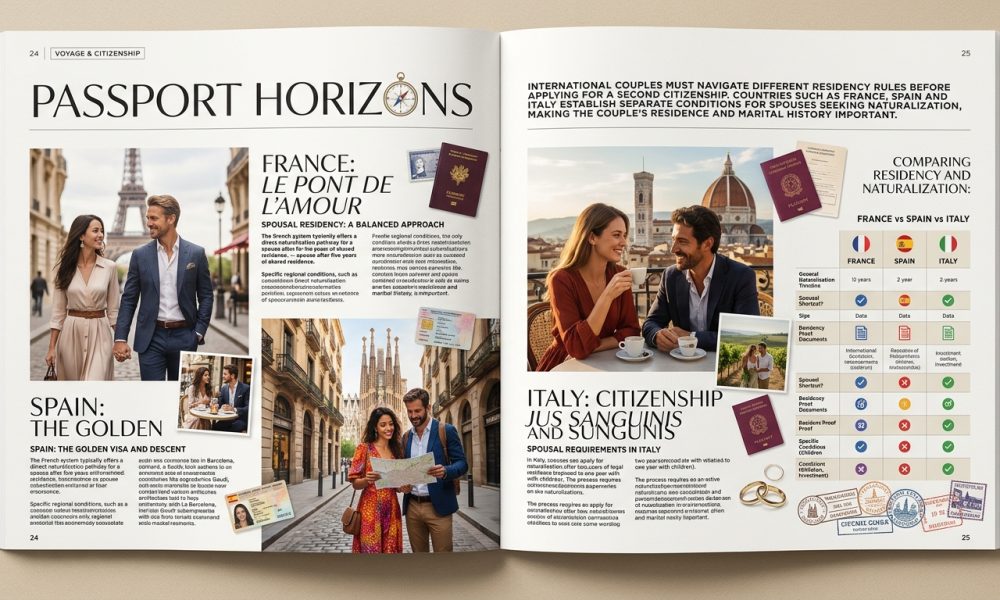
Countries such as France, Spain and Italy establish separate conditions for spouses seeking naturalization, making the couple’s residence and marital history important.
WASHINGTON, DC, November 16, 2026 — International couples exploring a second citizenship face sharply different residence requirements across Europe, where marriage may shorten an applicant’s qualifying period without automatically granting immigration status, nationality, or a right to a second passport.
An American married to a Spanish citizen may need to move to Spain before a shortened naturalization period can begin. In contrast, spouses of Italian citizens can sometimes pursue applications from abroad after a different marriage-duration requirement.
France offers another model based on a marriage declaration, making the couple’s documented life together and the French citizen’s overseas consular registration important factors in determining whether a four-year or five-year threshold applies.
Marriage and Residence Are Different Legal Events
A wedding establishes a family relationship when legally valid. Still, the nationality application often requires additional proof of where the couple lived, which spouse held citizenship, and whether the relationship remained legally intact throughout the relevant period.
Families should distinguish the ceremony date, the date immigration permission became effective, and the date a nationality application becomes legally available, because those milestones can occur years apart even within one marriage.
A person who visits a citizen spouse on tourist permissions may have a genuine relationship without accumulating the lawful residence necessary for a residence-based nationality pathway, making early immigration planning more important than counting anniversaries alone.
Spain Requires a Real Period of Legal Residence
Article 22 of Spain’s Civil Code allows certain foreign spouses to apply for nationality after one year of legal, continuous residence, provided they have been married to a Spanish citizen for at least one year and are not legally or actually separated. This exception is shorter than Spain’s ordinary ten-year nationality residence period. However, the applicant must still show that the required residence occurred immediately before filing, along with good civic conduct and sufficient integration under Spanish law.
A spouse living primarily in the United States or another country therefore cannot rely on a Spanish marriage certificate and an occasional holiday to establish one year of qualifying Spanish residence, regardless of how long the marriage has lasted.
A Spanish Family Residence Permit Is Only the First Stage
Couples preparing to relocate to Spain must identify the immigration framework that fits their circumstances, since the foreign partner’s legal permission to reside is separate from the later decision on eligibility for nationality through residence.
A foreigner Identification number, property ownership, or municipal address registration may provide useful supporting evidence. Still, none independently replaces a legally effective residence authorization or proves that an applicant maintained continuous residence during the qualifying year.
Residents should preserve authorization decisions, identity cards, renewals, and travel documentation, and review any long absences with qualified counsel before assuming a valid card guarantees the continuous residence nationality officials expect.
France Uses Marriage Duration and Overseas Registration
French law generally allows a qualifying foreign spouse to seek citizenship by declaration after four years of marriage, provided the French partner was already French at the wedding and retained that nationality during the relationship.
The period can increase to five years when the couple has not accumulated at least three years of qualifying residence in France after marriage, and the French spouse was not properly registered with French consular authorities while the couple lived abroad.
That arrangement means living overseas does not automatically disqualify a couple from marriage-based French nationality. Still, the couple must carefully document their continuing shared life and the specific circumstances that support the shorter marriage-duration threshold.
Living Together Means More Than Sharing an Address
French authorities examine whether the couple has maintained a genuine material and emotional community of life, so the application may require records showing that the relationship continued despite employment assignments, schooling responsibilities, or other periods of physical separation.
A shared tax return, utility statement, or household record can help corroborate the relationship. Still, applicants should provide documents that genuinely reflect their circumstances rather than assuming every couple must possess identical banking arrangements or property records.
Where professional obligations caused temporary separation, correspondence, travel evidence and credible records explaining those obligations may be relevant. However, the assessing authority determines whether the legal community-of-life condition is met in each case.
French Residence Permission Still Matters for Couples in France
A foreign spouse intending to settle in France should distinguish an appropriate family residence document from a visitor’s short-stay permission, because immigration status determines whether the person may lawfully remain and undertake activities during the marriage.
Official French guidance recognizes a separate residence route for eligible non-European spouses of French citizens, subject to conditions that can include the manner of entry, visa validation, and applicable documents establishing family relationships.
Those immigration requirements differ from the nationality declaration’s marriage-duration standard, allowing a couple to qualify to request residence well before citizenship or to live abroad while planning a later declaration.
Italy Permits Certain Marriage Applications From Abroad
Italian nationality law generally permits a foreign spouse or recognized civil-union partner to apply after two years of legal residence in Italy following marriage, or after three years of marriage when the qualifying couple resides abroad.
The applicable periods are halved when the spouses have qualifying children born or adopted together, showing that family circumstances can change the filing threshold without removing the other requirements imposed on the applicant.
The Italian partner’s nationality date also matters when citizenship was obtained after the wedding, because official consular guidance calculates the relevant waiting period from the later naturalization date in those particular family circumstances.
Italy’s Overseas Registry Is a Practical Requirement
Italian consular instructions ordinarily require the Italian spouse living abroad to be properly registered with the Registry of Italians Resident Abroad, commonly known as AIRE, in the consular district covering the couple’s actual residence.
The spouses generally must share an address or provide documentary explanations for different domiciles. At the same time, a marriage celebrated abroad normally must already have been transcribed into the competent Italian municipality’s civil register before filing.
These obligations make proper consular registration and civil-record accuracy central to the application, even though the qualifying marriage period can be completed outside Italy and no fixed two-year domestic residence is necessarily required.
Italian Applicants Still Face Language and Character Checks
Italy requires eligible marriage-based applicants to demonstrate Italian proficiency at no less than the B1 level unless a recognized exemption applies, and the government separately reviews specified criminal convictions and security concerns before granting nationality.
An American spouse married to an Italian citizen for more than three years may therefore remain ineligible to complete the process without acceptable language evidence, proper marriage transcription, and the necessary consular documentation.
The marriage or civil union must ordinarily remain legally valid through the government’s decision, making a later separation, divorce or other major change relevant even when the required residence or marriage-duration threshold has already been met.
A United States Comparison Shows Another Type of Residence Rule
The American system generally permits eligible spouses of United States citizens to naturalize after three years as lawful permanent residents. Still, it also requires a qualifying marital union, the citizen spouse’s required citizenship history, and compliance with physical-presence conditions.
The United States Citizenship and Immigration Services instructions for Form N-400 explain the required marital history and supporting records, illustrating why a wedding certificate alone cannot establish the full eligibility period for citizenship in the United States.
Unlike Italy’s recognized overseas-marriage route, the ordinary American three-year spousal process is anchored to permanent residence in the United States. However,h specialized provisions can apply to certain spouses connected to qualifying employment abroad.
Enforcement Cases Illustrate the Stakes of Accurate Evidence
An Associated Press report on an August 2026 federal marriage-fraud indictment described allegations against eleven defendants connected to arrangements prosecutors said involved more than one thousand sham weddings designed to obtain immigration benefits.
The allegations remained allegations rather than findings against every defendant, and the case does not imply that authentic multinational relationships are suspect merely because the spouses have different citizenships or maintain complex international lives.
It nevertheless clearly illustrates why applicants should reject fabricated cohabitation evidence, false marital histories, and offers to purchase nominal marriages, since lawful nationality systems assess genuine relationships alongside residence and other statutory conditions.
Periods Abroad Should Be Evaluated Under Each Country’s Rules
An extended assignment in another country may affect a Spanish spouse’s continuous legal residence and an American permanent resident’s physical-presence requirement. At the same time,e an Italian overseas applicant may instead need proof of shared domicile and consular registration.
French couples living abroad face a different evidentiary problem involving the marriage-duration threshold and the French spouse’s registration, showing why a blanket rule about how many months spouses may spend outside a country is unreliable.
Before scheduling long overseas travel, couples should review the specific nationality procedure they plan to use and keep accurate entry records and employment explanations, rather than applying one jurisdiction’s absence allowance to another jurisdiction’s law.
Previous Marriages Can Disrupt the Documentary Sequence
Civil authorities may need evidence that previous marriages ended before the current wedding, especially when the parties divorced abroad, changed surnames, or relied on foreign records that require legalization, recognized translations, or domestic registration.
A family should assemble an accurate chronology of the relationship, including the wedding location, the citizen spouse’s nationality acquisition date, te and any periods when both partners resided in different countries under separate immigration permissions.
Where records contain genuine spelling variations or administrative mistakes, applicants should seek legitimate corrections and supporting documentation instead of altering historical certificates, because contradictory identity information can create problems beyond marriage eligibility.
Children Can Change Eligibility Without Receiving Automatic Passports
Italian law halves the usual marriage-duration thresholds when spouses have children born to them or adopt children. Still, it does not eliminate the language requirement, background checks, or the obligation to maintain a valid marriage.
In other countries, children’s citizenship may be governed by separate descent, birthplace, or registration provisions, so a foreign spouse’s eventual naturalization does not necessarily grant the same nationality to every child in the household.
Parents should review each child’s position separately and preserve accurate birth and adoption records, especially when children were born before or after a parent acquired citizenship or when different countries recognize parental status differently.
Separation and Bereavement Demand Individual Advice
A marriage can be genuine when the application begins and later change through separation, divorce or death, with consequences that differ among the Spanish, French, Italian and American citizenship procedures described in government guidance.
Applicants facing domestic abuse or another urgent family crisis should seek qualified advice about independent immigration protections and applicable exceptions rather than remain in an unsafe relationship solely because a nationality application is pending.
Italy’s current consular guidance identifies circumstances in which a spouse’s death after filing does not necessarily terminate the application, showing why personal events should be assessed under the governing law rather than generalized from another country.
Language and Civic Examinations Remain Separate Requirements
France raised the French-language standard for marriage-based nationality declarations to B2 in 2026, while Italy generally requires B1 Italian for eligible spousal applicants, showing how proficiency evidence can delay a filing even after the marriage-duration requirement is met.
Spain generally requires a recognized Spanish-language qualification and an examination concerning constitutional and sociocultural knowledge, subject to statutory exemptions, so a one-year residence exception does not remove all integration or examination obligations for foreign spouses.
Couples should identify accepted test providers, official exemptions, and document validity early, because language preparation, consular appointments, and certificate issuance can create delays unrelated to the couple’s genuine relationship or qualifying residence history.
Eligibility to Apply Is Not Citizenship Approval
Even after the relevant marriage and residence periods have elapsed, nationality authorities may review civil records, security information, language evidence,ce and the couple’s ongoing legal relationship before issuing a favorable decision or completing formal registration.
A foreign spouse who files a valid application cannot assume that an existing residence permit becomes unnecessary, because immigration status and the pending nationality procedure continue under separate rules until the person legally acquires citizenship.
Parents should similarly avoid scheduling major international moves around a promised passport delivery date, since government processing times and subsequent civil registration or oath requirements can extend beyond the earliest lawful application milestone.
Tax Residence Is Not the Same as Nationality Residence
Couples relocating internationally may create tax residence, payroll and financial reporting obligations independently of the citizenship application, so an approved spouse visa or a completed marriage-duration threshold does not by itself settle their wider financial position.
Amicus International Consulting discusses this separation in its analysis of second passports and United States tax reporting. However, ugh any actual tax conclusion should be checked against official law and the couple’s individual citizenship and residence circumstances.
A household retaining businesses, retirement income or financial accounts abroad should coordinate appropriate immigration and tax advice before establishing a new residence, rather than assuming nationality acquisition automatically cancels obligations in another jurisdiction.
Professional Advice Should Identify the Actual Legal Route
Amicus International Consulting describes second-passport and international mobility advisory services for people evaluating lawful cross-border options. Still, only competent government authorities can determine whether a particular foreign spouse meets the relevant nationality legislation.
Applicants should ask advisers to distinguish residence authorization, marriage recognition, and citizenship eligibility, and to explain which records are required and whether filing can occur from abroad or depends on actual residence inside the country.
No private representative can guarantee a nationality decision, waive statutory residence conditions, or substitute invented marital evidence for genuine records, so independent verification matters most when a proposed plan promises citizenship by a fixed anniversary.
Couples Need a Timeline That Matches Their Actual Circumstances
A sound international citizenship plan begins by verifying both partners’ legal identities and nationality histories, then mapping marriage dates, residency permissions, overseas assignments, registration obligations, and the chosen country’s specific procedural requirements.
Spain’s one-year spousal exception, France’s four-year or five-year declaration thresholds and Italy’s distinct domestic and overseas routes illustrate why apparently similar marriages can produce very different eligibility dates for otherwise comparable lawful citizenship applications.
The opportunity to acquire a second nationality through marriage can be meaningful. Still, it depends on genuine family relationships and compliance with the destination country’s specific requirements, not the marriage certificate alone.




