
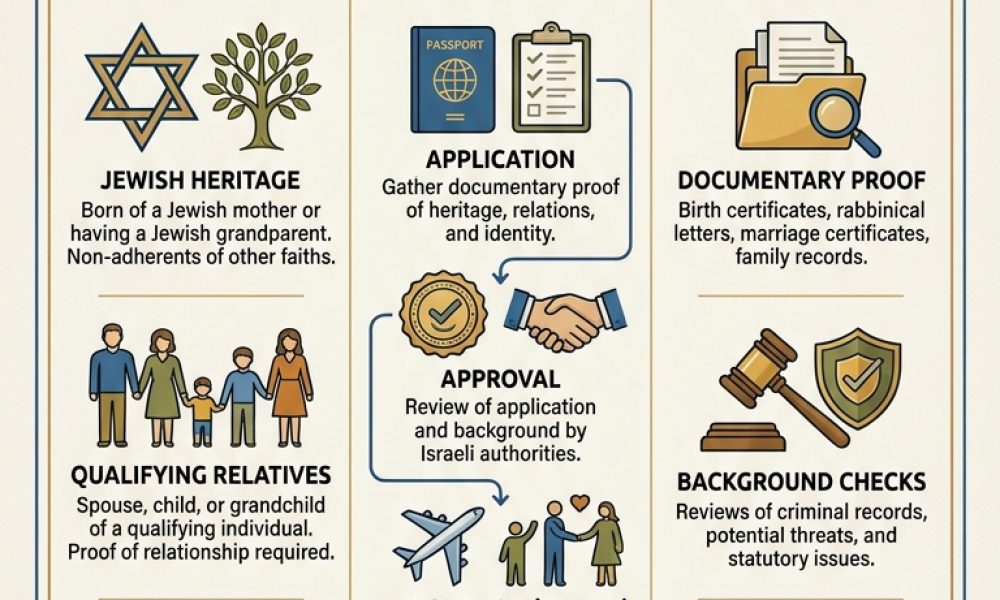
Israel’s nationality framework provides immigration and citizenship opportunities for eligible Jewish people and qualifying relatives, subject to statutory definitions and applicable restrictions.
WASHINGTON, November 16, 2026 — People tracing Jewish family heritage may have a specific route to immigrate to and obtain citizenship in Israel. Still, eligibility depends on statutory definitions, authentic ancestral documents, and individual government review, not a surname or family tradition alone.
The Law of Return differs from ordinary citizenship-by-descent programs because it links a right to immigrate with Israeli citizenship under a separate nationality statute, while extending specified rights to some relatives who are not themselves Jewish under religious definitions.
For families comparing second-citizenship options, key questions include who qualifies under the law, how officials verify a claimed relationship, when citizenship takes effect, and what practical obligations follow from settling in Israel.
A 1950 Law Establishes the Basic Immigration Right
Israel enacted the Law of Return in 1950, creating a statutory framework through which Jews living abroad could immigrate as olim, the Hebrew term for people making aliyah, while later nationality legislation connected qualifying immigration with citizenship.
The law should not be confused with an unrestricted right for anyone with a Jewish-sounding surname to obtain an Israeli passport, since officials review eligibility and the relevant legal requirements before authorizing the immigration process.
Israel’s Foreign Ministry describes citizenship under the Law of Return as a separate basis of acquisition from citizenship by birth, residence, or ordinary naturalization. This distinction matters when families consider whether they need to relocate first.
Unlike some citizenship-by-descent systems that confirm nationality already held from birth, this immigration route is connected to relocating and acquiring status under Israeli law, so an eligible ancestor does not automatically make every overseas descendant an Israeli citizen.
The 1970 Amendment Extends Rights Beyond Jewish Applicants
A 1970 amendment extended specified immigration and citizenship rights to a Jew’s child and grandchild, as well as the spouses of a Jew, a Jew’s child, and a Jew’s grandchild, subject to the law’s conditions.
That structure means a person with one qualifying Jewish grandparent may have an immigration route even when the person is not recognized as Jewish under religious law. However, the relevant family connection still requires authentic documentary proof.
The amendment also provides that the ancestor through whom eligibility is claimed need not still be alive or have immigrated to Israel, making historical records potentially consequential for people whose grandparents lived and died elsewhere.
That feature can matter to families with histories of displacement or migration, whose closest evidence may be an old marriage record or an archival document identifying a Jewish grandparent who never visited Israel during their lifetime.
The Statutory Definition of Jewish Identity Is Specific
For purposes of the Law of Return, the statutory definition generally identifies a Jew as a person born to a Jewish mother or converted to Judaism who is not a member of another religion, with judicial decisions shaping its interpretation.
That definition does not make every individual eligible through a Jewish father or grandparent Jewish for religious purposes, even though those family relationships can independently establish rights under the broader provisions added in 1970.
Families should distinguish legal eligibility for immigration from recognition by religious institutions, because decisions concerning marriage or other religious matters may follow different standards from those applied to citizenship through Israel’s civil authorities.
An applicant may therefore need different answers to two separate questions: whether the person can immigrate through the Law of Return and whether a religious authority would recognize the same person’s status for a religious marriage.
Conversion Recognition Remains a Significant Legal Issue
The law includes qualifying converts, but assessing a particular conversion can involve the religious institution that performed it, the applicant’s circumstances, and judicial rules governing which conversion processes Israeli civil authorities must recognize.
Conversions associated with Orthodox, Reform, and Conservative communities have produced legal disputes over recognition, showing why an applicant should not assume that either an informal declaration of faith or a generic certificate establishes immigration eligibility.
Lawmakers discussed a 2026 proposal that would narrow recognition for some conversions. Still, applicants should distinguish legislative proposals from operative law and verify current requirements before making plans based on anticipated changes.
A November Court Ruling Shows Why Individual Review Matters
A November 2026 report by The Times of Israel on the Supreme Court’s conversion decision described judicial recognition of a private Orthodox court following a dispute involving a Filipino woman who had converted while living in Israel.
The court determined that the relevant private rabbinical institution could not be categorically rejected for Law of Return purposes, while preserving the immigration authority’s ability to examine the sincerity and circumstances of individual conversions.
The reported decision concerned a particular conversion institution and legal dispute rather than automatically recognizing every religious conversion, underscoring the continuing importance of authoritative decisions and current instructions for applicants presenting comparable claims.
The ruling also highlights the practical importance of appeals and judicial review when immigration officials interpret conversion evidence differently from an applicant. However, a court decision favorable to one convert does not eliminate scrutiny in unrelated cases.
Civil Records Must Support a Family Tree
An applicant relying on a Jewish parent or grandparent should start with original birth certificates and marriage records connecting each generation, because a collection of family stories does not, by itself, establish a legally recognized genealogical chain.
Names may differ across immigration, religious, and civil records because of translation, marriage, or historical spelling conventions. Therefore, you need certified explanations and legitimate evidence of any name change, not a selective presentation of whichever document looks most persuasive.
Israeli authorities may also request community records, historical evidence of Jewish identity, and police certificates, with authentication or translation requirements varying by the document’s country of issue and the relevant processing channel.
Applicants should retain the original documents and request official instructions before obtaining apostilles or translations, since an authentication appropriate for one issuing country may differ from the procedure required for records obtained in another jurisdiction.
Former Soviet Records Create Additional Complications
People whose ancestors lived in the former Soviet Union may encounter archival passports, birth registrations and civil documents that refer to nationality, ethnicity and administrative status in ways that require careful historical interpretation.
Israel’s Nativ service provides eligibility-check procedures for certain applicants born in former Soviet republics, including requests for original documents concerning parents and grandparents, marital status, employment, education and criminal records where applicable under the official procedure.
A gap in an ancestral archive does not necessarily establish ineligibility. Still, the applicant should seek competent assistance to identify alternative official records rather than inventing missing evidence or assuming a family surname substitutes for proof.
Great-Grandchildren Do Not Have the Same Automatic Entitlement
The statutory list reaches children and grandchildren of Jews and specified spouses. Still, it does not create a universal independent Law of Return entitlement for every person whose only qualifying connection is a Jewish great-grandparent.
Israeli authorities provide a separate status procedure for some minors with Jewish great-grandparents whose parents are recognized as eligible, showing that a child’s possible residence or citizenship outcome may follow additional rules beyond the basic grandchild provision.
Parents should therefore establish eligibility individually for every household member, especially when siblings, children from previous relationships or younger descendants do not share precisely the same legal status, immigration position or documentary lineage.
A child’s foreign passport or a parent’s new immigration certificate does not, by itself, settle the child’s entitlement, and a family should ask the processing authority whether a separate residence status, certificate, or application is necessary.
Spousal Rights Also Depend on the Actual Relationship
A qualifying spouse of a Jew, child of a Jew or grandchild of a Jew may have rights under the 1970 amendment. Still, the marriage must be legally recognized and supported by accurate civil documentation.
Special immigration procedures can apply when a marriage occurred shortly before aliyah or when the couple’s circumstances require additional verification, so applicants should not assume every recent marriage produces the same immediate status.
Death of the qualifying Jewish relative does not automatically erase the statutory foundation of every descendant’s claim. Still, widowed applicants and spouses with complicated marital histories should obtain individualized confirmation under current administrative practice.
The Law Contains Express Grounds for Refusal
The Law of Return authorizes restrictions involving activity directed against the Jewish people, risks to public health or state security, and a criminal past considered likely to endanger public welfare, rather than granting unconditional admission.
Authorities may ask applicants to provide police clearance records and explain prior names, residence histories, or unresolved legal matters, making candor and properly authenticated certificates important safeguards throughout an application that involves personal and family information.
A past criminal charge should not be treated as either an automatic denial or an irrelevant detail, because the statute uses a risk-oriented standard and government officials examine the particular record and circumstances.
Applicants should disclose required criminal-history information accurately and address outstanding proceedings through qualified legal counsel, since acquiring another nationality cannot erase existing legal obligations, substitute for truthful documents, or prevent lawful cross-border cooperation.
Immigration, Citizenship and Passports Have Different Stages
Israel’s nationality guidance explains that qualifying citizenship through aliyah generally becomes effective upon arrival or issuance of the immigrant certificate, whichever occurs later, rather than when a person discovers an eligible grandparent abroad.
The same guidance describes a three-month period during which a qualifying immigrant may declare an intention not to become a citizen, illustrating that the status framework includes choices that should be understood before relocation.
A passport is a separate travel document issued under applicable procedures, and the ability to obtain an ordinary national passport rather than another Israeli travel document may depend on settlement history and current administrative rules.
Newly arrived immigrants should therefore establish how to register their identity, obtain their initial official documents and arrange future travel, rather than assume that a citizenship determination instantly delivers an unrestricted passport valid for every itinerary.
An A/1 Residence Option Can Allow More Time to Decide
Israel’s Population and Immigration Authority also describes an A/1 temporary residence option for people eligible under the Law of Return who wish to live and work in Israel while deciding whether to acquire citizenship through aliyah.
Official guidance identifies a potential validity of up to five years for this category. However, applicants must still demonstrate Law of Return eligibility and meet the specific application requirements before receiving the authorization.
This alternative is relevant when families need practical experience with schooling, employment, and healthcare before committing to citizenship. However, temporary permission should not be misrepresented as a passport or an automatic permanent status.
Choosing temporary residence can also raise separate questions about health coverage, local registration, and the treatment of accompanying relatives, which families should clarify directly before assuming that postponing citizenship has no meaningful administrative consequences.
United States Dual Nationals Need Specific Travel Documents
The United States Department of State’s October 2026 Israel travel guidance explains that American-Israeli dual citizens generally must enter and leave Israel using Israeli passports and must use American passports when entering or leaving the United States.
The department also advises that Israeli authorities treat dual U.S.-Israeli nationals as Israeli citizens within Israel, which can affect consular assistance, border procedures and how national obligations apply during a visit or extended residence.
Families should check the latest government guidance before each trip, because special temporary travel-document arrangements can expire and requirements for an Israeli citizen may differ substantially from those for an American tourist.
Security Conditions Must Be Considered Separately
The United States travel advisory issued October 23, 2026, advises Americans to reconsider travel to Israel because of terrorism and unrest, with stronger warnings for specified areas affected by armed conflict or border security risks.
Those travel warnings reflect current safety conditions rather than underlying legal eligibility for aliyah, and someone can have a recognized immigration claim while deciding that immediate relocation is impractical for personal reasons.
Families comparing potential destinations should also consider what local legal status would mean for employment, schooling, insurance, and emergency travel, treating national security alerts as an independent planning factor rather than a prediction about citizenship approval.
Prospective residents should examine reliable official security updates, medical needs, family circumstances, existing international obligations and travel connections, while avoiding the mistaken assumption that a citizenship opportunity necessarily makes immediate relocation suitable for every household.
Religious Status and Civil Citizenship Are Not Identical
Some descendants qualify under the broader family provisions without being regarded as Jewish by the Chief Rabbinate, whose rules for religious marriage and other services are distinct from civil immigration and nationality decisions.
Consequently, a family considering Israeli citizenship should examine practical questions about marriage, children’s records and community life separately from the right to immigrate, rather than assume every government-issued identity document resolves religious recognition.
Disagreement over these definitions continues to influence public debate, with some advocates favoring narrower conversion standards and others emphasizing family inclusion, historical Protection, and legal recognition of Jewish communities outside strictly Orthodox institutions.
A Second Passport Requires Independent Financial Planning
Amicus International Consulting describes second-passport advisory services for people considering international mobility. Still, no private adviser can determine a person’s Law of Return eligibility, manufacture a qualifying ancestry history, or guarantee an Israeli government’s decision.
Its separate discussion of second passports and United States tax reporting shows why immigration and nationality choices should be evaluated independently of existing financial obligations, particularly for American citizens who still have federal reporting responsibilities abroad.
Families should compare relocation expenses, employment prospects, healthcare access, and banking arrangements before traveling, while recognizing that aliyah benefits, tax residence, and citizenship status are related subjects governed by different and sometimes overlapping administrative rules.
The Practical Approach Begins With Verified Eligibility
A credible application starts by identifying the qualifying Jewish ancestor or recognized conversion, assembling authentic civil and community records, and determining whether the Jewish Agency, Nativ, or another official processing channel is appropriate.
The applicant should then verify family-member eligibility, any background concerns, the choice between immediate aliyah and temporary residence, and the documentary steps required for citizenship registration and subsequent issuance of appropriate travel papers.
Israel’s Law of Return offers a distinctive nationality pathway based on Jewish identity and defined family ties. Still, its value depends on meeting current legal standards and choosing genuine settlement, not on expecting an ancestry claim alone to deliver an immediate passport.




