
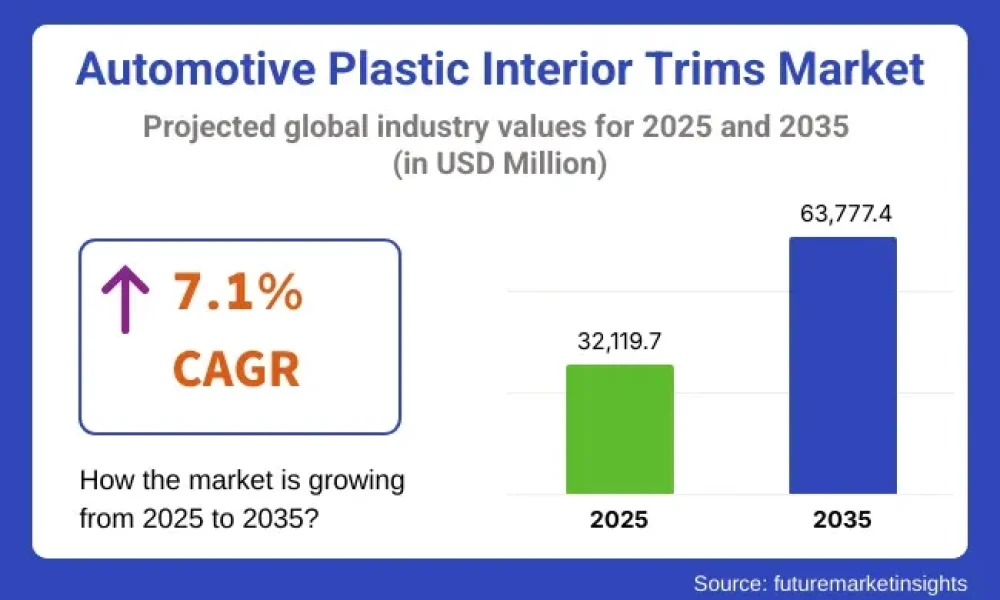
The global Automotive Plastic Interior Trims Market is set for robust expansion over the next decade, rising from USD 32,119.7 million in 2025 to USD 63,777.4 million by 2035, according to recent industry forecasts. This represents a healthy CAGR of 7.1%, driven by rising demand for lightweight materials, advanced cabin ergonomics, and sustainable polymers across EV and premium vehicle platforms.
Plastic interior trims—encompassing dashboards, door panels, pillar garnishes, seat backs, roof handles, and center consoles—have become vital architectural elements inside modern vehicles. As automakers redesign cabin layouts to reflect electric powertrain configurations and digital interfaces, plastic trims are evolving into multifunctional, visually sophisticated, and environmentally responsible components.
Passenger Cars Dominate with 68.1% Share as OEMs Prioritize Lightweight, Tech-Integrated Cabins
Passenger cars are expected to command 68.1% of the global market in 2025, maintaining leadership through 2035. OEMs are expanding the use of high-performance plastics—such as PP, ABS, PC/ABS blends, and TPOs—to deliver lightweight structures, premium textures, and integration-ready surfaces for infotainment systems and connected mobility features.
Rising global EV adoption has accelerated the shift toward modular plastic trims, silent cabin materials, and slim-profile instrument panels designed to house digital clusters and navigation displays. With consumers seeking personalized interiors and tactile comfort, passenger cars will continue to be the highest-consuming segment for polymer-based trim components.
Subscribe for Year-Round Insights → Stay ahead with quarterly and annual data updates
https://www.futuremarketinsights.com/reports/sample/rep-gb-9056
Instrument Panels Lead with 27.6% Share as Digital Cockpits Become Central to Vehicle Design
Instrument panels are poised to remain the largest application area, with a projected 27.6% market share in 2025. As OEMs transition to all-digital cockpit environments, demand is rising for plastics that offer dimensional stability, impact resistance, heat tolerance, and surface tunability.
Plastics now enable:
- Complex geometries for digital clusters
- Matte, anti-glare, and soft-touch finishes
- Integrated HVAC vents, sensors, and electronics
- Lightweight architectures supporting energy efficiency
The interplay between smart displays and sustainable materials is reshaping dashboard manufacturing, with ABS/PC blends, polypropylene composites, and recycled polymers gaining prominence.
Industry Challenges and Opportunities
Key Challenges
- VOC emissions and IAQ compliance: Global regulations are tightening around interior off-gassing and chemical exposure.
- Thermal degradation and UV stability: Particularly critical in hotter climates where plastics, adhesives, and finishes must withstand high cabin temperatures.
- Recycling complexity: Mixed-material bonding, foamed laminates, and adhesive-heavy assemblies hinder circularity.
High-Growth Opportunities
- EV architecture redesign enabling thinner, modular trim assemblies
- Bio-composites and natural fiber reinforcements such as hemp, flax, and kenaf
- 3D printing applications for rapid prototyping and customized interior parts
- In-cabin personalization through interchangeable trim panels, matte textures, and ambient-integrated designs
These innovations position plastic trims at the center of next-generation cabin development.
Country-Wise Market Outlook (2025–2035)
United States — CAGR: 7.4%
Demand is driven by advanced cabin ergonomics, rising premium vehicle production, and the shift toward rugged lightweight plastics in EV platforms. ABS, PP, and TPEs dominate U.S. production, with customization and ergonomic upgrades boosting OEM and aftermarket demand.
United Kingdom — CAGR: 7.0%
UK automakers are accelerating adoption of bio-based polymers, vegan-leather alternatives, and recycled plastics. High-end interiors and luxury exports drive investments in soft-touch finishes and modular trim designs.
European Union — CAGR: 7.1%
Germany, France, and Italy are leading with innovations in acoustic insulation, carbon-neutral materials, and advanced molding technologies. EU directives on recyclability and VOC reduction strongly influence material selection.
Japan — CAGR: 6.8%
Japan’s automotive interiors emphasize minimalistic design, durability, and scratch-resistant finishes. Compact vehicles and hybrids rely heavily on precision-molded plastics for optimized space utilization.
South Korea — CAGR: 7.5%
The fastest-growing market in Asia, driven by strong EV production and premiumization. Smart plastics with ambient lighting, sensor housings, and recycled composites are gaining significant momentum.
Competitive Landscape: Innovation in Smart Surfaces and Sustainable Trims Shapes Leadership
The global market is moderately consolidated, with Tier-1 suppliers expanding vertically through smart-surface integration, recycled polymer adoption, and lightweight manufacturing.
Key Companies and Market Shares
- Grupo Antolin (17–21%)
Leader in cockpit systems and headliners, with expertise in smart surfaces and eco-composites. - Faurecia SE (14–18%)
Strong focus on low-emission materials, modular interiors, and advanced eco-composites. - Toyota Boshoku (11–15%)
Specializes in ergonomic design and connected-cabin integration for global platforms. - Yanfeng Automotive Interiors (9–13%)
High-volume supplier of lighting-integrated trims and customizable surface technologies. - Magna International Inc. (6–9%)
Expanding capabilities in circular materials and high-precision molding processes.
Other Notable Innovators (25–31% combined share)
- NBHX Trim Group
- DRÄXLMAIER Group
- REHAU Automotive
- SABIC
- Motherson SMP
These players are accelerating advancements in scratch-resistant coatings, laser engraving, matte surfaces, chromeless decorations, and EV-friendly trim structures.
Personalize Your Experience: Ask for Customization to Meet Your Requirements!
https://www.futuremarketinsights.com/customization-available/rep-gb-9056
Segment Overview
By Vehicle Type:
- Passenger Cars
- Commercial Vehicles
By Application:
- Instrument Panels
- Door Trims
- Pillar Trims
- Armrests
- Seat Backs
- Central Consoles
- Luggage Trims
- Roof Handles
- Seat Belt Guides
By Sales Channel:
- OEM
- Aftermarket
By Region:
North America, Latin America, Western & Eastern Europe, East Asia, South Asia Pacific, Middle East & Africa
Future Outlook
As automakers race toward electric, sustainable, and digitally enhanced cabin experiences, the role of plastic interior trims is expanding beyond aesthetics. The next decade will see greater reliance on recyclable polymers, bio-based composites, 3D-printed trims, and smart-surface technologies, making plastic interior trims a central pillar of intelligent mobility and premium cabin design.
Have a specific Requirements and Need Assistant on Report Pricing or Limited Budget please contact us –[email protected]
About Future Market Insights (FMI)
Future Market Insights, Inc. (FMI) is an ESOMAR-certified, ISO 9001:2015 market research and consulting organization, trusted by Fortune 500 clients and global enterprises. With operations in the U.S., UK, India, and Dubai, FMI provides data-backed insights and strategic intelligence across 30+ industries and 1200 markets worldwide.



