
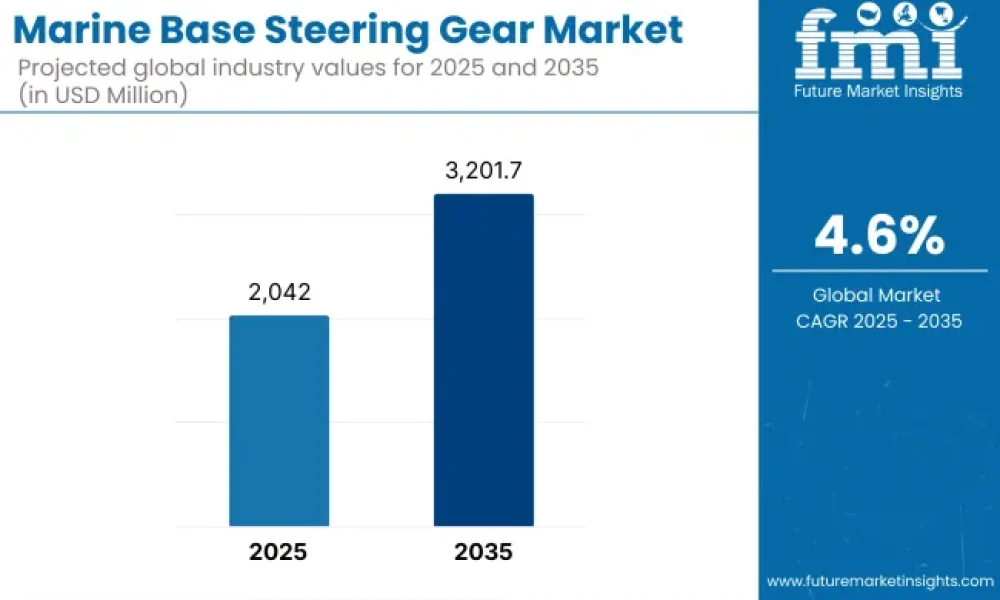
The global Marine Base Steering Gear Market is set for steady expansion, rising from USD 2,042 million in 2025 to USD 3,201.7 million by 2035, advancing at a CAGR of 4.6%. Growth is being propelled by modernization of commercial and naval fleets, expanding offshore exploration activity, and rapid adoption of digital and electro-hydraulic steering technologies.
Steering gear systems remain indispensable components in marine architecture, enabling precise rudder movement, directional stability, and manoeuvrability under heavy sea loads. As shipbuilders prioritize energy-efficient, automation-ready designs, next-generation steering gear solutions are becoming central to vessel safety, performance, and compliance.
Technology Advancements Driving Market Evolution
Across the industry, demand is shifting from legacy hydraulic units to electro-hydraulic and fully electric steering systems that offer lower power consumption, faster response times, and compatibility with integrated bridge and digital navigation platforms. The introduction of remote diagnostics, predictive maintenance, and real-time control modules is transforming steering gears from mechanical hardware into smart marine control systems.
Manufacturers are also developing compact, high-torque, and shock-resistant rigs capable of meeting the requirements of new IMO and SOLAS safety mandates. This shift accelerates adoption among commercial cargos, LNG carriers, naval ships, and offshore support vessels.
Subscribe for Year-Round Insights → Stay ahead with quarterly and annual data updates
https://www.futuremarketinsights.com/reports/sample/rep-gb-8569
Market Dynamics: Challenges and Opportunities
Key Challenge — Maintenance Complexity & Hydraulic Wear
Traditional hydraulic steering systems remain vulnerable to leakages, pressure losses, corrosion, and component fatigue. Retrofitting advanced units onto older hulls is costly and technically restrictive, limiting modernization across aging global fleets. For large cargo vessels, steering downtime leads to costly delays and safety risk.
Key Opportunity — Digital Steering Systems & Regulatory Push
IMO’s growing emphasis on reliability, fault tolerance, automation, and emission reduction is driving adoption of electro-hydraulic and electric steering systems. Smart steering gear integrated with autopilot, navigation AI, and condition-based maintenance will play a pivotal role in next-generation autonomous and green shipping platforms.
Market Shifts: 2020–2024 vs. 2025–2035
Between 2020–2024, the industry relied heavily on conventional hydraulic systems. From 2025–2035, shipbuilders are transitioning toward fluid-free electric systems, stringent digital fail-safes, sustainable designs, and advanced automation. Competition is shifting toward companies offering integrated steering and smart-ship control ecosystems.
Country-Wise Outlook
United States (CAGR: 4.3%)
The U.S. market is driven by naval fleet modernization, Jones Act–compliant shipbuilding, and rising offshore vessel construction. Adoption of redundant electro-hydraulic systems with digital diagnostics is strengthening demand across both commercial and defense vessels.
United Kingdom (CAGR: 4.4%)
UK shipyards prioritize electronically controlled, energy-efficient steering gear to meet decarbonization targets. Naval upgrades and port modernization continue to support installation of modular, maintenance-friendly steering systems.
European Union (CAGR: 4.6%)
Germany, Italy, and the Netherlands lead EU steering gear adoption through advanced shipbuilding capacity and strict environmental regulations. Demand is rising for electro-mechanical, low-maintenance steering solutions designed for ferries, cruise vessels, and bulk carriers.
Japan (CAGR: 4.2%)
Japan’s export-driven maritime sector favors flush-mount steering assemblies, automated control, and fatigue-resistant gear for LNG carriers and bulk vessels. Compliance with new classification rules drives continuous innovation.
South Korea (CAGR: 4.9%)
South Korea remains a global shipbuilding powerhouse, accelerating adoption of high-torque, electronic-ready steering systems for container ships, tankers, and offshore vessels. Investments in green shipping and digital shipyards support strong long-term demand.
Segmentation Insights
By Gear Type:
- Ram-Type Steering Gear leads due to high torque, symmetrical load handling, and shock resistance. It dominates medium to large vessels including naval ships, oil tankers, and bulk carriers.
By Power Source:
- Electro-Hydraulic Systems dominate the power source segment owing to superior control accuracy, lower energy consumption, and compatibility with automated bridge systems.
Personalize Your Experience: Ask for Customization to Meet Your Requirements!
https://www.futuremarketinsights.com/customization-available/rep-gb-8569
Competitive Landscape
The market features several global and regional manufacturers focused on compact, high-torque, and automation-integrated solutions.
Estimated Market Shares
- Rolls-Royce Holdings plc: 18–22%
- Kawasaki Heavy Industries: 14–18%
- Wärtsilä Corporation: 12–16%
- Jastram Engineering: 9–13%
- Palfinger AG: 7–11%
- Data Hidrolik: 6–10%
- Others: 20–30%
Key Developments
- Rolls-Royce launched integrated, redundant electro-hydraulic systems for naval ships (2025).
- Kawasaki introduced high-torque steering units for LNG carriers (2024).
- Wärtsilä released compact rotary vane units with digital monitoring (2025).
- Jastram developed modular electro-hydraulic systems for offshore vessels (2025).
- Palfinger deployed servo-assisted steering systems for mid-size vessels (2024).
- Data Hidrolik expanded rudder actuator production for coastal cargo fleets (2025).
Future Outlook
With rising maritime trade, green-ship regulations, autonomous vessel development, and next-gen shipyard digitization, the marine base steering gear market is positioned for strong transformation. Steering systems integrating electric actuation, AI-driven diagnostics, predictive maintenance, and navigation automation will shape the next decade of global marine innovation.
Have a specific Requirements and Need Assistant on Report Pricing or Limited Budget please contact us –[email protected]
About Future Market Insights (FMI)
Future Market Insights, Inc. (FMI) is an ESOMAR-certified, ISO 9001:2015 market research and consulting organization, trusted by Fortune 500 clients and global enterprises. With operations in the U.S., UK, India, and Dubai, FMI provides data-backed insights and strategic intelligence across 30+ industries and 1200 markets worldwide.



