
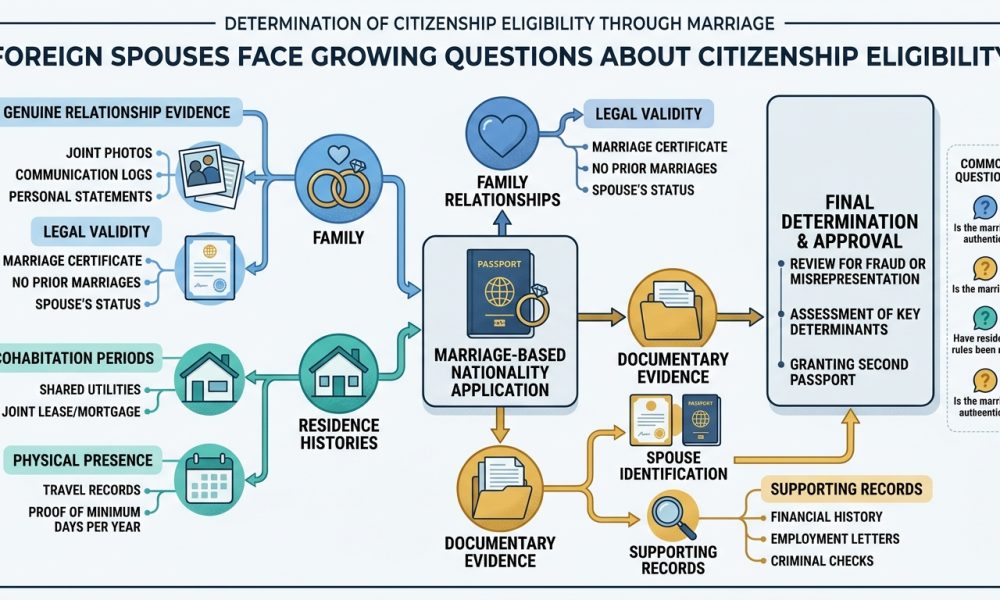
Marriage-based nationality applications place family relationships, residence histories and documentary evidence at the center of determining whether a foreign spouse qualifies. At the same time, immigration authorities distinguish genuine marital ties from the separate legal conditions required for citizenship and passport issuance.
WASHINGTON, November 16, 2026 — Foreign spouses pursuing citizenship through marriage face questions that extend well beyond their wedding certificates, as national authorities examine lawful residence, the citizen partner’s status, relationship histories and the documentary basis of naturalization applications.
The complexity matters for international couples who divide their lives between countries, because a marriage recognized for family purposes may support immigration without satisfying the independent residence, integration and citizenship standards imposed by a particular government.
Although some countries shorten naturalization periods for spouses, others provide specialized declarations or no spousal shortcut at all, leaving families to verify each legal sequence before treating a foreign passport as a predictable result of marriage.
Citizenship Eligibility Starts With the Legal Marriage
A marriage certificate can establish that a ceremony occurred and a relationship was registered. Still, citizenship officials may also need proof that the marriage is legally valid, prior unions ended, and the citizen spouse held the required nationality.
Couples married outside the destination country may face transcription or recognition procedures, especially when authorities require a foreign marriage to appear in domestic civil registers before accepting an application under a spouse-based nationality provision.
Different naming conventions, late registration, and missing divorce decrees can create discrepancies between civil records, so applicants should resolve those conflicts through lawful corrections and certified documentation rather than relying on explanations unsupported by official evidence.
A Wedding Date Is Not Always the Citizenship Clock
The date of marriage, the date permanent residence begins, and the date a spouse becomes a citizen can differ by years, so it’s essential to identify which event starts each statutory period before calculating eligibility.
For couples who marry while one partner holds only temporary visitor status, the relationship may justify a future immigration application without transforming previous holidays or visa-free visits into the lawful residence required for naturalization.
The distinction becomes particularly important when an applicant has traveled frequently, changed immigration categories,s or spent substantial periods working abroad, because residence continuity can be evaluated separately from the length and authenticity of the marriage.
The United States Requires Evidence of Marital Union
Under the ordinary three-year spousal naturalization provision, an applicant generally must have been a lawful permanent resident for three years, lived in marital union with a United States citizen spouse, and satisfied the applicable residence and physical-presence conditions.
The citizen spouse must ordinarily have possessed American citizenship throughout the relevant three-year period, and the applicant generally must remain married through the naturalization oath, making both the citizenship history and current marital circumstances significant.
The official United States Citizenship and Immigration Services instructions for Form N-400 identify marriage certificates, previous divorce decrees and evidence such as joint financial records, housing documents, insurance policies and tax transcripts as potentially relevant supporting material.
Evidence of Shared Life Is Considered in Context
Joint bank accounts and leases can help document a household. Still, they should accurately reflect the couple’s real circumstances, because a legally valid relationship does not require every family to manage finances or housing in precisely the same way.
Some genuine spouses maintain separate accounts, travel to care for relatives or work temporarily in different locations, making credible explanations and contemporaneous documents important where routine evidence of a shared residence is limited or inconsistent.
Applicants should not create artificial transactions, staged correspondence, or misleading tenancy records merely to imitate another family’s document package, since evidence that misrepresents actual arrangements can undermine an otherwise legitimate immigration or nationality case.
Fraud Allegations Have Heightened Attention to Evidence
In August 2026, Associated Press reported federal charges involving an alleged network of more than 1,000 sham marriages, with prosecutors accusing eleven defendants of organizing weddings intended to obtain immigration benefits rather than establish genuine family relationships.
The reported allegations involved staged photographs and payments connected to purported marriages, but charges are not findings of guilt, and the case should not be presented as evidence that ordinary cross-border marriages are inherently suspicious.
Instead, the prosecution illustrates why authorities distinguish documentary appearance from authentic marital relationships, while legitimate couples benefit from maintaining truthful records that accurately explain their living arrangements, shared responsibilities, family circumstances and changing circumstances over time.
Spain Offers a Shorter Residence Period With Conditions
Spain’s Civil Code permits certain foreign spouses to apply for citizenship after one year of qualifying legal residence when they have been married to a Spanish citizen for at least one year and are neither legally nor actually separated.
The shortened residence period does not turn visits into residence or remove good-conduct and integration requirements, so a couple living abroad must first determine how the foreign spouse can establish the legal residence needed for this particular route.
Spain also has a distinct two-year nationality residence provision for qualifying nationals by origin of specified countries, including Mexico and the Philippines, which may make the appropriate filing pathway depend on the individual’s nationality history and marital circumstances.
Portugal Uses a Distinct Marriage Declaration Procedure
Portugal allows qualifying foreign spouses married to Portuguese citizens for more than three years to seek nationality through a declaration procedure, rather than imposing the same fixed domestic residence period used in several ordinary naturalization systems.
The procedure can also apply to certain legally recognized de facto partnerships. However, relationship recognition, required documentation, public-security restrictions and any applicable demonstration of ties to the Portuguese community still require individual examination.
A couple living outside Portugal should therefore assess the Portuguese citizen’s status, civil registration of the marriage and current declaration requirements, rather than assume that a third wedding anniversary automatically triggers passport issuance.
France Requires Continuing Community of Life
French nationality by marriage generally requires at least four years of marriage, with five years applying in certain circumstances involving overseas residence and consular registration, along with proof that the couple’s community of life has continued
The French spouse must have held French nationality at the time of marriage and retained it. In contrast, foreign marriages may require transcription into French civil records before a declaration can proceed through the correct administrative channels.
From January 2026, France also requires B2-level French-language proficiency for marriage-based nationality declarations, demonstrating that a genuine relationship and sufficient marital duration do not eliminate formal language or documentary requirements imposed during official review.
Britain Requires Settlement Before Naturalization
In the United Kingdom, an eligible spouse or civil partner of a British citizen may apply for naturalization after three years of qualifying residence. Still, the applicant must ordinarily already have settled status or another qualifying unrestricted immigration status.
Marriage to a British citizen does not automatically confer that settled status, so a family may need to complete a separate partner immigration journey before the three-year nationality provision becomes practically available to the applicant.
Applicants must also consider absence limits, good character, language ability, and the Life in the UK test, making residence evidence essential even for couples whose marriage has lasted well beyond the statutory minimum.
Canada Does Not Accelerate Citizenship for Spouses
Canada explicitly states that marriage to a Canadian citizen does not confer citizenship or create a special naturalization process. However,h qualifying family sponsorship may help a foreign spouse obtain permanent residence under the applicable immigration rules.
After becoming a permanent resident, the spouse ordinarily must satisfy Canada’s general citizenship requirements, including at least 1,095 days of credited physical presence during the applicable five-year period and other statutory conditions.
A marriage may consequently help explain how the person entered the immigration system without changing the nationality rules that ultimately apply, a distinction families should understand before describing Canadian spousal sponsorship as an immediate second-passport program.
Germany Connects Marriage Duration With Residence
German citizenship law generally allows eligible spouses of German nationals to naturalize after three years of lawful habitual residence and two years of marriage, subject to the remaining identity, integration and substantive naturalization requirements.
The marriage must be valid under German law, and the required residence is a genuine legal condition, so a couple’s overseas wedding date is insufficient when the foreign spouse has never established a qualifying life in Germany.
German guidance also recognizes exceptions and circumstances after relationship changes, reinforcing why couples should get advice based on their actual immigration status rather than importing assumptions from another country’s marriage-based nationality rules.
Travel History Can Matter More Than Couples Expect
Residence-based citizenship procedures may require applicants to disclose international travel and demonstrate continuous residence or minimum physical presence, so frequent trips between family homes may affect eligibility even if the marriage remains genuine.
A foreign spouse who accompanies a citizen partner on extended overseas assignments should examine whether any statutory exception applies, since a continuing relationship does not automatically preserve ordinary residence eligibility during prolonged absences from the destination country.
Accurate travel histories can be reconstructed using passports, transport records and official immigration files, whereas casually estimating dates may create inconsistencies when authorities compare the applicant’s declaration with records previously submitted during residence renewals.
Previous Marriages and Name Changes Require Clear Records
Officials may request proof that each previous marriage ended through divorce, annulment, or death before the current union began, especially when earlier proceedings occurred abroad, or different legal systems recorded the parties’ identities differently.
An applicant whose name changed after marriage should preserve documentation connecting birth records, current passports, ts and previous immigration files, avoiding unexplained identity discrepancies that may delay an otherwise eligible case during formal review.
Where a foreign court decree requires recognition or further certification, the couple should obtain qualified local advice rather than submit edited documents, because the legal validity of the marriage remains foundational to a spouse-based nationality application.
Separation, Divorce and Bereavement Change the Assessment
A relationship may be genuine at the time of marriage yet change during a lengthy immigration process, raising questions about whether the applicant remains eligible under a provision that requires continuing marriage or a particular marital union.
In the United States, termination of the qualifying marital union can affect the ordinary three-year spousal route. At the same time,ile Spain’s one-year exception specifically requires that spouses not be legally or actually separated when applying.
Other countries provide tailored rules for bereavement, domestic abuse or exceptional family circumstances, so applicants facing separation should explore lawful protections and alternative eligibility rather than assume every residence or citizenship opportunity automatically disappears.
Children and Family Residence Need Separate Analysis
A marriage-based immigration approval for one parent does not automatically establish citizenship for children, whose legal position may instead depend on birthplace, descent rules, age, adoption, parental nationality changes, and separate registration requirements.
Families should assess each child’s passport and citizenship status independently, particularly when siblings were born in different countries or before and after a parent naturalized, creating potentially different transmission rights within the same household.
School enrollment, childcare, healthcare and parental consent rules can also shape the feasibility of relocation, so a credible nationality plan should support a genuine family life rather than focus narrowly on the principal applicant’s anticipated passport.
Financial Records May Serve More Than One Purpose
Shared financial documents may help demonstrate marital union in one jurisdiction. At the same time,e immigration sponsorship rules may separately require evidence of income, support commitments, or adequate accommodation, making the purpose of each document important.
Households with independent finances can still have authentic relationships. Still, they should provide clear evidence suited to the specific legal test rather than treating a generic bank statement package as universally sufficient across different nationality systems.
Foreign spouses who acquire another citizenship must also evaluate separate tax and reporting consequences, as discussed in Amicus International Consulting’s analysis of second passports and United States tax obligations, because marriage or naturalization does not automatically extinguish liabilities under existing law.
Legal Advice Must Distinguish Residence From Nationality
An adviser reviewing a marriage-based application should identify whether the relevant route first requires a family visa, permanent residence, registration of a foreign marriage or a nationality declaration, and which government office decides each stage.
Amicus International Consulting describes second-passport planning and advisory services for people evaluating international mobility. Still, eligibility and approval under marriage-based nationality legislation remain exclusively subject to the competent authorities and applicable national laws.
No private representative can legitimately guarantee approval, manufacture a marital history, or waive an official residence requirement, so applicants should request written legal reasoning and retain direct access to copies of every document submitted in their name.
Interviews Can Test Consistency Without Requiring Perfect Memories
Marriage-based immigration cases sometimes involve discussing household arrangements, prior relationships, and how the couple understands its shared life, so consider answers alongside formal records rather than expecting identical recollections of every minor event.
A truthful couple may disagree about dates or routine details, but deliberately rehearsed false explanations and fabricated documents can create more serious problems than honestly acknowledging uncertainty and providing records that clarify the relevant history.
Applicants who need interpreters, disability accommodations, or help understanding official questions should ask about procedures available through the responsible government office, so they can participate accurately without inventing answers or relying on unauthorized representatives.
Country-Specific Exceptions Need Careful Review
Some nationality systems recognize exceptions for people facing domestic abuse, bereavement, or unusually difficult family circumstances. Yet, these safeguards differ markedly across jurisdictions and should be considered separately from ordinary procedures that assume an ongoing marriage.
A spouse whose relationship has become unsafe should not be pressured to remain with an abusive partner merely to protect a possible passport application, because qualified legal counsel can examine available immigration protections and alternative citizenship provisions.
Similarly, a spouse working overseas for a government agency or qualifying employer may face specialized residence rules in some systems. Still, those exceptions require evidence of the precise legal category rather than a generic assertion of international employment.
Digital Records Increase the Importance of Accuracy
Electronic application systems can preserve previous addresses, travel declarations and marriage records submitted over many years, so an applicant’s new nationality filing should be checked against earlier immigration statements before avoidable discrepancies trigger formal requests for clarification.
Couples should store copies of official submissions, appointment confirmations and decision letters in a secure, organized archive, while keeping original civil documents accessible for identity checks and avoiding alterations to records merely to improve presentation.
A marriage-based citizenship strategy becomes more manageable when documentary records tell a consistent chronology, including the citizen spouse’s nationality, the relationship’s legal beginnings, qualifying residence, and any substantial changes before the final decision.
The Strongest Applications Follow a Verifiable Timeline
A reliable eligibility review begins with the date of marriage, each spouse’s citizenship history, previous marital records, and the foreign spouse’s immigration permissions, then compares those facts with the actual statutory requirements of the proposed country.
Couples should identify which residence periods count, whether extended absences create problems, and when language or integration requirements must be fulfilled, so the eventual application date reflects legal eligibility rather than promotional expectations.
Marriage may open important citizenship opportunities, but the result remains the result of a valid government process built on truthful relationships, truthful records, and completed legal conditions, not an automatic reward for marrying a foreign citizen.




