
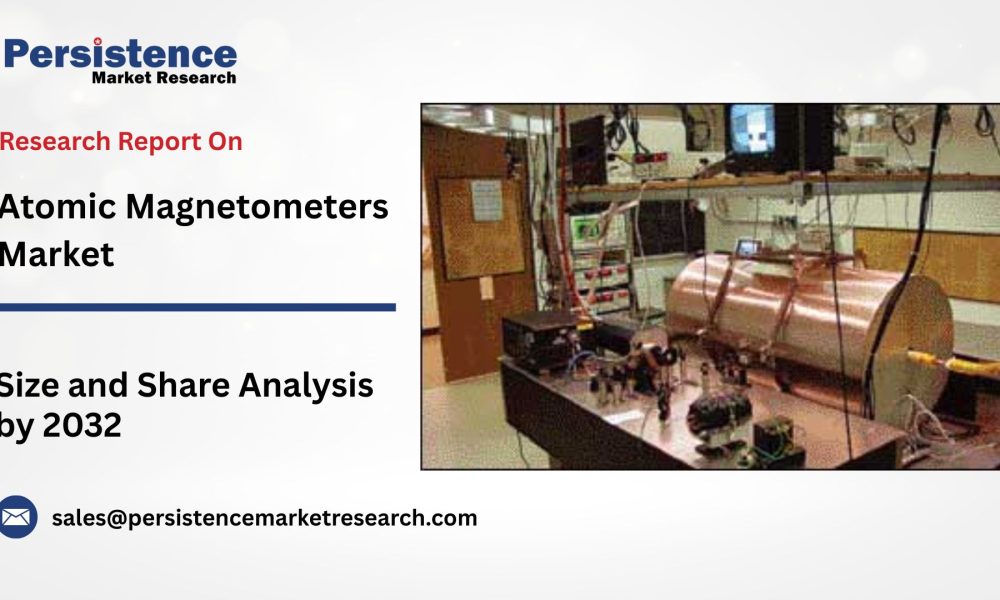
The atomic magnetometers market is on the cusp of rapid expansion, poised to transform applications in healthcare, geophysics, defense, and space technology. According to recent forecasting, the global market for atomic magnetometers is expected to be valued at approximately US$1.2 billion in 2025, growing steadily to reach about US$3.2 billion by 2032, which corresponds to a compound annual growth rate (CAGR) of 15.14% during the period from 2025 to 2032.
Below is an in-depth look at what is driving this growth, how the market breaks down by region, product type, and end-use, what the challenges are, and where the major opportunities lie.
🔗Get a Sample PDF Brochure of the Report (Use Corporate Email ID for a Quick Response): https://www.persistencemarketresearch.com/samples/5297
Market Drivers and Growth Enablers
Several forces are coming together to fuel the atomic magnetometers market’s strong projected growth:
- Advances in Quantum Technology
The sensitivity of atomic magnetometers—especially in detecting extremely weak magnetic fields—depends on state-of-the-art quantum physics principles. As research in quantum sensors, quantum optics, and related fields accelerates, devices become more accurate, smaller, lower in power consumption, and more cost-effective. These advances make atomic magnetometers more viable for a wider range of applications. - Healthcare Demand and Non-invasive Diagnostics
Medical diagnostics is a major use-case: techniques such as magnetoencephalography (MEG) and magnetocardiography (MCG) benefit greatly from magnetic sensors capable of detecting very weak biomagnetic signals. There is a growing demand for non-invasive, high-resolution imaging and diagnostics techniques, driving hospitals, research institutes, and healthcare equipment manufacturers to adopt more sensitive magnetometer technologies. - Geophysical and Environmental Exploration
Atomic magnetometers are useful for surveying magnetic fields in the environment and subsurface—valuable in mineral exploration, oil & gas, and geological mapping. Their sensitivity allows for more precise mapping of mineral deposits, fault lines, or magnetic anomalies. As industries seek better data for resource exploration, atomic magnetometers offer advantages over more conventional sensors. - Military, Defense and Space Navigation Needs
Defense agencies and aerospace firms have been increasing funding for sensors that can function in challenging conditions (e.g., in space, undersea, or where GPS signals are weak or absent). Atomic magnetometers are highly suitable for precise navigation, threat detection, and space missions. The importance of sensor reliability, miniaturization, and sensitivity is especially great in these domains. - Regional Investment & Policy Support
Several countries are investing in quantum technologies—including quantum sensing and metrology—as part of their technological development plans. Support via research funding, government laboratories, and stimulus for advanced sensor development is helping create an environment in which atomic magnetometers can scale in production and application.
Market Segmentation and Key Shares
The atomic magnetometers market can be analyzed by product type, application, end-use, and geography, each with distinct behavior and growth trends.
Product Type
- Optically Pumped Magnetometers hold a dominant share of the market (nearly 40%) in 2025. These types are preferred for many medical and geophysical applications because of their sensitivity and relative maturity of their technology.
- Spin-Exchange Relaxation-Free (SERF) Magnetometers are projected as the fastest-growing product segment in the forecast period. Their ability to detect ultra-weak magnetic fields without the need for cryogenic cooling makes them especially attractive in cutting-edge diagnostic and research settings.
- Others (less common product types) will also contribute but are likely to have more modest growth compared to the optically pumped and SERF segments.
Applications
- Medical Diagnostics leads in revenue share (over 35% in 2025), driven by demand for precise, non-invasive imaging technologies (such as MEG, MCG) and neurological/biological sensing.
- Geophysical Exploration and Military & Defense are other key application areas.
- Space Exploration is expected to be the fastest growing application due to increasing space missions and need for instrumentation that can handle extreme environments.
- Other smaller application areas might include environmental monitoring, navigation in GPS-denied environments, research laboratories, etc.
End-Use
- Healthcare is among the top end-use sectors, both for equipment suppliers and for institutional buyers (hospitals, neurology centers, research hospitals).
- Aerospace and Defense are increasingly important, especially for navigation, satellite instrumentation, unmanned vehicles, etc.
- Research Institutes also contribute significantly but often act as technology incubators rather than mass purchasers.
Regional Insights
Distinct regional trends will shape how the market evolves:
- North America is expected to have the largest share in 2025 (≈ 38.7%), thanks to strong research infrastructure, defense expenditures, and healthcare innovation. The United States, in particular, through both public and private funding, is at the forefront of developing and deploying atomic magnetometer technologies.
- Asia Pacific is seen as the fastest-growing region. Rapid industrialization, heightened scientific research (China, Japan, India), and increasing government support are expanding markets for quantum sensors in the region. The combination of lower manufacturing cost bases and rising demand in both commercial and research sectors further accelerate growth here.
- Europe will also see solid growth, boosted by strong academic and scientific institutions, as well as by aerospace and defense applications, and a growing healthcare need for sophisticated diagnostic tools.
- Other regions—Latin America; Middle East & Africa—are likely to trail in both percentage growth and absolute market size, though pockets of adoption (e.g., mineral exploration, defense contracts) may offer localized growth.
Market Size Forecast
Given the CAGR of approximately 15.14% from 2025 to 2032, the market is expected to more than double in size over this period:
Thus, over the forecast period, the market is expected to expand by roughly US$2.0 billion, driven by both increasing unit adoption and higher demand for advanced, higher-priced instruments.
Challenges & Restraint
Growth will not come without obstacles. Major challenges include:
- High Development Costs & Technical Complexity
Building atomic magnetometers—especially those with exceptional sensitivity like SERF devices—requires advanced materials, precision engineering, ultraclean environments, and highly specialized calibration. These raise production costs and limit affordability, particularly in emerging markets. - Competition from Alternative Technologies
Less complex and less costly magnetometer technologies (fluxgate sensors, Hall effect sensors, etc.) continue to compete, especially in applications where ultra-high sensitivity is not strictly necessary. These alternatives can restrain adoption where cost sensitivity is high. - Integration Hurdles
Incorporating atomic magnetometers into existing systems (e.g., medical imaging suites, defense systems, space instrumentation) often demands customization, rigorous testing, and compatibility with environmental and operational constraints (temperature, interference, power supply, etc.). - Regulatory and Safety Concerns
In medical and defense applications, regulatory approval, safety, reliability, and certification are important. These introduce time delays and added costs. - Supply Chain and Scaling Limitations
As demand grows, scaling up production of high-precision devices, sourcing rare or high-purity materials, and maintaining high quality will become more difficult. Also, access to funding for R&D remains critical for companies to stay competitive.
Opportunities & Emerging Trends
Despite the constraints, the atomic magnetometers market has several promising opportunities:
- Miniaturization and Portability
There is growing demand for smaller, portable versions of atomic magnetometers—for wearable diagnostics, field exploration, drone-borne sensors, etc. Compact, power-efficient designs open up new use-cases. - Quantum Sensing Ecosystems
As quantum technologies mature, atomic magnetometers will be part of broader quantum sensor networks and systems. Integration with other quantum devices (clocks, quantum communication, etc.) can produce synergistic effects. - Space & Autonomous Systems
With growing interest in exploration of the Moon, Mars, asteroids, and with development of autonomous underwater vehicles, drones, and other systems operating in GPS-denied or harsh environments, the demand for precise onboard magnetic sensors is increasing. - Healthcare & Brain-Computer Interfaces
Advances in neuroscience and brain-computer interface (BCI) technologies require sensors that can non-invasively measure weak magnetic fields from the brain. Atomic magnetometers may offer an alternative to expensive superconducting magnetic sensors in MEG, given improvements in sensitivity and cost. - Government & Academic Funding
Continued or rising funding for quantum science, national security, climate/environment monitoring, and exploration will accelerate both innovation and market adoption.
Competitive Landscape
The market is composed of both established technology leaders and emerging innovators. Key players often compete on sensor sensitivity, size, power consumption, cost, reliability, and specialized application suitability.
Some companies and institutions active in this field include QuSpin Inc., Twinleaf LLC, Geometrics Inc., Sandia National Laboratories, Kromek Group plc, among others. These entities invest in product development, new model launches (e.g., more portable optically-pumped units), and collaborations with aerospace, defense, and medical research institutes to stay ahead.
Small- and mid-sized innovators also have opportunity niches—for example, developing physician-friendly devices, field-deployable environmental sensors, or modular add-ons for drones or unmanned systems
Outlook & Implications
By 2032, with the market having grown to roughly US$3.2 billion, atomic magnetometers will shift more into mainstream applications. While high-end research and defense will remain important buyers, commercialization at scale will reach new sectors, especially where non-invasive diagnostics and environmental monitoring are in demand. The balance between cost and performance will be critical: manufacturers capable of driving down cost while maintaining sensitivity will likely capture outsized market share.
For investors, R&D institutions, and companies in adjacent fields (medical devices, aerospace, exploration, quantum tech), this market promises strong returns—but success will depend on innovation, regulatory navigation, and strategic partnerships.
Conclusion
The atomic magnetometers market is projected to see robust growth between 2025 and 2032, expanding from US$1.2 billion in 2025 to US$3.2 billion by 2032, at a CAGR of about 15.14%. Fueled by advances in quantum technology, increasing applications in healthcare diagnostics, defense, and space exploration, and strong regional support especially in North America and Asia Pacific, the market provides ample opportunity. Still, cost pressures, technical challenges, and competing technologies will demand strategic focus for firms looking to succeed.
Explore the Latest Trending Research Reports:




