
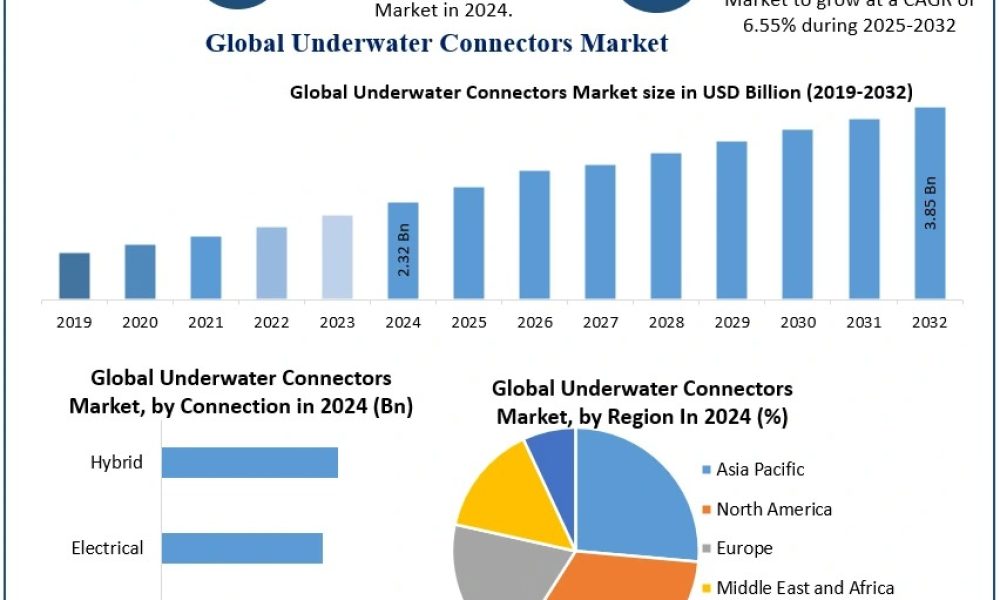
Underwater Connectors Market Overview :
Underwater Connectors Market, valued at USD 2.32 billion in 2024, is forecast to reach nearly USD 3.85 billion by 2032, expanding at a compound annual growth rate (CAGR) of 6.55%. Advanced product innovation, robust demand from energy and defense sectors, and expanding marine infrastructure are setting the course for sustained growth, with the Asia Pacific region holding the highest market share.
Key Highlights & Insights
Market Size & Growth: The market is on track to expand from USD 2.32 billion in 2024 to USD 3.85 billion by 2032, at a CAGR of 6.55%.
Dominating Region: Asia Pacific dominated the global market in 2024, leveraging investments in marine technology, deep-sea exploration, and subsea infrastructure, as well as the strategic role of China and Japan in key manufacturing and offshore projects.
Leading Segment: Wet-mateable connectors (WMCs) outpace other categories, driven by their advanced capability to be connected and disconnected under water, making them indispensable for deep-sea and harsh-environment applications. WMCs are favored in oil & gas exploration, marine research, and renewable offshore energy, underlining their growing market share.
Key Driver: Rising defense and underwater surveillance budgets, along with heightened investments in offshore oil & gas production, renewable marine energy systems, and expansion in subsea telecommunications, directly spur the demand for high-performance underwater connectors.
Recent Developments
January 2024: Macartney, a global market leader, launched the TrustLink Metal Shell series hybrid connector, which supports a variety of deep-water applications and broadens the company’s connectivity portfolio.
Ongoing: Amphenol Corporation continues to expand with launches of high-reliability connectors and strategic acquisitions, especially for defense and marine communication infrastructure.
BIRNS AQUAMATE LLC and BIRNS Inc. C.R. Encapsulation Limited maintain aggressive rivalry through innovations in high-pressure and specialized encapsulation connectors used for naval and research expeditions.
Collaborations and product advancements in Europe and North America reflect new approaches to address biofouling and insulation challenges, such as developing anti-fouling coatings and advanced insulating materials.
Market Dynamics
Growth Drivers:
Continuous growth in maritime defense investments, including naval fleets and secure underwater communications.
Need for robust, reliable connectors in deep-sea oil & gas and renewable energy installations.
Expansion of subsea communication projects, with more than 1,400 landing points either active or under development in North America alone as of 2024.
Challenges:
Biofouling, where marine organisms can impair functionality, raises maintenance and lifecycle costs.
Electrical insulation is critical in saltwater environments, demanding ongoing innovation to minimize short circuits and performance degradation.
Only a few countries have the capabilities to produce the most advanced categories, such as wet-mateable connectors, which may constrain innovation and supply.
Regional Analysis
Asia Pacific: Held the largest share in 2024, led by aggressive investment in marine and subsea technology in China and Japan, as well as expanding offshore energy and research sectors.
North America: Significant advancements in subsea cable systems and telecommunications connectivity, with the U.S. and Canada investing heavily in new infrastructure and defense systems.
Europe: Notable growth in Germany and other nations focused on renewable energy, with strong emphasis on submarine cable projects supporting both communication and offshore wind developments.
For full access to the data, request a sample report now : https://www.maximizemarketresearch.com/request-sample/34400/
Product & Application Segmentation
Types: Wet-mateable connectors (WMCs; dominant technology), Dry-mateable Connectors (DMCs), Inductive Coupling, Rigid Shell, Rubber Molded.
Connections: Electrical, Optical Fiber, Hybrid.
Applications: Oil & Gas (largest share), Defense (rapidly growing), ROVs/AUVs, Telecommunications, Oceanographic Research. Demand in defense is rising rapidly alongside expanding applications in subsea vehicles and renewable energy.
Key Trends
Move toward more complex, high-reliability subsea connections, especially for long-term and deepwater projects.
Material innovation for anti-biofouling and insulation is a top priority.
Increasing number of partnerships, acquisitions, and collaborations among leading connector manufacturers across the U.S., Europe, and Asia.
Quote
Asia Pacific’s leadership in the underwater connectors market demonstrates the region’s commitment to marine innovation and infrastructure. As subsea defense, energy, and research demands rise worldwide, advanced connector technologies are becoming the critical enablers of the next era in underwater engineering.
With marine infrastructure and defense dynamics evolving across continents, the underwater connectors market is positioned for resilient growth, backed by technology innovation, regional competition, and increasing application diversity from resource extraction to ocean science and security.




