
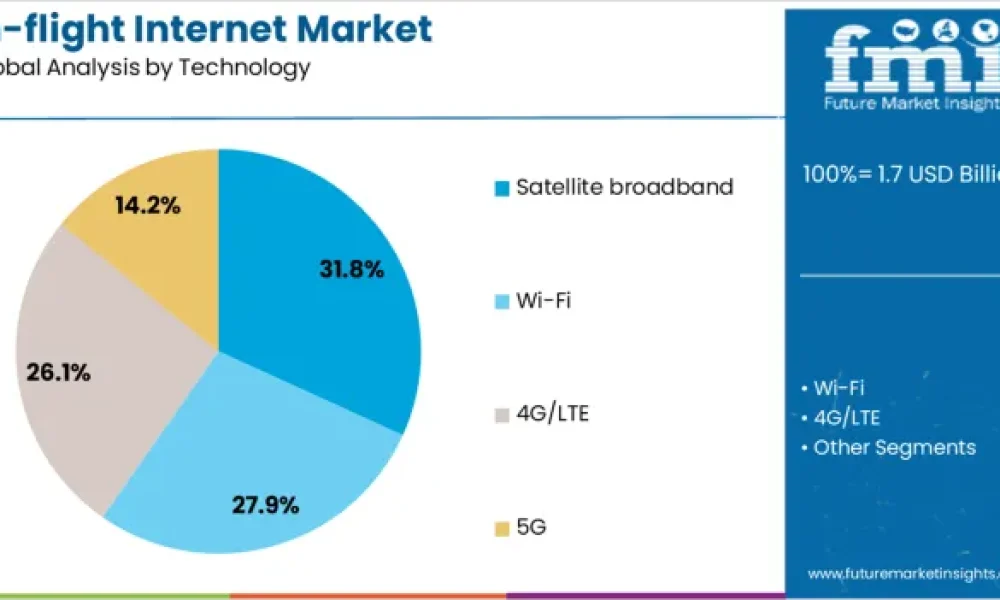
The in-flight internet market is soaring, reflecting both the digitalization of aviation and the increasing expectations of passengers for uninterrupted connectivity. Valued at USD 1.7 billion in 2025, the market is projected to nearly double to USD 3.1 billion by 2035, expanding at a compound annual growth rate of 6.1%. This growth trajectory illustrates the steady adoption of advanced onboard connectivity systems, enabled by rapid technological advancements and supported by strict regulatory oversight to ensure operational safety and reliability.
Stringent regulations from aviation authorities, including the Federal Aviation Administration in the United States, the European Union Aviation Safety Agency in Europe, and counterparts in the Asia-Pacific region, shape market dynamics. These regulations cover electromagnetic compatibility, frequency licensing, safety certifications, and cybersecurity. Compliance with these requirements influences technology adoption, network architecture decisions, and market entry timelines. International guidelines on satellite communications and interference mitigation further direct investment in hardware, software, and infrastructure.
While regulatory constraints moderate growth, they also drive innovation. Manufacturers are developing high-efficiency, safety-compliant systems that deliver high-speed internet access for passengers and support operational needs for airlines. The market expansion from USD 1.7 billion in 2025 to USD 3.1 billion by 2035 reflects a sector that is steadily maturing while simultaneously integrating new technologies, satellite constellations, and network optimization tools.
Full Market Report available for delivery. For purchase or customization, please request here: https://www.futuremarketinsights.com/reports/sample/rep-gb-25811
Drivers of Market Growth
Passenger demand for continuous connectivity has emerged as the primary growth driver. Travelers now expect seamless access to streaming platforms, social media, video conferencing, and cloud-based services throughout flights. This demand has encouraged airlines to invest in satellite broadband, air-to-ground links, and hybrid connectivity solutions that ensure uninterrupted service across short-haul and long-haul routes.
The market is also supported by the growing use of internet-based aircraft operations, crew communication, and real-time telemetry for operational efficiency. Integrating connectivity with airline applications, onboard entertainment, and passenger services enhances the overall travel experience while opening new revenue streams through subscription packages and tiered service models.
Technological advancements in high-throughput satellites, low-earth orbit (LEO) constellations, and next-generation ground infrastructure are critical enablers. These innovations enhance coverage, reduce latency, and enable scalable bandwidth, allowing airlines to deliver business-class internet performance to all passengers. Hybrid Ku/Ka-band systems, 5G-enabled ground stations, and intelligent bandwidth allocation platforms are increasingly deployed to optimize network performance.
Segment Insights
Among connectivity types, satellite-based solutions dominate, projected to capture 45.8% of market revenue in 2025. Satellite connectivity offers global coverage and stable bandwidth, essential for transcontinental flights where terrestrial networks are unavailable. Geostationary and low-earth orbit satellites provide extensive reach, supporting both passenger usage and aircraft operational systems. The flexibility and scalability of satellite platforms make them a preferred choice for airlines seeking consistent service and reliable network performance.
Within technology segments, satellite broadband leads with a 31.8% revenue share. High-capacity satellite communication systems enable passengers to stream content, conduct video calls, and access cloud applications even at cruising altitudes. Airlines favor satellite broadband for its ability to enhance both passenger satisfaction and operational efficiency. Continuous investment in high-throughput satellites and low-earth orbit constellations further improves speeds, reduces latency, and strengthens network reliability.
High-speed connectivity is the leading performance segment, expected to hold 48.2% of revenue in 2025. Business and leisure travelers increasingly demand uninterrupted streaming, virtual meetings, and cloud-based access during flights. Advanced antenna technologies, such as electronically steerable phased arrays, combined with low-latency satellite networks, deliver broadband-like speeds at cruising altitudes. This capability not only enhances passenger experience but also enables airlines to monetize digital services and strengthen brand loyalty.
Regional Insights
The Asia-Pacific region is poised for the fastest growth, with China leading at a projected CAGR of 8.2%. Expanding domestic and international airlines, investment in satellite broadband, and passenger demand for reliable connectivity drive this trend. China Eastern, China Southern, and COMAC are collaborating with technology providers like Gogo and Panasonic Avionics to equip aircraft with advanced connectivity solutions. As of 2023, over 1,200 commercial aircraft in China have in-flight internet, with satellite broadband accounting for nearly 60% of installations.
India follows with a projected CAGR of 7.6%, driven by fleet modernization, rising passenger expectations, and expanding domestic airline operations. IndiGo, Air India, and SpiceJet are integrating Ka-band and Ku-band satellite systems, offering tiered subscription plans to cater to both business and leisure travelers. Around 500 commercial aircraft in India have onboard internet, with satellite broadband representing more than 55% of deployments.
Europe is also a significant growth region, with Germany projected at 7% CAGR. Lufthansa and Eurowings lead the market, with over 350 connected aircraft featuring high-speed satellite Wi-Fi. Lufthansa’s partnerships with Panasonic Avionics and Thales are expanding network reliability and service coverage. The UK, projected to grow at 5.8%, emphasizes fleet upgrades and premium subscription models, with British Airways and Virgin Atlantic implementing advanced connectivity solutions.
In the United States, the market is projected to grow at 5.2% CAGR. Delta, United Airlines, and American Airlines collaborate with Gogo, Viasat, and Thales to equip over 2,000 aircraft with in-flight internet. High-throughput satellite systems account for nearly 70% of connected aircraft, supporting both passenger connectivity and operational applications.
Request Market Research Draft Report: https://www.futuremarketinsights.com/reports/brochure/rep-gb-25811
Competitive Landscape
The in-flight internet market features a mix of global leaders and specialized regional players. Viasat, Inc. leads with satellite-based broadband, delivering high-speed global coverage and innovative Ka-band and LEO solutions. Panasonic Avionics Corporation integrates in-flight entertainment with high-performance connectivity systems, targeting fleet-wide upgrades. Gogo Business Aviation LLC specializes in air-to-ground and satellite solutions for private and business aviation, emphasizing real-time communication, streaming, and operational efficiency.
Deutsche Telekom AG leverages global telecom infrastructure and satellite partnerships to provide enterprise-grade connectivity, while Lufthansa Technik integrates advanced network management, cybersecurity, and tailored passenger experience solutions. Emerging providers focus on region-specific bandwidth solutions, IoT-enabled aircraft systems, and cost-effective deployment models for both line-fit and retrofit installations.
Innovation continues to reshape competition. Satellite mega-constellations, hybrid 5G networks, AI-driven bandwidth management, and secure data handling are redefining service standards. Strategic partnerships, mergers, and technology licensing agreements enable providers to scale operations and enhance reliability while expanding digital offerings for airlines and passengers alike.
About Future Market Insights (FMI)
Future Market Insights, Inc. (ESOMAR certified, recipient of the Stevie Award, and a member of the Greater New York Chamber of Commerce) offers profound insights into the driving factors that are boosting demand in the market. FMI stands as the leading global provider of market intelligence, advisory services, consulting, and events for the Packaging, Food and Beverage, Consumer Technology, Healthcare, Industrial, and Chemicals markets. With a vast team of over 400 analysts worldwide, FMI provides global, regional, and local expertise on diverse domains and industry trends across more than 110 countries.
Contact Us:
Future Market Insights Inc.
Christiana Corporate, 200 Continental Drive,
Suite 401, Newark, Delaware – 19713, USA
T: +1-347-918-3531
For Sales Enquiries: [email protected]



