
Introduction: Navigating the Future of Indoor Location
The indoor location market is poised for unprecedented growth, reflecting the accelerating demand for real-time positioning solutions across commercial, industrial, and public infrastructure sectors. Valued at USD 11.1 billion in 2025, the market is expected to reach USD 40.1 billion by 2035, registering a robust CAGR of 13.7%. This surge is driven by technological innovation, evolving enterprise requirements, and the strategic expansion efforts of both established global giants and nimble start-ups.
Companies such as Apple, Google, Cisco, Ericsson, Microsoft, Motorola Solutions, Nokia, STMicroelectronics, Qualcomm, and Zebra Technologies continue to lead the market with innovations in RF-based systems, managed services, and AI-powered analytics. At the same time, emerging players like SIRL, IIWARI, Arara, Invento Robotics, and ARWAY are pioneering ultra-wideband solutions, indoor positioning analytics, and Wi-Fi-driven navigation systems, signaling a rapidly diversifying competitive landscape.
Full Market Report available for delivery. For purchase or customization, please request here: https://www.futuremarketinsights.com/reports/sample/rep-gb-2446
Market Drivers: Technology, IoT, and Real-Time Intelligence
The indoor location market’s growth is underpinned by the rising need for real-time navigation and asset tracking within complex indoor environments. Retailers are using indoor location systems to guide customers through expansive stores, enhancing engagement and driving sales. Healthcare institutions deploy these technologies for efficient patient navigation, asset monitoring, and improved care delivery. Industrial players rely on indoor location solutions to track inventory, optimize operations, and maintain safety compliance in warehouses, factories, and large facilities.
Technological advancements in sensors, wireless communication protocols, and integration with IoT ecosystems have improved system accuracy and scalability. RF-based technologies, which include Wi-Fi, Bluetooth, and RFID, are emerging as dominant solutions, accounting for over 51% of market share in 2025. Their low-cost deployment, broad device compatibility, and high adaptability across diverse indoor environments have fueled widespread adoption.
Moreover, the proliferation of 5G networks, cloud-based analytics, and AI-enabled platforms has reduced latency, enhanced processing speed, and enabled actionable insights for enterprises. Managed services, providing end-to-end deployment, ongoing support, and software integration, are leading the market, contributing 44.6% to the total revenue in 2025. Organizations increasingly prefer these services for their agility, scalability, and cost predictability.
Segment Insights: Managed Services, RF Technologies, and Software Tools
Managed services have emerged as a cornerstone for enterprises implementing indoor location systems. By bundling hardware, software, and ongoing support, managed solutions simplify deployment and ensure continuous optimization and compliance with data security standards. Subscription-based models offer predictable costs, making these services attractive for organizations undergoing digital transformation.
RF-based technologies remain the technological backbone of the industry, leveraging wireless signals for navigation, asset tracking, and indoor analytics. Continuous improvements in antenna design, RF chipsets, and power efficiency have enhanced accuracy, while sensor fusion and dead reckoning techniques are expanding capabilities. RF-based positioning is expected to sustain leadership as the technology integrates seamlessly with IoT ecosystems and smart building applications.
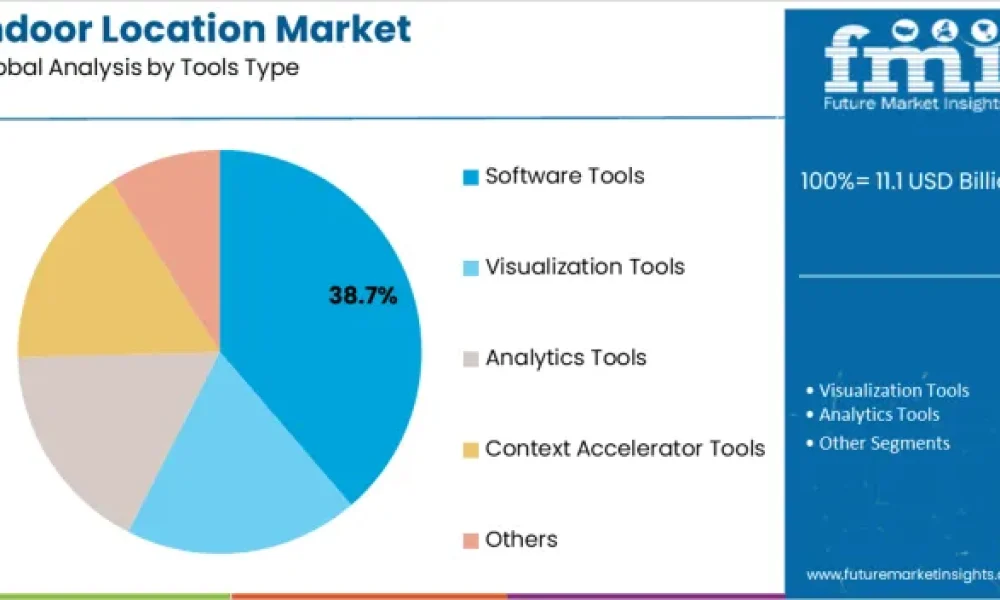
Software tools, accounting for 38.7% of market revenue in 2025, are central to indoor location solutions. These platforms process location data, deliver actionable insights, and enable enterprises to deploy predictive analytics for operational optimization. Cloud integration and AI-driven automation are facilitating scalable deployments for businesses of all sizes, making software tools indispensable in the evolution of indoor location services.
Market Opportunities: North America and Europe Lead Growth
Geographically, North America continues to be a leading adopter, with a projected market share of 27.6% through 2035. The region benefits from increasing deployment of proximity-based solutions in retail, mobile media promotion, and location-enabled searches. Customization of indoor location solutions is particularly strong, as businesses seek tailored experiences for both customers and employees.
Europe also demonstrates steady growth, accounting for 23.7% of the market in 2025. Germany and Italy, in particular, are seeing strong adoption driven by the development of commercial and residential sectors, coupled with enterprises’ demand for customizable indoor navigation and analytics solutions. Smart buildings, retail spaces, and industrial facilities are increasingly leveraging indoor location technologies to optimize operational efficiency and enhance safety protocols.
The United States stands out with a remarkable CAGR of 19.4%, driven by high industrial and commercial adoption. Germany follows at 10.4%, Japan at 2.4%, and Australia at 1.7%, reflecting regional variations in industrialization, technology adoption, and regulatory support.
Emerging Players: Innovation and Market Disruption
Start-ups are playing a crucial role in shaping the indoor location market. Companies such as Arara, IIWARI, and Invento Robotics are pioneering Wi-Fi analytics, ultra-wideband positioning, and precise indoor navigation systems. Arara’s solutions leverage received signal strength indicator (RSSI) technology for highly accurate positioning, while IIWARI focuses on data-driven route optimization and location-based marketing. These innovative approaches are expanding the use cases for indoor location systems beyond traditional navigation, opening new opportunities in retail analytics, logistics, and smart infrastructure management.
Market Challenges: Privacy and Regulatory Constraints
Despite robust growth, the market faces challenges, particularly around privacy and data security. Stringent regulations such as the Health Insurance Portability and Accountability Act (HIPAA), W3C guidelines, and Open Geospatial Consortium standards restrict data collection, sharing, and use. Companies must navigate these regulations carefully to ensure compliance while maintaining high levels of service reliability. Addressing privacy concerns, ensuring secure data handling, and transparent analytics practices are becoming essential components of market strategy.
Request Market Research Draft Report: https://www.futuremarketinsights.com/reports/brochure/rep-gb-2446
Industry Trends and Technological Advancements
The indoor location market is witnessing continuous technological evolution. Innovations such as sensor fusion, AI-powered analytics, and cloud-enabled platforms are transforming traditional indoor navigation into intelligent, actionable systems. Retailers are using these solutions to improve customer experiences, optimize store layouts, and enhance engagement through personalized location-based promotions. Healthcare providers leverage indoor mapping to streamline hospital operations, improve patient flow, and support emergency response teams in critical scenarios.
RF-based analytics, combined with software intelligence, is enhancing asset tracking, inventory management, and workflow optimization. Integration with AI and IoT allows for predictive insights and real-time decision-making, enabling enterprises to reduce operational inefficiencies and improve safety protocols.
Recent Developments: Strategic Moves by Key Players
Major corporations are expanding their capabilities and global reach through strategic acquisitions and partnerships. In August 2025, Cisco acquired Code BGP, a Greek company specializing in network monitoring, enhancing Cisco ThousandEyes’ capabilities and providing a global view of Internet health. Meanwhile, Mapsted has advanced indoor mapping solutions for hospitals, improving navigation, patient care, and operational efficiency in healthcare settings.
Apple, Google, Microsoft, and Qualcomm continue to innovate, focusing on seamless integration with consumer devices, improved accuracy, and AI-powered predictive insights. These developments demonstrate the convergence of hardware, software, and managed services in creating highly scalable and efficient indoor location ecosystems.
About Future Market Insights (FMI)
Future Market Insights, Inc. (ESOMAR certified, recipient of the Stevie Award, and a member of the Greater New York Chamber of Commerce) offers profound insights into the driving factors that are boosting demand in the market. FMI stands as the leading global provider of market intelligence, advisory services, consulting, and events for the Packaging, Food and Beverage, Consumer Technology, Healthcare, Industrial, and Chemicals markets. With a vast team of over 400 analysts worldwide, FMI provides global, regional, and local expertise on diverse domains and industry trends across more than 110 countries.
Contact Us:
Future Market Insights Inc.
Christiana Corporate, 200 Continental Drive,
Suite 401, Newark, Delaware – 19713, USA
T: +1-347-918-3531
For Sales Enquiries: [email protected]



