
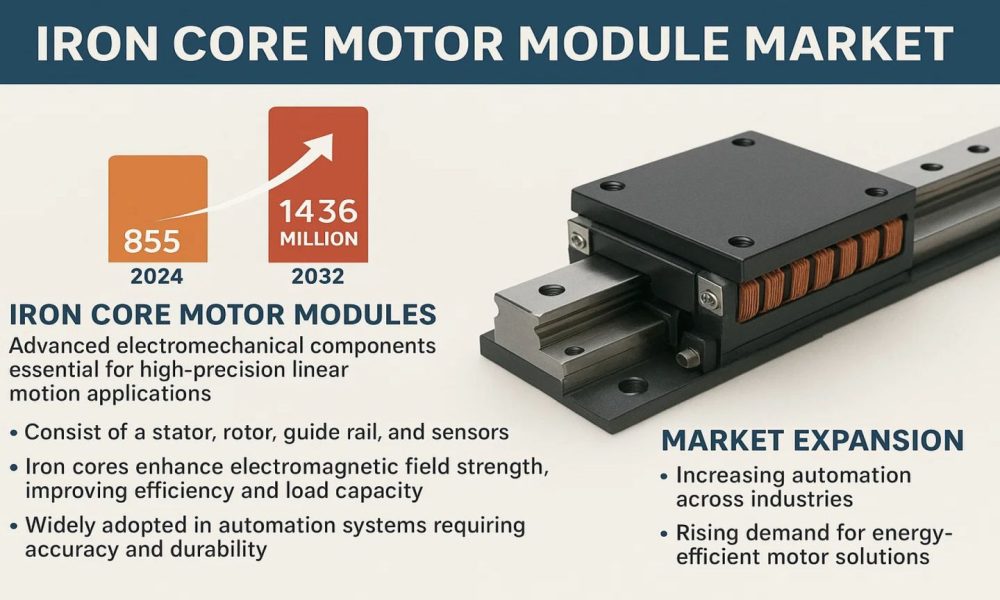
Iron Core Motor Module Market was valued at 855 million in 2024 and is projected to reach US$ 1436 million by 2032, at a CAGR of 7.7% during the forecast period.
Iron core motor modules are advanced electromechanical components essential for high-precision linear motion applications. These modules consist of a stator, rotor, guide rail, and sensors, utilizing electromagnetic induction to convert electrical energy into precise linear movement. The inclusion of iron cores significantly enhances electromagnetic field strength, improving motor efficiency and load capacity. They are widely adopted in automation systems requiring exceptional accuracy and durability.
Market expansion is driven by increasing automation across industries such as manufacturing, healthcare, and transportation, coupled with rising demand for energy-efficient motor solutions. The brushless motor segment is gaining traction due to its superior performance and longer lifespan. Key players like Siemens, ABB, and Yaskawa Electric are investing in R&D to enhance product capabilities, further propelling market growth. Additionally, rapid industrialization in emerging economies presents lucrative opportunities for market expansion.
Receive Your Sample Report at No Cost- https://semiconductorinsight.com/download-sample-report/?product_id=117895
MARKET DYNAMICS
MARKET DRIVERS
Industrial Automation Boom to Accelerate Iron Core Motor Module Demand
The global surge in industrial automation adoption is significantly propelling the iron core motor module market forward. As manufacturing sectors worldwide embrace Industry 4.0 technologies, the requirement for precision motion control systems has intensified. Iron core motors offer superior performance in high-load applications compared to traditional motors, with torque outputs exceeding 30% higher in similar form factors. The robotics sector alone is expected to drive over 40% of global demand, particularly in material handling and assembly line applications where iron core motors’ high force density proves essential. Recent advances in direct drive linear motion systems have further enhanced efficiency, with leading manufacturers now achieving positional accuracy within ±5 microns.
Energy Efficiency Regulations to Stimulate Market Growth
Stringent global energy efficiency standards are compelling manufacturers to transition from conventional motors to advanced iron core brushless modules. These motors demonstrate 15-20% higher energy efficiency compared to traditional brushed alternatives, translating to substantial operational cost savings. The International Electrotechnical Commission’s latest IE4 efficiency classification has accelerated adoption, particularly in European and North American markets where regulatory pressures are strongest. Additionally, the reduced cogging torque characteristic of optimized iron core designs minimizes energy losses during partial load operation – a critical advantage in variable speed applications that constitute nearly 60% of industrial motor usage.
Medical Equipment Miniaturization to Create New Application Areas
The healthcare industry’s push towards compact, high-precision medical devices is opening new frontiers for iron core motor modules. These motors are proving indispensable in surgical robotics, imaging systems and laboratory automation where space constraints demand maximum power density. Recent innovations have yielded iron core modules with power-to-weight ratios exceeding 1kW/kg – a capability revolutionizing portable medical equipment design. The growing adoption of robotic-assisted surgery, projected to maintain 22% CAGR through 2030, particularly benefits from the rapid response times and precision positioning enabled by advanced iron core servo motors.
Recent Developments in the Iron Core Motor Module Market:
- Technological Advancements in Motor Efficiency
Leading manufacturers are introducing iron core motor modules with enhanced efficiency and reduced energy losses. Innovations in magnetic materials and core design have improved torque density, making these modules more suitable for electric vehicles (EVs) and industrial automation applications. - Rising Adoption in Electric Vehicles (EVs)
Several EV manufacturers are increasingly integrating iron core motor modules into their propulsion systems due to their durability and high performance. Partnerships between motor module suppliers and EV companies are driving market expansion in North America, Europe, and Asia-Pacific. - Focus on Miniaturization and Lightweight Designs
To support portable and compact devices, companies are developing smaller, lighter iron core motor modules without compromising performance. This trend is particularly significant in robotics, aerospace, and consumer electronics sectors. - Expansion of Production Facilities
Key market players are investing in expanding production capacities to meet growing demand. For instance, some manufacturers in China and Germany have recently established new manufacturing units dedicated to high-performance iron core motor modules. - Government Initiatives Supporting EV Infrastructure
Incentives and subsidies for electric mobility are driving demand for efficient motor modules. Policies in Europe, the U.S., and China are encouraging adoption, leading to increased R&D and commercialization of iron core motors. - Strategic Collaborations and Acquisitions
Industry leaders are entering collaborations and acquisitions to strengthen their product portfolios and technological capabilities. Recent alliances aim to enhance motor efficiency, reduce manufacturing costs, and accelerate the market rollout of next-generation modules.
MARKET OPPORTUNITIES
Emerging Robotics Applications to Drive Next Growth Phase
The rapidly evolving field of collaborative robotics presents substantial opportunities for iron core motor advancement. The unique combination of compact size, high torque density and precise controllability makes these motors ideal for next-generation cobot joints and end-effectors. Market projections indicate the collaborative robotics sector will require over 1.2 million precision motor units annually by 2026 – representing a largely untapped market segment for iron core technology providers.
Smart Manufacturing Initiatives Creating Demand for Intelligent Motor Solutions
The integration of IoT capabilities into motion control systems is creating premium opportunities for intelligent iron core motor modules. Modern smart factories increasingly demand motors with integrated condition monitoring, predictive maintenance features and networked control – capabilities that align perfectly with iron core technology’s inherent precision. Early adopters implementing these smart motor solutions report 30-50% reductions in unplanned downtime, creating compelling value propositions for broader industrial adoption.
List of Key Iron Core Motor Module Manufacturers
- Siemens AG (Germany)
- ABB Ltd (Switzerland)
- Yaskawa Electric Corporation (Japan)
- Robert Bosch GmbH (Germany)
- Schneider Electric SE (France)
- Parker Hannifin Corporation (U.S.)
- Mitsubishi Electric Corporation (Japan)
- Fanuc Corporation (Japan)
- Moog Inc. (U.S.)
- Delta Electronics (Taiwan)
- Omron Corporation (Japan)
- Aimega Motion Technology (China)
- Shenzhen Fgs Mechanical Electrical Equipment (China)
- CCTL Linear Motion Technology (China)
- MBYS Precision Machinery (China)
Receive Your Sample Report at No Cost- https://semiconductorinsight.com/download-sample-report/?product_id=117895
Segment Analysis:
By Type
Brushless Motor Module Segment Dominates Due to Energy Efficiency and Low Maintenance Needs
The market is segmented based on type into:
- Brushed Motor Module
- Subtypes: Single-phase, Three-phase, and others
- Brushless Motor Module
- Subtypes: PMSM, BLDC, and others
By Application
Industrial Production Leads the Market Due to High Adoption in Automation Systems
The market is segmented based on application into:
- Industrial Production
- Sub-categories: Robotics, CNC Machines, Conveyor Systems
- Medical Equipment
- Sub-categories: Surgical Robots, Diagnostic Machines
- Transportation
- Military Research
- Others
By End User
Manufacturing Sector Holds Major Share Due to Rising Automation Investments
The market is segmented based on end user into:
- Automotive Industry
- Electronics & Semiconductor
- Healthcare Sector
- Aerospace & Defense
- Others
By Power Rating
High Power Modules Drive Market Growth in Heavy Industrial Applications
The market is segmented based on power rating into:
- Low Power (<1 kW)
- Medium Power (1-10 kW)
- High Power (>10 kW)
Other Topic- Multi-core Fibre Connector Market
CONTACT US:
City vista, 203A, Fountain Road, Ashoka Nagar, Kharadi, Pune, Maharashtra 411014
[+91 8087992013]




