
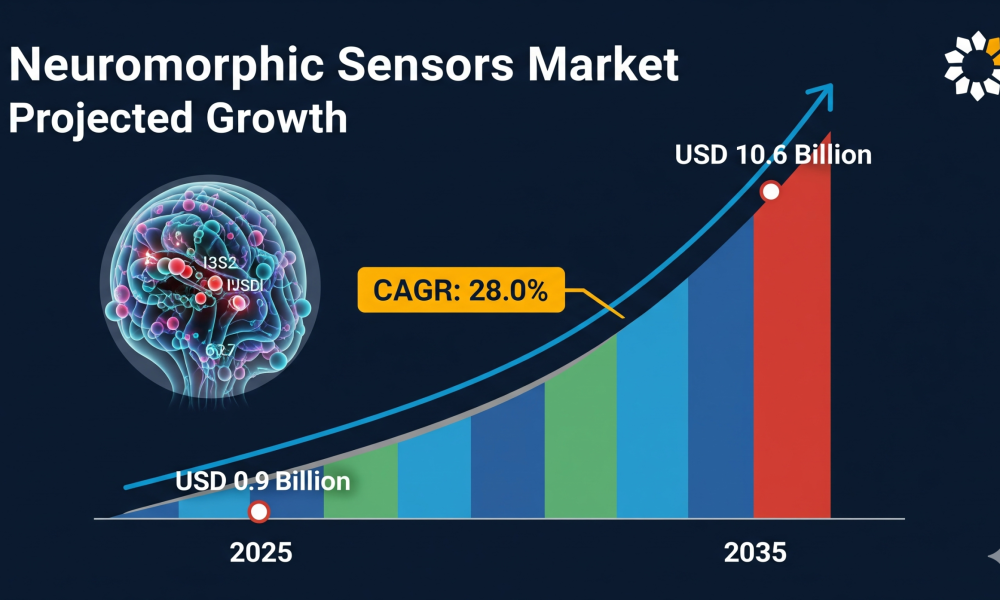
The Neuromorphic Sensors Market is poised for remarkable growth, transforming industries ranging from automotive to healthcare with brain-inspired computing technologies. Valued at USD 0.9 billion in 2025, the market is projected to reach USD 10.6 billion by 2035, reflecting a robust compound annual growth rate (CAGR) of 28.0%.
This growth trajectory illustrates a classic “S-curve” adoption pattern: an early acceleration phase driven by innovative AI, robotics, and autonomous systems, followed by rapid adoption between 2025 and 2028. Post-2028, growth stabilizes as integration becomes widespread across high-demand sectors such as automotive, defense, and advanced electronics, signaling a maturation phase with sustained absolute growth.
Driving Forces Behind Market Expansion
The neuromorphic sensors market is gaining momentum as industries embrace sensors that mimic neural processing for faster, energy-efficient, and adaptive data handling. Image recognition, robotics, AI applications, and edge computing are key drivers, supported by improvements in sensor accuracy and low-power designs.
Full Market Report available for delivery. For purchase or customization, please request here: https://www.futuremarketinsights.com/reports/sample/rep-gb-24332
The growing prevalence of smart devices, IoT ecosystems, and autonomous platforms demands localized processing, low latency, and high adaptability. Edge deployment enables real-time decision-making, enhancing responsiveness in applications such as autonomous vehicles, drones, and smart cameras.
Segment Insights: Image Sensors Lead
Among sensor types, Image Sensors are projected to capture 34.8% of market revenue in 2025. These sensors excel in vision-based applications including autonomous driving, computer vision, and surveillance systems.
Neuromorphic image sensors replicate biological vision processes, enabling faster detection of environmental changes while minimizing data transfer to central processors. The surge in robotics and advanced consumer electronics has further boosted adoption. As industries continue to demand superior visual sensing capabilities, Image Sensors are expected to retain a leading market position.
Hardware Components: The Backbone of Neuromorphic Sensors
The Hardware segment dominates the components category, representing 59.4% of revenue in 2025. Hardware encompasses physical sensor chips and associated electronics critical to neuromorphic computing.
Advancements in semiconductor fabrication and miniaturization have allowed complex neural network models to integrate into compact sensor systems. Combined with evolving software algorithms, these improvements enhance sensor efficiency, reliability, and energy performance. Consumer electronics, automotive, and industrial automation are key contributors to hardware demand, ensuring the segment’s sustained prominence.
Edge Devices Drive Deployment
Edge Devices are projected to account for 65.1% of market revenue in 2025, highlighting a strong preference for decentralized data processing. Edge deployment reduces latency, lowers bandwidth requirements, and improves data privacy.
Applications in autonomous vehicles, robotics, and smart cameras benefit from real-time processing, supporting critical operational decisions. Growing IoT infrastructure and demand for on-site analytics are accelerating the adoption of edge-based neuromorphic sensors. As industries prioritize speed, energy efficiency, and localized intelligence, edge devices will remain the dominant deployment mode.
Applications and Industry Adoption
Neuromorphic sensors are reshaping industries across multiple domains:
- AI Hardware: Event-driven processing enhances efficiency for smartphones, IoT devices, and portable electronics, supporting energy-conscious applications.
- Healthcare and Biomedicine: Sensors enable neuroprosthetics, brain–machine interfaces, and medical imaging, delivering low-latency, personalized patient solutions.
- Autonomous Systems: Robotics, drones, and self-driving vehicles leverage spiking neural networks for obstacle avoidance, navigation, and environmental adaptation.
- IoT and Smart Devices: Neuromorphic sensors provide always-on functionality with minimal power draw, powering smart home devices, wearables, and industrial monitoring tools.
The combination of low-latency processing, energy efficiency, and bio-inspired computation positions neuromorphic sensors as critical enablers of next-generation technologies.
Global Growth Dynamics
Asia-Pacific is emerging as a dominant market, with China leading at a 37.8% CAGR due to government funding, AI research programs, and industrial automation initiatives. India follows with 35.0%, driven by digital infrastructure expansion, smart city projects, and academic research investments.
Europe demonstrates strong growth in research-driven applications. France’s CAGR reaches 29.4%, fueled by aerospace, healthcare, and robotics projects. The UK achieves 26.6%, supported by government-backed AI programs and edge computing adoption.
The United States records a CAGR of 23.8%, reflecting a mature but steadily advancing market with selective deployment in defense, autonomous mobility, and healthcare. The global outlook emphasizes Asia’s leadership in scale and adoption, Europe’s research-focused strength, and the USA’s steady innovation trajectory.
Competitive Landscape: Established and Emerging Players
The neuromorphic sensors market is highly competitive, blending global semiconductor leaders and specialized start-ups. Key players include:
- Intel Corporation: Leading with its Loihi research chip for edge computing and adaptive sensor integration.
- IBM Corporation: Deploying TrueNorth architecture and partnering with research institutions to advance low-power sensory systems.
- Qualcomm Incorporated: Integrating neuromorphic features into mobile and IoT chipsets.
- BrainChip Holdings Ltd.: Commercializing Akida neuromorphic processors for vision, cybersecurity, and edge AI applications.
- SynSense: Delivering ultra-low-power vision and auditory processors for robotics, IoT, and consumer electronics.
Emerging players are focusing on spiking neural networks, event-based vision sensors, and AI ecosystem integration. Differentiation is shaped by energy efficiency, performance scalability, and adaptability across real-time applications.
Request Market Research Draft Report: https://www.futuremarketinsights.com/reports/neuromorphic-sensors-market
Strategic Moves and Recent Developments
Companies are investing in partnerships, research, and application-specific solutions. Strategies include:
- Collaborating with system integrators for sector-specific deployments.
- Advancing research in edge AI and neuromorphic computing.
- Expanding commercialization in automotive, healthcare, defense, and consumer electronics.
This competitive landscape is driving innovation, reducing latency, and promoting energy-efficient neuromorphic sensor solutions across global markets.
Market Outlook
The neuromorphic sensors market is set to continue its strong growth trajectory, moving from rapid adoption to broader commercialization and eventual market maturity by 2035. Image Sensors, Hardware, and Edge Devices will remain key revenue drivers, while AI hardware, autonomous systems, healthcare, and IoT applications will continue to fuel demand.
Both established corporations and nimble start-ups have opportunities to expand, innovate, and lead in this rapidly evolving market. As neuromorphic sensors redefine the future of intelligent computing and sensing, companies that invest in performance, scalability, and integration will thrive in a sector defined by rapid technological advancement.
About Future Market Insights (FMI)
Future Market Insights, Inc. (ESOMAR certified, recipient of the Stevie Award, and a member of the Greater New York Chamber of Commerce) offers profound insights into the driving factors that are boosting demand in the market. FMI stands as the leading global provider of market intelligence, advisory services, consulting, and events for the Packaging, Food and Beverage, Consumer Technology, Healthcare, Industrial, and Chemicals markets. With a vast team of over 400 analysts worldwide, FMI provides global, regional, and local expertise on diverse domains and industry trends across more than 110 countries.
Contact Us:
Future Market Insights Inc.
Christiana Corporate, 200 Continental Drive,
Suite 401, Newark, Delaware – 19713, USA
T: +1-347-918-3531
For Sales Enquiries: [email protected]



