
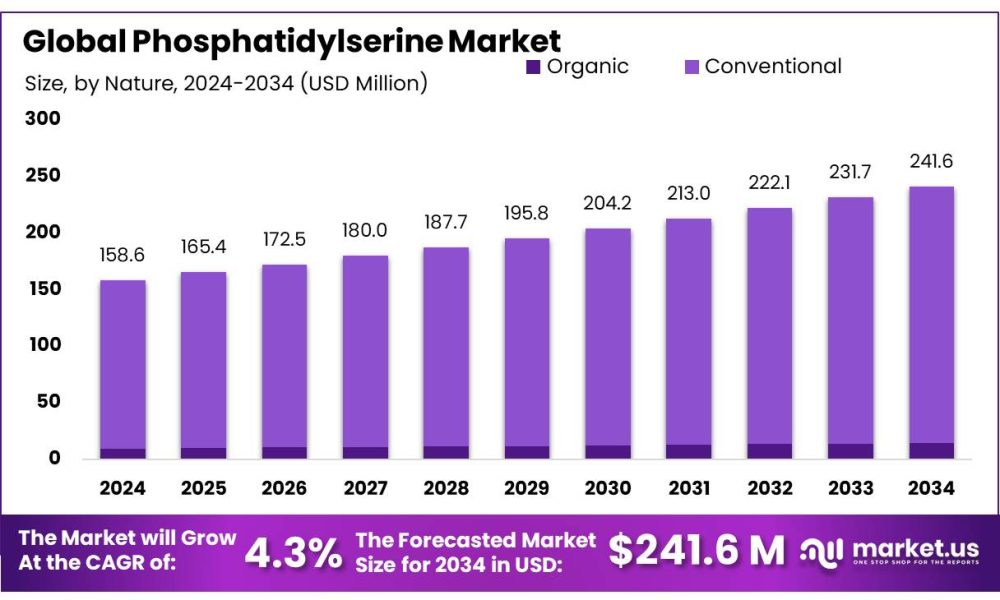
According to market.us, The Global Phosphatidylserine Market size is expected to be worth around USD 241.6 Million by 2034, from USD 158.6 Million in 2024, growing at a CAGR of 4.3% during the forecast period from 2025 to 2034.
Phosphatidylserine (PS) concentrates are specialized lipid compounds predominantly used in dietary supplements and pharmaceuticals due to their critical role in cognitive function, memory enhancement, and neurological health. Derived mainly from soy lecithin or sunflower lecithin, these concentrates have gained traction in the nutraceutical and functional food industries as demand for brain health supplements rises globally.
The industrial landscape for phosphatidylserine (PS) concentrates is evolving in response to increasing global focus on cognitive well-being, especially among aging populations. With the World Health Organization projecting the number of individuals aged 60 and above to surge from 900 million in 2015 to nearly 2 billion by 2050, there is a growing demand for brain-supportive nutritional solutions. This demographic trend is playing a crucial role in boosting both the production and consumption of PS concentrates across developed and developing regions.
Consumer interest in cognitive health is steadily rising, fueled by the growing prevalence of neurological conditions such as Alzheimer’s disease and dementia. Approximately 55 million individuals worldwide are currently living with dementia, with an estimated 10 million new cases reported each year. These alarming statistics have intensified the need for nutritional supplements that may support brain function, placing phosphatidylserine in a strategic position within the health and wellness segment.
Public sector investments further reinforce this momentum. In the United States, the National Institute on Aging increased its allocation for cognitive health-related research by around 12% in 2023, bringing the budget to approximately USD 500 million. This funding encourages further exploration of dietary compounds, including phosphatidylserine, that may assist in preserving mental acuity.
Beyond traditional cognitive health uses, phosphatidylserine is gaining attention in the field of sports nutrition. Its potential to aid in mental focus and reduce stress during high-performance activities is opening new opportunities for innovation. Future market expansion may also be supported by comprehensive health research initiatives such as the European Union’s Horizon Europe framework, which has committed over €95 billion between 2021 and 2027 for health and scientific advancement.
Key Takeaways
- Phosphatidylserine Market size is expected to be worth around USD 241.6 Million by 2034, from USD 158.6 Million in 2024, growing at a CAGR of 4.3%.
- Conventional phosphatidylserine held a dominant market position, capturing more than a 94.6% share.
- Plant-based phosphatidylserine held a dominant market position, capturing more than a 74.8% share.
- The powder form of phosphatidylserine held a dominant market position, capturing more than a 65.9% share.
- Dietary supplements held a dominant market position in the phosphatidylserine industry, capturing more than a 45.2% share.
- Offline distribution held a dominant market position in the phosphatidylserine market, capturing more than a 76.4% share.
- North America emerged as the leading region in the global phosphatidylserine market, commanding a substantial share of 42.9%, translating to approximately USD 68.0 million.
Access a Complimentary Sample of This Premium Report: https://market.us/report/phosphatidylserine-market/request-sample/
Factors Affecting the Growth of the Phosphatidylserine Market
Rising Awareness of Cognitive Health: Increasing public concern over mental well-being, memory retention, and age-related cognitive decline is encouraging the adoption of brain health supplements. Phosphatidylserine, recognized for its role in supporting brain cell function, is benefiting from growing consumer demand for preventive health solutions.
Increasing Prevalence of Neurodegenerative Disorders: The global rise in conditions such as Alzheimer’s disease, Parkinson’s, and dementia has significantly influenced interest in nutritional compounds that may aid in neurological support. As populations age, the need for cognitive support solutions becomes more urgent, driving demand for phosphatidylserine.
Expansion in Sports and Performance Nutrition: Phosphatidylserine is gaining traction in the athletic and fitness community due to its potential to reduce exercise-induced stress and improve mental focus. Its incorporation into sports supplements broadens its consumer base beyond the elderly to include younger, performance-driven demographics.
Supportive Government and Institutional Research Initiatives: Increased government funding and institutional interest in healthy aging and cognitive health are indirectly supporting the growth of phosphatidylserine-related research and innovation. These initiatives help validate its benefits and encourage wider use in dietary formulations.
Ongoing Product Innovation and Diversification: Advancements in supplement delivery methods and formulations are making phosphatidylserine more accessible and appealing to a broader range of consumers. Innovations such as blends with other nootropic ingredients and functional food applications are enhancing its visibility and driving market expansion.
Key Market Segmentation
By Nature Analysis
In 2024, conventional phosphatidylserine dominated the global market with a substantial share exceeding 94.6%. This dominance is largely driven by the reliability and cost-effectiveness of traditional extraction methods, primarily from soy and other plant-based sources.
Manufacturers continue to favor conventional PS due to its consistent quality, regulatory compliance, and established supply chains. Despite rising interest in alternative sources, conventional phosphatidylserine remains the primary choice for both dietary supplements and pharmaceutical use, supported by long-term consumer trust and official approvals.
By Source Analysis
In 2024, plant-based phosphatidylserine accounted for over 74.8% of the total market share, reflecting strong consumer preference for natural and sustainable ingredients. Sourced mainly from soy and sunflower lecithin, this segment has benefited from technological improvements in extraction methods and regulatory support, particularly from agencies like the U.S. FDA.
The global shift toward eco-friendly, non-animal products has reinforced the dominance of plant-based phosphatidylserine, securing its position as the leading segment in the market.
By Forms Analysis
In 2024, the powder form of phosphatidylserine dominated the market with a share exceeding 65.9%. Its widespread use is attributed to formulation flexibility, ease of integration into capsules, tablets, and functional foods, and advantages such as longer shelf life and cost-efficient transport. Enhanced stability during processing and storage further supports its preference among supplement manufacturers, securing its leading position in the global phosphatidylserine market.
By Application Analysis
In 2024, dietary supplements accounted for over 45.2% of the phosphatidylserine market, maintaining the leading application segment. This dominance is driven by growing consumer interest in cognitive health, memory enhancement, and stress management.
The segment experienced steady growth between 2023 and 2025, particularly among aging populations. The convenience of supplement formats such as capsules and powders, along with supportive regulatory frameworks and health awareness campaigns, has reinforced dietary supplements as the primary driver of phosphatidylserine consumption.
By Distribution Channel Analysis
In 2024, offline distribution accounted for over 76.4% of the phosphatidylserine market, maintaining its dominant position. This stronghold is supported by the widespread presence of pharmacies, health stores, and specialty supplement outlets, which remain the preferred choice for consumers seeking in-person product evaluation and expert guidance.
The personalized shopping experience and regulatory preference for traditional retail further reinforced offline sales, allowing this channel to outperform others despite the growing presence of e-commerce.
Key Market Segments
By Nature
- Organic
- Conventional
By Source
- Meat
- Fish
- Plants
By Forms
- Powder
- Liquid
- Capsule
By Application
- Dietary Supplements
- Functional Food
- Medical Food
- Others
By Distribution Channel
- Online
- Offline
Regional Analysis
In 2024, North America led the global phosphatidylserine market with a 42.9% share, valued at approximately USD 68.0 million. This leadership is driven by strong consumer awareness of cognitive health, an aging population, and a high adoption rate of dietary supplements.
The United States remains the key contributor, influenced by increasing cases of age-related cognitive decline. The region’s established healthcare infrastructure and widespread retail and e-commerce access have further supported the availability and growth of phosphatidylserine products, reinforcing North America’s dominant market position.
Top Key Players in the Market
- Chemi Nutra LLC
- Doosan Corporation
- Double Wood Llc.
- ECA Healthcare Inc.
- IvoVital Gmbh
- Jarrow Formulas Inc
- Lipogen Products Ltd.
- Lipoid GmbH
- Lonza AG -Enzymotec Ltd
- Nagase Chemtex Corporation
- Nature’s Way Products Llc.
- Novastell
- Solgar Inc.
- Swanson Health Products Inc.
- Xian Natural Field Bio-Technique Co. Ltd.
Get in Touch with Us:
Market.us (Powered By Prudour Pvt. Ltd.)
Address: 420 Lexington Avenue, Suite 300 New York City, NY 10170, United States
Send Email: [email protected]
Refer to More Related Reports:



