
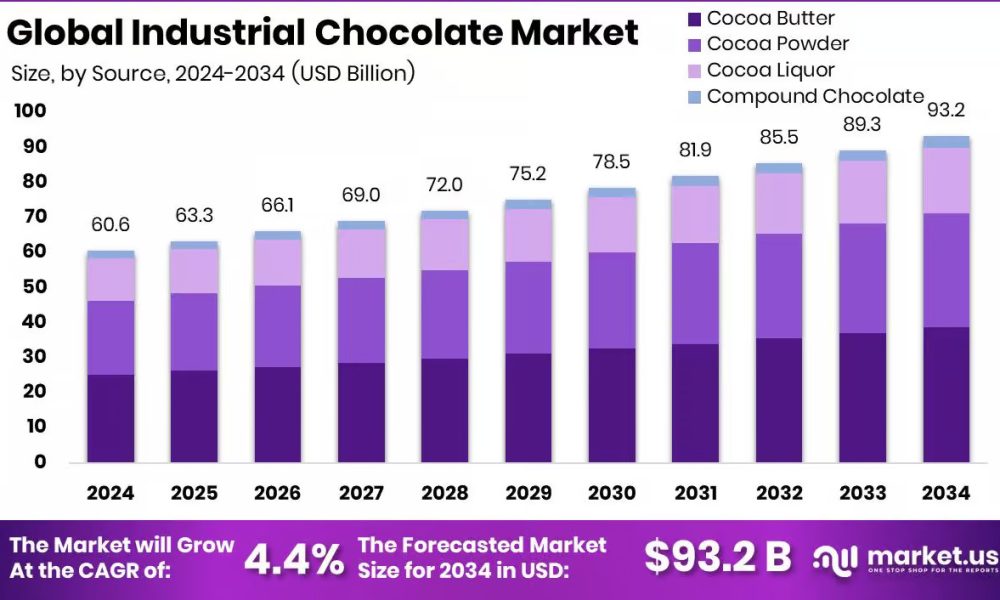
According to Market.us, the global industrial chocolate market is projected to reach approximately USD 93.2 billion by 2034, rising from USD 60.6 billion in 2024, at a CAGR of 4.4% from 2025 to 2034. Europe dominated the market with a USD 26.1 billion value in 2024, accounting for 43.2% of the global share.
Industrial chocolate is produced in bulk and used primarily as a raw material by food manufacturers, bakeries, and confectionery producers. It is typically supplied in block, chip, or liquid form and serves as a key ingredient in products such as cookies, cakes, chocolate-coated snacks, flavored dairy items, and cereals.
The market spans sectors like confectionery, bakery, dairy, frozen desserts, and beverages, with growth driven by business-to-business supply chains and long-term contracts. Increased consumer preference for indulgent and premium chocolate-based foods is fueling demand. This is especially notable in emerging markets where Western-style confections are becoming more popular.
Manufacturers require consistent quality and flavor, making industrial chocolate essential in mass-produced goods like ice cream, wafers, and breakfast bars. Seasonal demand surges during festive periods, and the expanding use of chocolate in dairy, cereals, and beverages continues to enhance market opportunities.
Key Takeaways
- Global Industrial Chocolate Market is expected to be worth around USD 93.2 billion by 2034, up from USD 60.6 billion in 2024, and grow at a CAGR of 4.4% from 2025 to 2034.
- In 2024, Cocoa Butter accounted for a 41.5% share in the Industrial Chocolate Market by product type.
- By application, Bakery Products held a 57.9% share, highlighting strong demand for industrial chocolate usage.
- Europe accounted for 43.2% of the industrial chocolate market, worth USD 26.1 Bn.
Access a Complimentary Sample of This Premium Report: https://market.us/report/global-industrial-chocolate-market/request-sample/
Factors Affecting the Growth of the Industrial Chocolate Market
Rising Demand from the Food Processing Industry: Industrial chocolate is widely used in the production of confectionery, bakery products, dairy desserts, and beverages. The consistent demand from these sectors, particularly for coatings, fillers, and flavoring agents, significantly drives market expansion.
Evolving Consumer Preferences for Indulgent and Premium Products: The growing inclination toward premium chocolate-infused items and indulgent treats has led food manufacturers to increase their use of high-quality industrial chocolate. This shift in consumer taste preferences directly influences production volumes and chocolate formulations.
Expansion of Western-style Confectionery in Emerging Markets: As urbanization and disposable incomes rise in developing regions, there is greater exposure to Western-style chocolate products. This trend encourages local manufacturers to incorporate industrial chocolate into new product lines, boosting overall market demand.
Seasonal and Festive Consumption Patterns: Demand for industrial chocolate experiences noticeable peaks during festive seasons and holiday periods when manufacturers scale up production of limited-edition and seasonal items. These cycles have a recurring impact on bulk procurement and chocolate supply contracts.
Innovation in Product Applications Across Food Categories: The growing use of chocolate in non-traditional segments such as breakfast cereals, yogurt, ready-to-drink beverages, and frozen snacks is expanding the scope of industrial chocolate usage. This diversification in application areas plays a critical role in market growth.
Key Market Segmentation
By Product Type Analysis
In 2024, cocoa butter accounted for a dominant 41.5% share in the industrial chocolate market by product type. Its leadership is driven by its critical role in providing smooth texture, gloss, and a melt-in-the-mouth experience, making it essential for chocolate coatings, moldings, and enrobing applications. Cocoa butter’s high stability and superior mouthfeel have made it the preferred choice for premium chocolate products.
Strong demand from the confectionery and bakery sectors has further reinforced its leading position. Its compatibility with industrial tempering processes ensures consistent quality, making it ideal for large-scale production. Due to its sensory and technical benefits, cocoa butter remains the most widely used product type in industrial chocolate formulations.
By Application Analysis
In 2024, bakery products held a leading 57.9% share in the industrial chocolate market by application. This dominance highlights the widespread use of industrial chocolate in items such as cakes, cookies, brownies, croissants, muffins, and artisan breads.
Chocolate enhances both the taste and appearance of baked goods, making it a favored ingredient in premium and indulgent bakery offerings. The rise of on-the-go snacking and café culture has further increased the use of chocolate in ready-to-eat bakery products. Industrial chocolate is valued for its consistent melting, rich flavor, and suitability for high-volume production.
Its reliability under diverse processing and storage conditions makes it ideal for bakery chains and dessert manufacturers. As bakery consumption remains strong globally and expands in emerging markets, demand for chocolate in this segment is expected to stay robust.
Key Market Segments
By Product Type
- Cocoa Butter
- Cocoa Powder
- Cocoa Liquor
- Compound Chocolate
By Application
- Bakery Products
- Confectionary
- Bakery Premixes
- Beverages
- Frozen Desserts and Ice Creams
- Others
Regional Analysis
In 2024, Europe led the global industrial chocolate market with a dominant 43.2% share, valued at USD 26.1 billion. This leadership is attributed to its strong chocolate processing industry and high demand for chocolate-based bakery, confectionery, and dairy products.
European manufacturers consistently rely on industrial chocolate for both premium and mass-market offerings. North America followed with steady consumption in snack bars, ice creams, and baked goods. Asia Pacific showed accelerating growth as food processors increasingly adopted chocolate to align with evolving consumer tastes.
The Middle East & Africa and Latin America also contributed, driven by urbanization and the growing integration of chocolate in traditional and modern foods. Despite global expansion, Europe maintained its top position due to its advanced manufacturing base and high per capita chocolate consumption.
Top Key Players in the Market
- Aalst Chocolate Pte Ltd
- Berry Callebaut
- Cargill
- Blommer Chocolate Company
- Nestlé
- Cemoi Chocolatier
- Fuji Oil Holdings Inc.
- Guittard Chocolate Company
- Kerry Group PLC
- Mars Inc.
- Mondelez International
- NATRA SA
- Olam Food Ingredients
- Puratos Group
- Republica del Cacao
- The Hershey Company
Get in Touch with Us:
Market.us (Powered By Prudour Pvt. Ltd.)
Address: 420 Lexington Avenue, Suite 300 New York City, NY 10170, United States
Send Email: [email protected]
Refer to More Related Reports:



