
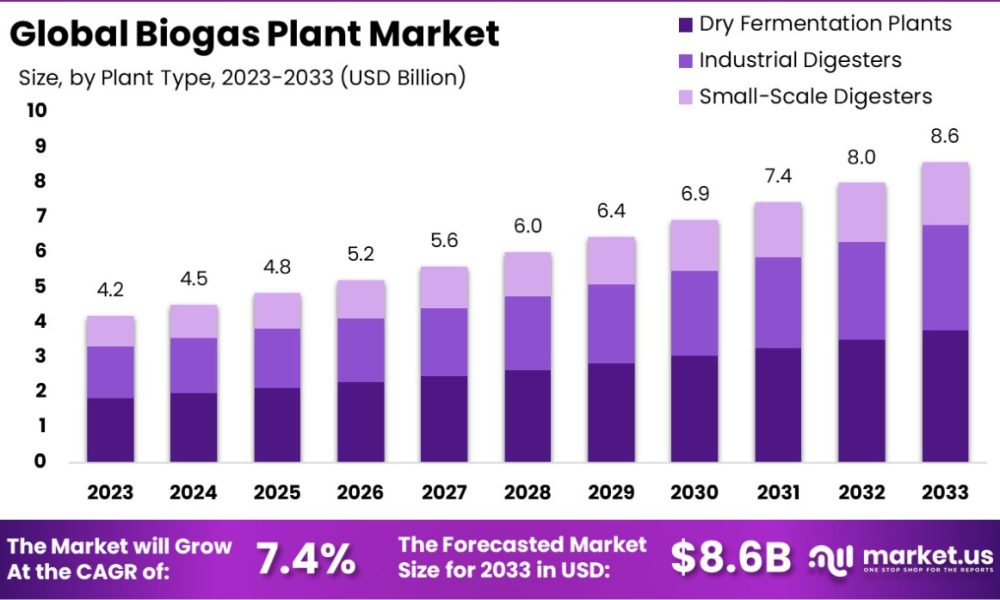
According to market.us, the Global Biogas Plant Market is expected to be worth around USD 8.6 Billion by 2033, up from USD 4.2 billion in 2023, and grow at a CAGR of 7.4% from 2024 to 2033. Europe holds 46.5% of the biogas plant market, worth USD 1.9 billion.
The biogas plant market encompasses the development, manufacturing, and upkeep of facilities that convert organic waste into renewable energy through anaerobic digestion. Growth in this sector is largely propelled by environmental regulations and government incentives aimed at reducing greenhouse gas emissions and promoting clean energy solutions. Industries are increasingly adopting biogas technologies due to their dual benefits of energy production and sustainable waste management, particularly in agriculturally rich regions where organic waste is abundant.
The United States highlights the market’s potential, with over 2,000 active biogas sites already in operation. According to the U.S. Department of Agriculture, an estimated 11,000 additional biogas systems could be developed, potentially powering over 3 million homes. This growth would not only support energy independence but also significantly reduce methane emissions, equivalent to approximately 4 to 54 million metric tons by 2030. Furthermore, existing infrastructure includes more than 630 landfill gas energy projects, which currently contribute over 2,000 MW of installed electricity capacity.
With ongoing technological innovations enhancing system efficiency and biogas yields, along with increasing commercial applications, the biogas plant market is poised for accelerated growth. It plays a pivotal role in addressing global climate goals while advancing circular economy principles and creating green employment opportunities.
Key Takeaways
- The Global Biogas Plant Market is expected to be worth around USD 8.6 Billion by 2033, up from USD 4.2 Billion in 2023, and grow at a CAGR of 7.4% from 2024 to 2033.
- Municipal sources dominate the Biogas Plant Market, contributing 40.8% to the overall market share.
- Dry fermentation plants hold a significant 44.4% share in the Biogas Plant Market by plant type.
- Continuous flow filling is the leading operation mode, accounting for 63.4% of the market.
- Large size biogas plants are predominant, comprising 59.5% of the market by size.
- Electricity generation is a major application of biogas, representing 34.5% of the market.
- The European Biogas Plant Market holds a 46.5% share, valued at USD 1.9 billion.
Access a Complimentary Sample of This Premium Report: https://market.us/report/biogas-plant-market/request-sample/
Factors Affecting the Growth of the Biogas Plant Market
Government Regulations and Policy Support: Environmental policies promoting renewable energy and reducing greenhouse gas emissions significantly influence the expansion of the biogas plant market. Regulatory mandates, subsidies, feed-in tariffs, and waste management policies encourage both public and private sector investment in biogas infrastructure.
Availability of Organic Feedstock: The growth of biogas plants is heavily dependent on the steady supply of biodegradable waste such as agricultural residue, animal manure, food waste, and sewage. Regions with abundant organic waste resources—particularly from agriculture and livestock—tend to experience stronger development in biogas production facilities.
Technological Advancements: Innovations in anaerobic digestion technology, including improvements in system design, gas purification, and energy conversion efficiency, enhance plant performance and reduce operational costs. These advancements make biogas systems more attractive and viable for industrial, agricultural, and municipal applications.
Industrial and Agricultural Integration: The rising demand for energy self-sufficiency and sustainable waste disposal in industries and farms is driving the adoption of biogas plants. Industries benefit from lower energy costs and reduced environmental compliance burdens, while farms utilize biogas as a solution for managing animal waste and generating power on-site.
Public and Private Sector Investment: Increased funding from both public institutions and private investors is essential for infrastructure development, technology deployment, and scaling of biogas projects. Investment appetite often hinges on perceived economic viability, long-term policy stability, and the availability of financial incentives.
Key Market Segmentation
By Source Analysis
In 2023, municipal sources led the biogas plant market by source, contributing 40.8% of the total share, reflecting the significant use of urban organic waste in biogas production. Landfills followed with an 18.5% share, supported by policies targeting landfill waste reduction. Wastewater sources accounted for 14.7%, driven by increased investments in biogas-integrated treatment systems.
The industrial sector contributed 8.6%, as industries gradually adopt renewable energy solutions. Food scrap sources made up 5.3%, backed by regulatory efforts promoting organic waste recycling. The agricultural sector, comprising dairy, poultry, and swine farms, collectively held a 12.1% share, underlining its growing role in sustainable biogas generation.
Agricultural residue had a smaller contribution of 2.7%, indicating untapped potential for future growth. These diverse sources together form the backbone of the biogas plant market’s expansion and its alignment with sustainability goals.
By Plant Type Analysis
In 2023, Dry Fermentation Plants led the biogas plant market by plant type, capturing 44.4% of the total share. Their dominance is attributed to their high efficiency in processing solid organic waste like yard debris and agricultural residues without requiring pre-treatment. Industrial Digesters followed with a 33.9% share, driven by their widespread use in large-scale municipal and industrial waste treatment operations, offering efficient biogas production and energy recovery.
Small-Scale Digesters accounted for 21.7% of the market, reflecting their adoption by farms, households, and SMEs for localized energy generation and waste management. This distribution highlights a strong market preference for both centralized and decentralized biogas solutions.
By Operation Mode Analysis
In 2023, Continuous Flow Filling dominated the biogas plant market by operation mode, accounting for 63.4% of the market share. Its preference stems from its ability to maintain a consistent input of substrate, ensuring steady and efficient biogas production, especially beneficial for large-scale commercial and industrial facilities.
Semi-Batch Filling held the remaining 36.6%, favored in smaller or variable-feedstock operations due to its flexibility in managing different waste types and intermittent loading. Together, these two operation modes reflect the industry’s dual focus on high-volume efficiency and adaptable waste management solutions.
By Size Analysis
In 2023, Large Size Biogas Plants dominated the market by size, capturing 59.5% of the total share. These plants are widely used in industrial and municipal sectors due to their ability to handle high volumes of organic waste and deliver substantial energy output, benefiting from economies of scale and cost efficiency.
Small Size Biogas Plants held a 40.5% share, mainly serving rural areas, small farms, households, and local businesses. They support decentralized energy generation and localized waste management. This size-based segmentation reflects the market’s dual approach—meeting both large-scale energy demands and community-level sustainability goals.
By Application Analysis
In 2023, electricity generation was the leading application in the biogas plant market, accounting for 34.5% of the total share. Its dominance reflects the rising demand for renewable power and the suitability of biogas for efficient electricity production. Vehicle fuel followed with a 21.2% share, driven by its growing use as a cleaner transport alternative.
Heat applications comprised 19.8% of the market, supporting industrial and residential heating needs. Upgraded biogas, refined to natural gas quality, held a 13.7% share, enabling integration into gas networks. Cooking gas accounted for 10.8%, serving as a key energy source in regions focused on local, sustainable energy access.
Key Market Segments
By Source
- Municipal
- Landfills
- Wastewater
- Industrial
- Food Scrape
- Agricultural
- Dairy
- Poultry
- Swine Farm
- Agricultural Residue
By Plant Type
- Dry Fermentation Plants
- Industrial Digesters
- Small-Scale Digesters
By Operation Mode
- Continuous Flow Filling
- Semi-Batch Filling
By Size
- Small Size Biogas Plant
- Large Size Biogas Plant
By Application
- Vehicle fuel
- Electricity
- Heat
- Upgraded Biogas
- Cooking Gas
- Others
Regional Analysis
In the global biogas plant market, Europe leads with a 46.5% share, valued at USD 1.9 billion, driven by strict environmental regulations and strong governmental support for renewable energy. North America, particularly the U.S., is expanding rapidly due to rising investments and emission reduction policies.
The Asia Pacific region is poised for significant growth, especially in China and India, as they address growing energy demands and urban waste challenges. The Middle East & Africa is gradually adopting biogas technologies to utilize agricultural waste, though the market remains in early development. Latin America, led by Brazil’s bioenergy initiatives, shows growth potential but remains less mature than other regions.
Top Key Players in the Market
- Ameresco
- PlanET Biogas Global GmbH
- Scandinavian Biogas
- Biofrigas Sweden AB
- Swedish Biogas International
- EnviTec Biogas AG
- Air Liquide
- Wärtsilä.
- SP Renewable Energy Sources Pvt. Ltd.
- Quadrogen
- Biofuel USA Corporation
- CH4 Biogas
- Beijing Sanyi Green Energy Development Co.
- Agrinz Technologies GmbH
- IES BIOGAS srl
Get in Touch with Us:
Market.us (Powered By Prudour Pvt. Ltd.)
Address: 420 Lexington Avenue, Suite 300 New York City, NY 10170, United States
Send Email: [email protected]
Refer to More Related Reports:



