
Market Overview
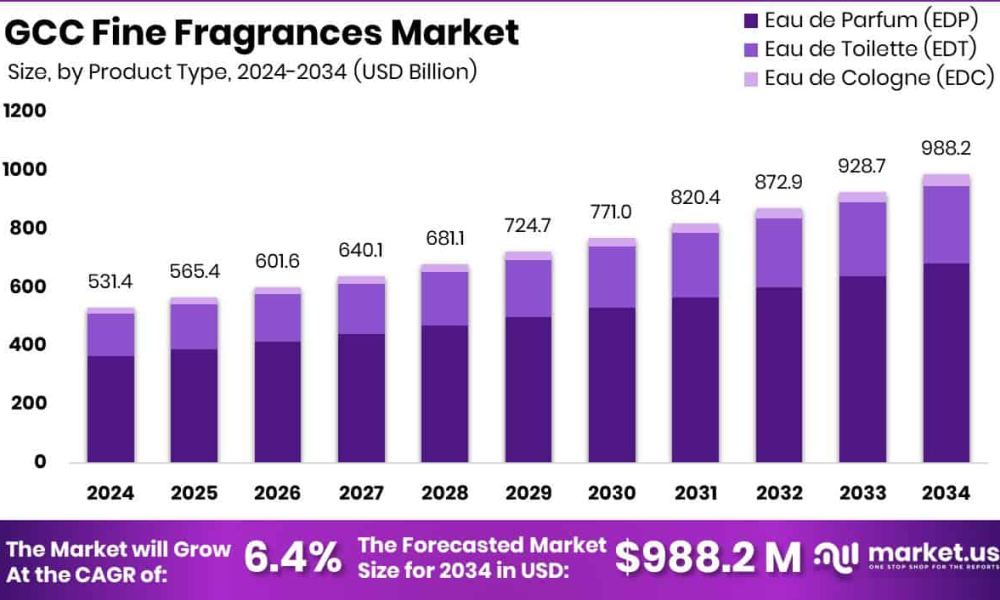
According to market.us, The GCC fine fragrances market is projected to reach approximately USD 988.2 million by 2034, rising from USD 531.4 million in 2024, reflecting a compound annual growth rate (CAGR) of 6.4% between 2025 and 2034. This market comprises premium perfumes and luxury scent-based products specifically tailored to the preferences of consumers in the Gulf Cooperation Council countries, including Saudi Arabia, the United Arab Emirates, Qatar, Kuwait, Bahrain, and Oman. Fine fragrances in this region are deeply embedded in cultural practices and are characterized by rich, long-lasting notes such as oud, amber, and musk—scents that are traditionally favored for personal grooming and ceremonial use.
The sector represents a dynamic and expanding component of the luxury goods industry, supported by a consumer base that prioritizes exclusivity and quality. Growth is largely attributed to increasing disposable incomes, a youthful demographic inclined toward luxury lifestyles, and the cultural importance of fragrances in daily and festive settings. Furthermore, urban development and the rise of high-end retail environments across GCC cities have enhanced the accessibility of premium fragrances, thereby stimulating market demand.
Economic prosperity across the GCC continues to drive higher consumer spending on luxury personal care items, including fine fragrances. The cultural tradition of regular perfume usage further sustains robust consumption patterns. In addition, the region’s strong tourism industry, particularly in major cities and airports, contributes significantly to fragrance sales, especially through duty-free outlets and upscale shopping centers.
Important Revelation
- GCC Fine Fragrances Market is expected to be worth around USD 988.2 Million by 2034, up from USD 531.4 Million in 2024, and grow at a CAGR of 6.4% from 2025 to 2034.
- In the GCC Fine Fragrances Market, Eau de Parfum dominates with a 69.3% share.
- Synthetic ingredients lead the market, capturing a significant 97.5% share across fragrance formulations.
- Deodorants and perfumes contribute the most to demand, accounting for 54.2% of total applications.
- Specialty fragrance stores remain the key retail channel, representing 64.7% of total product distribution.
Download Exclusive Sample Of This Premium Report (Including Full TOC, Table & Figures): https://market.us/report/gcc-fine-fragrances-market/free-sample/
Factors Affecting the Growth of the GCC Fine Fragrances Market
- Rising Disposable Incomes and Economic Diversification: Economic prosperity in the GCC, supported by national strategies to diversify beyond oil-based revenues (such as Saudi Arabia’s Vision 2030 and the UAE’s Centennial Plan 2071), has led to higher disposable incomes. This financial empowerment has increased consumer spending on luxury goods, including fine fragrances, which are viewed as both personal indulgences and social essentials in the region.
- Strong Cultural Affinity for Fragrance: The cultural significance of perfumes in GCC societies remains a foundational growth factor. Fragrances—particularly traditional scents like oud, musk, and amber—are used daily and during religious and social occasions. Perfumes are often layered and reapplied, leading to higher consumption rates compared to global averages. This deep-rooted tradition fuels consistent demand and brand loyalty across generations.
- Youthful Population with a Luxury Mindset: The GCC has a predominantly young population with high purchasing power and a growing inclination towards prestige and designer brands. This demographic segment seeks out premium and niche fragrance products that align with global fashion trends while retaining regional olfactory preferences, driving demand for innovation and exclusivity in the market.
- Urbanization and Retail Infrastructure Expansion: Rapid urban development and the proliferation of luxury retail outlets, including shopping malls, boutique perfume stores, and duty-free zones, have improved accessibility to high-end fragrance brands. Cities like Dubai, Riyadh, and Doha have become fragrance retail hubs, attracting both local consumers and tourists with a wide array of fine fragrance offerings.
- Influence of Tourism and Travel Retail: The GCC is a major global travel destination, and its international airports are some of the busiest in the world. The duty-free fragrance segment has seen robust growth, as tourists and transit passengers often purchase fine perfumes as luxury gifts or personal indulgences. This trend significantly supplements retail sales in the region.
Report Segmentation
By Product Type Analysis: In 2024, Eau de Parfum (EDP) emerged as the leading product type in the GCC fine fragrances market, commanding a dominant 69.3% share. This strong performance reflects the region’s marked preference for high-concentration, long-lasting scent formulations that cater to the demands of both the climate and cultural usage. EDP’s higher oil concentration compared to other variants like Eau de Toilette or cologne aligns with consumer expectations for lasting impact and luxurious appeal.
By Ingredient Analysis: Synthetic ingredients dominated the GCC fine fragrances market by ingredient type in 2024, holding a commanding 97.5% market share. This overwhelming preference stems from the advantages synthetic components offer, including affordability, formulation consistency, and large-scale production capabilities. These attributes are critical in a region where fragrances are widely used in everyday life and demand for reliable, long-lasting products is high. Synthetic ingredients also allow for the recreation of rare or complex scent profiles and ensure product stability, which is particularly valuable in the GCC’s hot and arid climate.
By Application Analysis: Deodorants and perfumes constituted the most significant application segment in the GCC fine fragrances market in 2024, accounting for 54.2% of the total market share. This reflects the strong cultural emphasis on personal grooming and fragrance use in the region, where it is customary to apply scents daily and for special occasions. Deodorants are favored for their practical benefits in combating heat-induced perspiration, while perfumes are cherished for their expressive and luxury appeal. The combined use of both products enhances their dominance in the market, supported by increasing urbanization, a youthful consumer base, and rising awareness of personal care.
By Distribution Channel Analysis: Specialty fragrance stores maintained their leadership in the distribution channel segment of the GCC fine fragrances market in 2024, capturing a significant 64.7% share. These outlets are highly preferred by consumers seeking exclusive fragrances and personalized service experiences. In a market where scent selection is deeply tied to identity and cultural expression, specialty stores stand out by offering curated collections, knowledgeable staff, and immersive retail environments. Their dominance is further cemented by strategic placement in luxury shopping districts and high-end malls across major GCC cities, appealing to both local consumers and international tourists.
Market Key Segmentation
By Product Type
- Eau de Parfum (EDP)
- Eau de Toilette (EDT)
- Eau de Cologne (EDC)
By Ingredient
- Natural
- Synthetic
By Application
- Deodorants and Perfumes
- Soaps and Detergents
- Cosmetics and Personal Care
- Home Care Products
- Others
By Distribution Channel
- Specialty Fragrance Stores
- Online Platforms
- Others
To Purchase this Premium Report@ https://market.us/purchase-report/?report_id=147703
Driving Factors: The growth of the GCC fine fragrances market is primarily fueled by the rising demand for premium personal grooming products. In this region, personal appearance and daily grooming are deeply ingrained cultural priorities, with fragrances playing a central role. As disposable incomes increase across the GCC, more consumers are investing in high-quality perfumes and deodorants. Fragrances are not reserved for special occasions; they are used daily at workplaces, social gatherings, and religious events. The region’s hot climate also heightens the need for long-lasting, luxurious scents, reinforcing the role of fine fragrances as essential items in everyday grooming routines.
Restraining Factors: Despite strong cultural demand, the high price of premium fragrance products poses a significant barrier in the GCC fine fragrances market. Luxury perfumes and deodorants often remain inaccessible to budget-conscious consumers, including younger buyers and migrant workers who make up a considerable portion of the population. Although the region has a long-standing perfume tradition, the cost of fine fragrances limits their reach to affluent segments. This affordability gap may drive some consumers toward cheaper alternatives or even counterfeit products, slightly constraining overall market expansion.
Growth Opportunity: The expanding youth population in the GCC presents a key opportunity for growth in the fine fragrances market. Younger consumers, influenced by global fashion trends and social media, are more open to exploring new scents and establishing personal grooming routines. This demographic is increasingly attracted to signature fragrances that reflect their identity, mood, or lifestyle. With improved access to international and local brands through online platforms and specialty retailers, young buyers are shaping new fragrance preferences and fueling innovation in both product offerings and marketing strategies.
Latest Trends: A notable trend emerging in the GCC fine fragrances market is the rising popularity of gender-neutral perfumes. Younger consumers, in particular, are moving beyond traditional male and female labels in favor of fragrances that align with their individual expression. Unisex scents, often characterized by minimalist packaging and universal notes, appeal to those seeking uniqueness and flexibility. Both regional and global fragrance brands are responding by introducing inclusive product lines that emphasize personal identity over gender categorization, reflecting a broader cultural shift toward diversity and personalization in scent selection.
Competitive Landscape
- LVMH Moët Hennessy Louis Vuitton
- Rasasi
- Kering Holland NV
- Yas Perfumes
- Firmenich SA
- Al-Haramain
- Gulf Flavours & Fragrances
- Zohoor AL Reef Co.
- Bath & Body Works, Inc.
- ALREHAB PERFUMES
- Other
Refer More Related Reports:
Get in Touch with Us:
Market.us (Powered By Prudour Pvt. Ltd.)
Address: 420 Lexington Avenue, Suite 300, New York City, NY 10170, United States.
Contact No: +1 718 874 1545 (International), +91 78878 22626 (Asia).
Email: [email protected]



