
Market Overview
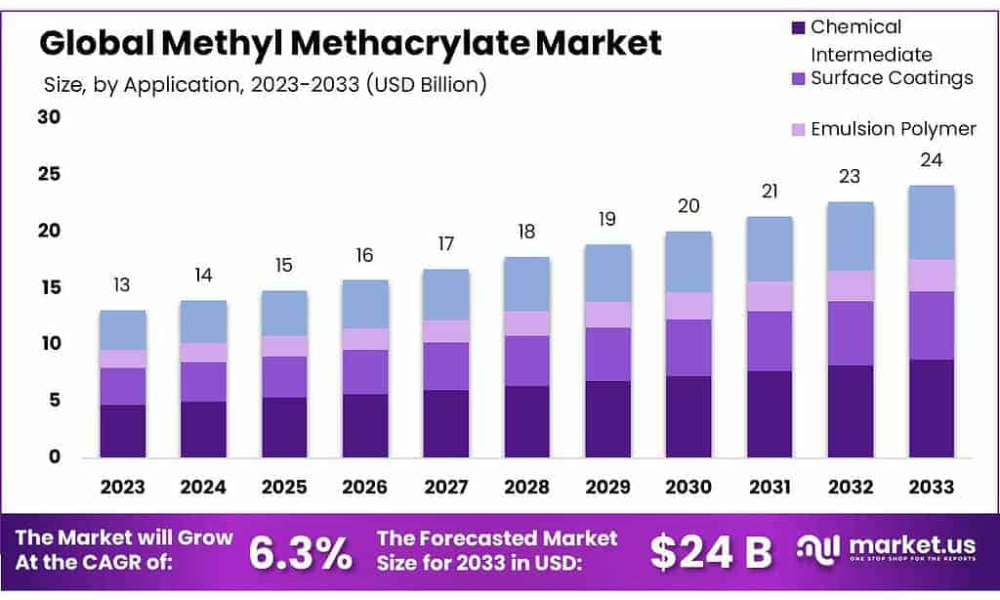
The global Methyl Methacrylate market is projected to grow significantly, with its valuation expected to reach approximately USD 24 billion by 2033, rising from USD 13 billion in 2023. This growth trajectory represents a compound annual growth rate (CAGR) of 6.3% over the forecast period from 2023 to 2033.
MMA, a clear and colorless liquid, serves as a vital raw material in the production of polymethyl methacrylate (PMMA) plastics and resins. These materials are widely valued for their exceptional clarity, strength, and resistance to shattering, making them indispensable across multiple industries. A key driver in this market is the increasing regulatory push and sustainability focus, particularly in Europe. Notably, the European Commission’s MMAtwo project exemplifies this trend, aiming to recycle 27,000 tons of PMMA scrap into 12,250 tons of regenerated MMA each year, promoting circular economy principles and environmental responsibility.
Market expansion is also being fueled by rising demand in the Asia-Pacific region, where urbanization and industrial growth are accelerating the need for MMA. Key players in this region are actively boosting their production capacities through partnerships and facility expansions to better serve the growing market. Additionally, Asia-Pacific countries such as China and South Korea have become central to the global MMA supply chain, not only as leading producers but also as major exporters, leveraging their advanced infrastructure and ample raw material resources.
Important Revelation
- The Methyl Methacrylate (MMA) market is projected to reach a valuation of USD 24 billion by 2033, rising from USD 13 billion in 2023, with a steady compound annual growth rate (CAGR) of 6.3%.
- Acetone currently dominates the raw material segment, accounting for 45.6% of the market share, primarily due to its cost efficient use in production processes such as the acetone cyanohydrin (ACH) method.
- In terms of application, MMA’s use as a chemical intermediate leads the market, representing over 34.5% of total demand. The buildings and construction industry also plays a significant role, holding a 43.3% share, driven by the high durability and visual appeal of PMMA materials in architectural uses.
- When it comes to distribution channels, indirect sales dominate with a 55.3% market share, supported by strong networks of distributors and growing e-commerce channels.
- Geographically, North America stands out as the leading regional market, commanding a 40.6% share, thanks to advanced industrial infrastructure and robust demand across multiple end-use sectors.
Download Exclusive Sample Of This Premium Report (Including Full TOC, Table & Figures):
https://market.us/report/methyl-methacrylate-market/free-sample/
Factors Affecting the Growth of the Methyl Methacrylate Market
1. Demand from End-Use Industries
- Automotive Industry: MMA is widely used in automotive parts due to its durability and lightweight properties. Rising vehicle production, especially electric vehicles, fuels demand.
- Construction Sector: Growing infrastructure and real estate development globally drive demand for MMA-based products like acrylic sheets and adhesives.
- Electronics and Signage: Increased use in LED screens, displays, and signage contributes to market growth, particularly in urban and commercial environments.
2. Advancements in Manufacturing Technologies
- Innovations in MMA production, such as bio-based MMA and energy-efficient catalytic processes, are reducing production costs and environmental impact.
- Adoption of ACH (acetone cyanohydrin) and C4 process with better yield efficiency impacts market dynamics positively.
3. Price Volatility of Raw Materials
- MMA production relies heavily on acetone, methanol, and hydrogen cyanide, whose fluctuating prices due to supply chain disruptions or crude oil variations can impact profit margins and pricing strategies.
4. Environmental and Regulatory Factors
- Stringent regulations on VOC emissions and environmental safety can hinder growth, especially in regions with strict environmental laws (e.g., EU, North America).
- However, shift toward sustainable and bio-based MMA is creating new growth avenues.
5. Regional Economic Growth and Urbanization
- Rapid urbanization and industrialization in Asia-Pacific (China, India, Southeast Asia) are driving demand in the construction and automotive sectors, boosting MMA usage.
- Government investments in infrastructure projects also provide a strong push to the MMA market.
6. Substitution and Competitive Materials
- The presence of alternative materials like polycarbonate, polyethylene, and glass can restrain the growth of MMA applications, especially in cost-sensitive industries.
Report Segmentation
By Feedstock
As of 2023, the Methyl Methacrylate (MMA) market has exhibited diverse preferences across feedstocks, which are integral to the production process.
Acetone emerged as the leading feedstock, commanding over 45.6% of the market share. Its dominance stems from the widespread use of the acetone cyanohydrin (ACH) process, which is both cost-efficient and supported by the broad availability of acetone. This method is particularly prevalent in regions with strong acetone production capabilities, enabling streamlined and economical MMA synthesis.
Ethylene also plays a vital role in MMA production through a method involving more complex chemical reactions. Despite the added complexity, this route is favored for producing high-purity MMA, which is essential in high-performance plastic applications across specialized sectors.
Methanol is another key feedstock, often used within the ACH process as a crucial intermediate. It offers a flexible alternative production route when combined with other chemicals, allowing producers to adapt to raw material availability and price fluctuations.
Isobutylene, while occupying a smaller portion of the feedstock market, is significant in certain facilities where it is available as a byproduct of other chemical operations. The isobutylene process is known for its efficiency and cost advantages in such environments.
By Application
In 2023, MMA was employed across a wide array of applications, each contributing to its diverse industrial use.
Chemical Intermediates led the market, holding over a 34.5% share. This segment involves using MMA in the synthesis of various polymers and copolymers, notably PMMA, which is widely adopted in automotive and construction due to its transparency, strength, and resilience.
Surface Coatings represent another major application area, with MMA used extensively in producing weather-resistant and visually appealing coatings. These coatings are valued for enhancing the aesthetic quality and durability of building exteriors and vehicle surfaces.
Emulsion Polymers benefit from MMA’s ability to improve adhesion and mechanical strength. In this application, MMA is a key component in developing products like adhesives, sealants, and paints, contributing to their performance and lifespan.
By End-Use
The MMA market in 2023 was shaped by robust demand from several key end-use sectors.
Buildings & Construction was the dominant sector, accounting for over 43.3% of the market. MMA, primarily through PMMA, is used in products like windows, lighting covers, and decorative elements due to its weather resistance, strength, and visual clarity. These properties make MMA a top choice for modern architectural applications.
Automotive applications also held significant market share, with MMA integrated into parts such as light diffusers, panels, and trims. The material’s lightweight and impact-resistant characteristics contribute to vehicle durability and improved fuel efficiency aligning with the industry’s sustainability goals.
Electronics continued to drive demand for MMA, particularly for components requiring high optical clarity, such as display panels and protective covers for consumer devices. Rapid innovation and consumer demand in this segment underscore MMA’s value.
Paints & Coatings is another important end-use, leveraging MMA’s weatherability and aesthetic finish in residential, commercial, and industrial applications. Its inclusion enhances both durability and surface appeal.
By Distribution Channel
In 2023, distribution dynamics played a pivotal role in shaping MMA market accessibility and customer reach.
Indirect Sales dominated the distribution landscape with a market share exceeding 55.3%. This approach, involving intermediaries such as distributors and e-commerce platforms, enabled broader penetration across global markets. Indirect channels are particularly effective in reaching smaller businesses and expanding into regions where manufacturers lack a direct presence.
Direct Sales, while smaller in share, remain vital for serving large industrial buyers. Through direct channels, MMA producers build strategic partnerships with automotive OEMs, construction conglomerates, and electronics manufacturers. This model supports high-volume sales, customized service, and streamlined contract management, fostering long-term business relationships.
To Purchase this Premium Report@ https://market.us/purchase-report/?report_id=124053
Market Key Segmentation
By Feedstock
- Acetone
- Ethylene
- Methanol
- Isobutylene
- Others
By Application
- Chemical Intermediate
- Surface Coatings
- Emulsion Polymer
- Others
By End-Use
- Buildings & Construction
- Automotive
- Electronics
- Paints & Coatings
- Others
By Distribution Channel
- Direct Sales
- Indirect Sales
Regional Analysis
North America stands at the forefront, commanding a dominant 40.6% share of the global MMA market, valued at approximately USD 5.3 billion. This leadership is largely attributed to robust demand from the automotive, construction, and electronics sectors, especially in the United States and Canada. The region’s advanced manufacturing infrastructure and commitment to technological innovation continue to fuel market growth.
Europe follows with substantial market activity, driven by the automotive and construction industries in countries such as Germany, France, and the United Kingdom. Europe’s focus on sustainability and the adoption of high-performance materials is fostering consistent growth. Initiatives promoting green building solutions and lightweight automotive components are further accelerating the demand for MMA across the region.
Asia Pacific is witnessing the fastest growth, propelled by expanding automotive, electronics, and construction industries in key economies like China, India, Japan, and South Korea. The region’s large population and rapid urbanization are major factors behind the surging demand for MMA in a wide array of applications from automotive parts to consumer electronics and construction products. Additionally, supportive government policies and infrastructure investments are reinforcing the region’s position as a growing MMA hub.
The Middle East & Africa, though holding a smaller share of the market, demonstrates rising potential. Increasing infrastructure development and construction activities, particularly in the UAE and Saudi Arabia, are fueling regional growth. Large-scale development projects and modernization efforts are laying the foundation for future expansion.
Competitive Landscape
- Arkema
- Asahi Kasei Corporation
- BASF SE
- Dhalop Chemicals
- DuPont Inc
- Evonik industries AG
- Huntsman Corporation
- Kuraray Group
- Kowa India Pvt. Ltd.
- Lucite International
- LG Chem
- Heilongjiang Zhongmeng Longxin Chemical Co., Ltd.
- Monómeros del Vallés S.L.
Get in Touch with Us
Market.us (Powered By Prudour Pvt. Ltd.)
Address: 420 Lexington Avenue, Suite 300 New York City, NY 10170, United States
Send Email: [email protected]
Refer More Related Reports



