
Overview
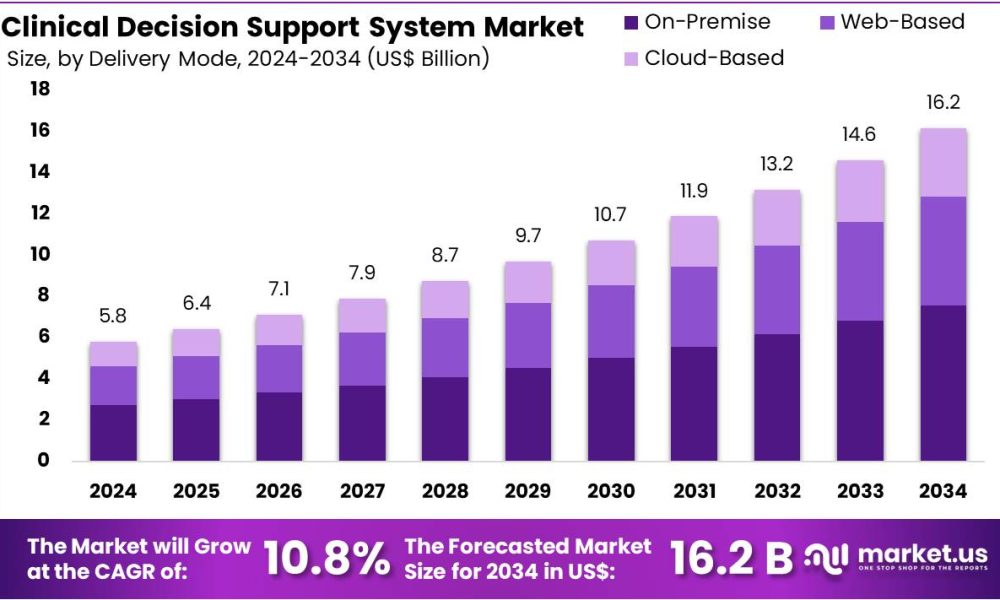
The Clinical Decision Support System market is expected to grow from USD 5.8 billion in 2024 to USD 16.2 billion by 2034, at a CAGR of 10.8%. North America holds a dominant share of 40.3%, valued at USD 2.3 billion in 2024. The growth is driven by the rising use of artificial intelligence and big data analytics in healthcare. These technologies improve the accuracy of clinical decisions, leading to better outcomes. The demand for data-driven tools in diagnostics and treatment planning is steadily increasing.
Digitization in healthcare is fueling CDSS adoption. The integration of electronic health records (EHRs) allows for seamless data sharing. This improves the efficiency of CDSS in clinical workflows. For example, in December 2022, researchers at Dell Medical School introduced an AI-based CDSS that gives personalized dietary guidance. The system supports real-time discussions between patients and providers. It uses medical data to create customized nutritional plans. Such innovations are enhancing the value of CDSS in preventive care and personalized treatment strategies.
The growing burden of chronic diseases is further boosting demand for Clinical Decision Support System Market. These systems help manage conditions like diabetes and cardiovascular disorders more effectively. CDSS tools offer real-time alerts on drug interactions and potential contraindications. They assist physicians in making accurate decisions. As telemedicine expands, remote providers are using CDSS to ensure evidence-based care. This is crucial for improving patient safety and reducing medical errors. Cloud-based systems allow easy access to clinical data, even in remote or rural healthcare settings.
Technological innovations are key drivers in the CDSS market. In May 2022, Epocrates launched a CDSS tool for long COVID-19, aligned with current clinical guidelines. Such tools reduce clinical errors and support faster diagnosis. Automation also minimizes repetitive tasks, easing physician workload. Improved interoperability between EHRs and CDSS platforms is streamlining patient management. These developments help in selecting the best treatment based on individual profiles. AI-based tools are being adopted widely to support complex clinical decisions.
Government initiatives and regulatory support are creating growth opportunities for CDSS solutions. Cloud-based and interoperable platforms are encouraging cross-institution collaboration. The emphasis on cost-effective care is pushing adoption in hospitals. CDSS is now being applied across specialties like oncology, radiology, and critical care. As healthcare systems move toward precision medicine, CDSS platforms are evolving to meet demand. The market is poised for strong, long-term growth, supported by a focus on data-driven healthcare and standardized clinical practices.
Key Takeaways
- In 2024, the Clinical Decision Support System (CDSS) market generated US$ 5.8 billion in revenue and is forecasted to reach US$ 16.2 billion by 2034.
- The market is growing at a robust CAGR of 10.8%, driven by rising digitalization in healthcare and demand for data-driven clinical decisions.
- Standalone CDSS solutions led the product type segment in 2024, capturing a 40.7% market share due to their focused diagnostic capabilities.
- Among delivery modes, on-premise systems dominated with a 46.8% market share, reflecting continued preference for secure, in-house clinical infrastructure.
- Drug allergy alerts emerged as the leading application area, contributing 38.5% of total market revenue in 2024 due to high patient safety needs.
- Hospitals and clinics represented the top end-user group, holding 53.4% market share, driven by widespread EHR and CDSS integration in clinical workflows.
- Regionally, North America maintained market dominance with a 40.3% share in 2024, supported by advanced healthcare infrastructure and regulatory support.
Get Sample: https://market.us/report/global-clinical-decision-support-system-market/request-sample/
Segmentation Analysis
The standalone Clinical Decision Support System (CDSS) segment led the market in 2024 with a 40.7% share. These systems are widely used in smaller healthcare settings that do not have integrated Electronic Health Record (EHR) or Computerized Physician Order Entry (CPOE) systems. Their cost-effective and easy-to-deploy nature drives adoption. As the demand for tools that enhance clinical decision-making grows, standalone CDSS offers a reliable solution. Its simplicity, affordability, and ability to reduce medical errors make it appealing to non-hospital providers aiming to improve care quality.
The on-premise delivery mode captured a 46.8% market share in 2024. Healthcare organizations prefer on-premise systems due to the high level of data control they offer. These systems support strict regulatory compliance and ensure enhanced data security. On-premise CDSS also provides better system performance and fast response times, which are essential in high-stakes medical settings. As institutions prioritize customized solutions and invest in robust infrastructure, the on-premise deployment model is likely to see steady growth in the coming years.
The application segment was dominated by drug allergy alerts, accounting for 38.5% of revenue in 2024. This growth is driven by the rising complexity of drug regimens and the need to prevent adverse drug reactions. With more medications being prescribed, the risk of allergic reactions increases. CDSS solutions that feature drug allergy alerts help identify these risks early, supporting safer clinical decisions. Their integration into high-risk settings such as hospitals improves patient safety, enhances care outcomes, and supports regulatory compliance initiatives.
Hospitals and clinics accounted for 53.4% of the end-user segment’s revenue share in 2024. These facilities are the primary users of CDSS due to their central role in patient care. They rely on such systems to streamline clinical workflows and manage growing patient loads. CDSS provides real-time decision support, which is crucial in complex medical cases. As hospitals aim for better care coordination and safety, investments in CDSS solutions are increasing. This trend is expected to drive further adoption and growth in this segment.
Conclusion
In conclusion, the Clinical Decision Support System market is expected to grow steadily due to rising digital transformation in healthcare. The increasing use of artificial intelligence and electronic health records is making CDSS more effective and widely accepted. These systems help improve patient safety, reduce medical errors, and support clinical decisions. Hospitals, clinics, and remote healthcare providers are adopting CDSS to deliver accurate and timely care. Strong government support, along with ongoing innovations, is encouraging adoption across different medical specialties. As healthcare moves toward personalized and value-based care, CDSS will play a key role in improving outcomes and streamlining clinical workflows. The market outlook remains strong and positive.
Get in Touch with Us:
Market.us (Powered By Prudour Pvt. Ltd.)
Address: 420 Lexington Avenue, Suite 300, New York City, NY 10170, United States.
Contact No: +1 718 874 1545 (International), +91 78878 22626 (Asia).
Email: [email protected]
View More



