
Overview
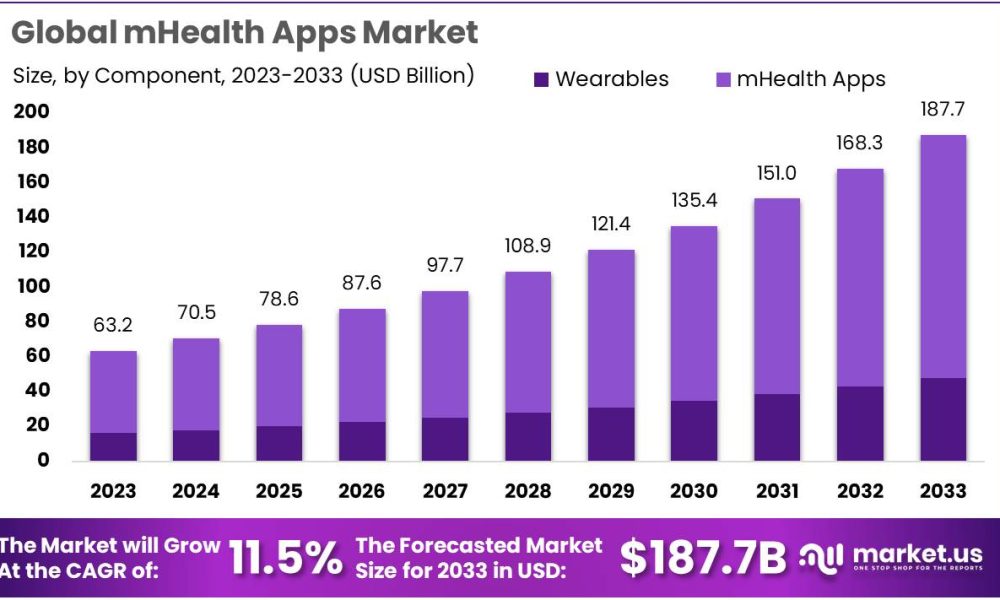
The Global mHealth Market is projected to reach approximately USD 187.7 billion by 2033, rising from USD 63.2 billion in 2023. This growth reflects a compound annual growth rate (CAGR) of 11.5% from 2024 to 2033. Mobile health, or mHealth, uses mobile phones and wireless technology to deliver healthcare services. It plays a critical role in public health education, disease surveillance, and chronic illness management. Its rapid adoption is especially notable in regions with limited healthcare access but high mobile phone usage, promoting efficient and inclusive health solutions.
MHealth’s key appeal lies in its convenience and accessibility. It enables individuals to monitor their health continuously without frequent hospital visits. Mobile apps support functions like symptom tracking, medication reminders, and fitness management. The integration of some mHealth applications with electronic health records allows healthcare providers and patients to share data in real time. This leads to improved coordination between patients and professionals, making care delivery more efficient and timely. The convenience factor is central to the rising popularity of these digital tools.
Despite its benefits, the mHealth sector faces notable challenges. Privacy and data security are growing concerns, as many apps do not comply with regulatory standards. Inaccurate health information is another issue, which may cause users to rely on apps instead of professional medical advice. This could result in delayed treatment or mismanagement of health conditions. As the market expands, stronger regulations and quality standards will be essential to ensure user safety and trust in digital health platforms.
Several drivers are supporting the growth of the mHealth market. The global rise in smartphone adoption is a major factor, as mobile apps rely on these devices for service delivery. With mobile connectivity increasing, a broader population now has access to healthcare tools and resources. This has enhanced healthcare equity, particularly in underserved communities. The proliferation of affordable smartphones and internet services continues to create opportunities for digital health platforms to expand and scale across various regions.
Another growth driver is the increasing interest in personal health and wellness. Users are actively seeking ways to improve their fitness, nutrition, and mental well-being. MHealth apps cater to this demand by offering personalized insights and real-time feedback. Additionally, remote monitoring technologies are helping healthcare professionals manage patient conditions more efficiently. These solutions reduce the need for in-person consultations and hospital stays. Together, these trends position mHealth as a critical element of modern, accessible, and data-driven healthcare systems.
Key Takeaways
- The mHealth market is projected to grow at a CAGR of 11.5%, reaching US$ 187.7 billion by 2032 from US$ 63.2 billion in 2023.
- mHealth apps dominated the landscape in 2023, accounting for 74.4% of the total market share and driving healthcare digitalization.
- Monitoring services held over 62.4% of the market, offering real-time tracking and management of patient health conditions.
- Mobile operators captured the leading 47.2% market share, followed by device vendors, content developers, and healthcare providers.
- Widespread smartphone adoption significantly boosted mHealth usage by enhancing access to digital healthcare services.
- Data security concerns and regulatory compliance requirements remain major restraints to widespread adoption of mHealth solutions.
- North America led the global mHealth market with a 36.8% revenue share in 2023, driven by advanced digital health infrastructure.
- Major market players include AT&T, Telefonica S.A., Google Inc., Apple Inc., and other prominent technology and telecom firms.
Get Sample: https://market.us/report/mhealth-market/
Regional Analysis
North America held the largest revenue share in the global mHealth market, accounting for 36.8% in 2023. The growth in this region is attributed to several factors, including high healthcare spending, a rising geriatric population, and a well-established digital infrastructure. The increasing prevalence of chronic diseases such as diabetes and cardiovascular conditions also supports the demand for mHealth solutions. Moreover, the region benefits from widespread access to smartphones and internet connectivity, enabling effective delivery of digital health services.
The growing use of mobile healthcare applications and supportive government initiatives are further boosting mHealth adoption in North America. Real-time health monitoring, particularly for cardiovascular conditions, is gaining popularity. These apps help track vital signs, reduce the risk of severe events like cardiac arrest, and improve disease management. With continuous development in health IT systems, regional healthcare providers are integrating mobile technologies to enhance remote care services and reduce hospital visits.
In Asia Pacific, the mHealth market is witnessing rapid growth due to rising smartphone penetration and expanding mobile subscriber base. According to GSMA’s The Mobile Economy 2020 report, unique mobile subscribers in the region are projected to exceed 3 billion by 2025, up from 2.8 billion in 2019. This significant rise in mobile usage supports the adoption of mobile health technologies across rural and urban areas.
The market expansion in emerging economies like India and China is also supported by government-led initiatives to modernize healthcare delivery. National digital health missions, electronic health record systems, and mobile health outreach programs are facilitating digital transformation. These developments are expected to drive mHealth deployment, enhance care accessibility, and improve health outcomes across underserved populations in the region.
Segmentation Analysis
In 2023, mHealth Apps dominated the component segment with a commanding 74.4% market share. These apps transformed healthcare delivery by offering personalized digital tools. Medical Apps enabled users to monitor their health proactively. Women’s Health Apps addressed reproductive and general health needs. Personal Health Record Apps allowed for efficient data management. Additionally, Medication Management Apps improved adherence to prescribed treatments. Disease Management and Diagnostic Apps provided targeted support and early assessments, respectively. The wide range of functionality led to increased adoption of mHealth Apps globally, enhancing individual health management.
Within the services segment, monitoring services held a leading position, accounting for over 62.4% market share in 2023. These services allowed real-time tracking of vital signs, supporting both patients and providers. Independent aging solutions also gained traction, helping elderly individuals maintain autonomy while staying connected to care systems. Chronic disease management services ensured effective long-term condition tracking. Post-acute care and diagnostic services also saw growth. Their convenience and timely intervention capabilities contributed significantly to the overall utility and expansion of the mHealth service segment.
Participant analysis showed Mobile Operators held 47.2% of the mHealth market in 2023. Their expansive networks enabled broad access to digital health services. Device Vendors advanced the sector with innovative tools, tailored to mHealth needs. Their smart designs attracted users and expanded market scope. Content Players enriched platforms with health content, boosting user awareness and engagement. Healthcare Providers offered virtual consultations and remote monitoring. Their digital presence bridged gaps in care delivery. This multi-participant collaboration fostered steady mHealth market growth, supporting improved global healthcare accessibility and outcomes.
Component
- Wearables
- BP Monitors
- Glucose Meters
- Pulse Oximeters
- Sleep Apnea Monitors (PSG)
- Neurological Monitors
- Activity Trackers/ Actigraphs
- mHealth Apps
- Medical Apps
- Women’s Health
- Personal Health Record Apps
- Medication Management Apps
- Disease Management Apps
- Diagnostic Apps
- Remote Monitoring Apps
- Others
- Fitness Apps
- Exercise & Fitness
- Diet & Nutrition
- Lifestyle & Stress
- Medical Apps
Service
- Monitoring Services
- Independent Aging Solutions
- Chronic Disease Management & Post-acute Care Services
- Diagnosis Services
- Healthcare Systems Strengthening Services
- Others
Participants
- Mobile Operators
- Device Vendors
- Content Players
- Healthcare Providers
Key Players Analysis
The mHealth market is experiencing intense competition driven by the rising demand for advanced mobile health platforms. This surge in interest is prompting established companies to enhance their offerings. Increased mergers and acquisitions among top players are consolidating market power while allowing new entrants to capture emerging opportunities. As healthcare applications become more widely adopted, startups and innovative firms are entering the field, aiming to establish a strong presence. This competitive atmosphere is reshaping the industry and creating fertile ground for digital transformation in healthcare delivery.
Key market players are actively investing in research and development to strengthen their mobile health app portfolios. These initiatives are enhancing app functionalities, ensuring compliance with health standards, and improving user engagement. Established companies such as AT&T, Telefonica S.A., and Google Inc. are leading the way in integrating wireless technology with healthcare services. Their strategies focus on scalable platforms and interoperability. This trend reflects a shift toward personalized care and real-time health monitoring solutions that meet the needs of an increasingly tech-savvy population.
Other prominent players in the mHealth ecosystem include SoftServe, Airstrip Technologies Inc., Samsung Electronics Co Ltd., Allscripts Healthcare Solutions, and Apple Inc. These companies are developing user-friendly digital tools that improve health outcomes while ensuring data security. Their active participation is fostering innovation and competition in the sector. The growing popularity of mobile health solutions is expected to enhance access to care, reduce costs, and empower patients. As the market evolves, collaboration between established companies and emerging players will further accelerate growth and adoption.
Conclusion
The mHealth market is growing quickly due to rising smartphone use and demand for digital healthcare. Mobile apps and monitoring tools are helping people manage their health more easily. This is especially important in areas with limited access to hospitals and clinics. While privacy and data security are ongoing challenges, many companies are improving their products to meet health standards. Support from governments and strong digital infrastructure are also pushing the market forward. As more people use mobile health apps, the focus will shift to better user experiences, secure platforms, and wider coverage. mHealth is expected to play a key role in making healthcare more accessible, personal, and efficient worldwide.
Get in Touch with Us:
Market.us (Powered By Prudour Pvt. Ltd.)
Address: 420 Lexington Avenue, Suite 300, New York City, NY 10170, United States.
Contact No: +1 718 874 1545 (International), +91 78878 22626 (Asia).
Email: [email protected]
View More
Healthcare Business Intelligence Market
Healthcare Cybersecurity Market



