
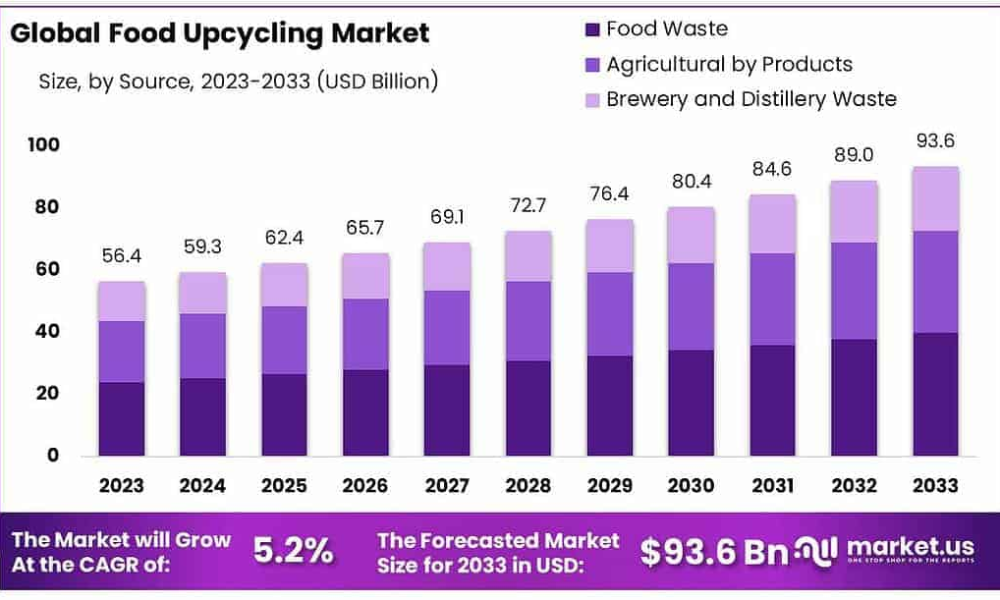
New York, NY – July 03, 2025 – The Global Food Upcycling Market is witnessing robust expansion, with its market size projected to rise from USD 56.4 billion in 2023 to approximately USD 93.6 billion by 2033, reflecting a compound annual growth rate (CAGR) of 5.2 % during the 2024–2033 forecast period. Demand is being driven by heightened consumer awareness toward sustainability, food waste reduction, and nutrition, supported by evolving regulatory frameworks and industry investment.
Market popularity has surged as food manufacturers and retailers increasingly adopt upcycling methods, transforming byproducts such as spent grains, pulp, and surplus produce into value‑added, fiber‑rich, or protein‑enhanced products. Growth factors include technological innovation in processing, rising raw material costs prompting alternative sourcing, and shifts toward circular economy models.
Opportunities abound in plant‑based and clean‑label segments, digital and offline distribution expansion, and strategic partnerships that broaden geographic reach and scale production. Market expansion is further propelled by the greater incorporation of upcycled ingredients in mainstream snacks, beverages, bakery goods, and pet foods. In summary, the Food Upcycling Market is advancing rapidly on the basis of sustainability trends, nutritional appeal, evolving consumer preferences, and favourable regulatory and investment climates, solidifying its position as a growth‑oriented segment within the global food industry.
Important Revelation
- The global food upcycling market will grow from USD 56.4 billion in 2023 to USD 93.6 billion by 2033, with a 5.2% CAGR.
- Food Waste holds over 42.6% market share, processing leftovers into animal feed, compost, or bioenergy.
- Food Processing dominates with a 40.3% market share, meeting the demand for sustainable food ingredients.
- North America leads with a 38.4% market share valued at USD 21.65 billion, driven by strong consumer demand for sustainability.
➤ Download Exclusive Sample Of This Premium Report (Including Full TOC, Table & Figures): https://market.us/report/food-upcycling-market/request-sample/
Report Segmentation
By Source
- In 2023, the Food Waste segment led the global food upcycling market, accounting for over 42.6% of the total share. This category comprises discarded food from households, restaurants, and food service facilities, often repurposed into animal feed, compost, or renewable energy. Growing environmental concerns, particularly about landfill overuse and greenhouse gas emissions, are pushing both consumers and businesses to adopt food waste reduction measures, significantly driving this segment’s growth.
- Agricultural By-products also held a strong position, involving the upcycling of farming residues such as stalks, husks, and leaves. These materials are increasingly being transformed into commercial products, including bio-based packaging and natural ingredients. Enhanced processing technologies have made it more viable to extract value from agricultural remnants, promoting their wider market acceptance.
By Application
- Food Processing emerged as the leading application area in 2023, securing over 40.3% of the market share. The increasing shift towards ethical sourcing and waste reduction has encouraged food manufacturers to repurpose by-products into high-value ingredients. This approach not only reduces waste volumes but also enhances supply chain sustainability.
- Beverage Processing is another key application segment, utilizing nutrient-rich food waste and by-products to formulate innovative drinks. These unique ingredients, often derived from fruits and vegetables, allow beverage brands to differentiate themselves through sustainability-driven product development.
Market Key Segmentation
By Source
- Food Waste
- Agricultural by Products
- Brewery and Distillery Waste
By Application
- Food Processing
- Beverage Processing
- Cosmetics & Personal Care
- Dietary Supplements & Nutraceuticals
- Animal Feed
- Others
Regional Analysis
North America led the global food upcycling market in 2023, holding a dominant 38.4% share valued at approximately USD 21.65 billion. The region’s leadership is driven by growing consumer preference for sustainable food systems and active investment in waste reduction technologies. The United States, in particular, has shown strong governmental and private sector support, emphasizing innovation in food reuse and circular production practices.
The market’s momentum in North America is further supported by a well-established food processing industry and high public awareness around environmental issues, fostering widespread adoption of upcycled products. Europe stands as the second-largest regional market, with countries like Germany and France implementing rigorous environmental regulations that promote the upcycling market across the food supply chain. This region benefits from a consumer base that prioritizes eco-friendly choices and supports producers adopting green initiatives. The growing availability and popularity of upcycled food products in European retail further indicate a market steadily transitioning toward circular and sustainable models.
Factors Affecting the Growth of the Food Upcycling Market
- Consumer Sustainability Awareness: Growing public concern about environmental impact and food waste drives demand for upcycled products. Consumers seek environmentally responsible food choices, encouraging brands to introduce upcycled options. This awareness fosters a shift toward circular economy practices, ensuring sustainable sourcing and product innovation become a strategic priority for food companies.
- Regulatory and Policy Support: Government regulations and sustainability frameworks promote food waste reduction and resource efficiency. Incentives, grants, and favorable policies motivate producers to adopt food upcycling market practices. Clear guidelines help ensure product safety and labeling standards, enabling broader market acceptance and easier entry for new upcycled offerings under official quality controls.
- Technological Innovation and Infrastructure: Advances in processing technologies—such as fermentation, dehydration, and extraction—have enhanced the ability to convert food waste into valuable ingredients. Improved infrastructure and specialized equipment support consistent production at scale. These technical developments reduce costs, improve yield, and increase product quality, making upcycling commercially viable for manufacturers.
- Supply Chain and Sourcing Challenges: Securing a steady and cost‑effective supply of raw materials from food waste streams remains a challenge. Food waste is often fragmented and dispersed, increasing logistics complexity. Establishing reliable collection, storage, and transportation systems is essential to support continuous production and control costs across the food upcycling market supply chain.
- Consumer Acceptance and Taste Preferences: Consumer willingness to purchase upcycled products is influenced by perceptions of quality, taste, and safety. Clear, consumer‑friendly product definitions and attractive branding are required to overcome skepticism. Sensory qualities must meet expectations; otherwise, taste differences could limit market penetration. Education and marketing are essential to build trust and drive adoption.
Competitive Landscape
- ReGrained Inc.
- Toast Ale LLC
- RISE Products, Inc.
- Misfit Foods, Inc.
- US Foods Holding Corp.
- Agricycle Global, Inc.
- Pulp Pantry, Inc.
- SUPERFRAU LLC
- Blue Circle Foods, LLC
- Riff Cold Brewed LLC
- Barnana Inc.
- Planetarians Inc.
Get in Touch with Us:
Market.us (Powered By Prudour Pvt. Ltd.)
Address: 420 Lexington Avenue, Suite 300, New York City, NY 10170, United States
Send Email: [email protected]
Refer More Related Reports:
Dishwasher Detergent Market
Tetramethyl Bisphenol F Market
Cis-4-Hydroxy-L-Proline Market



