
Overview
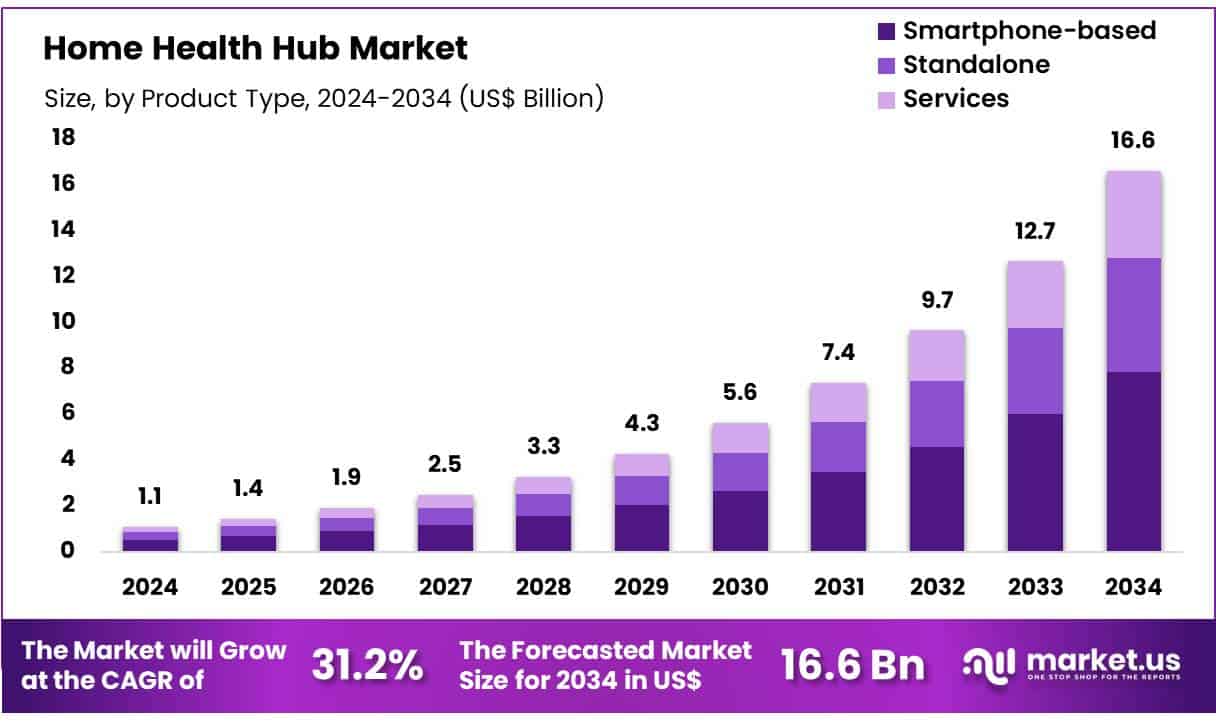
Global Home Health Hub Market size is expected to be worth around US$ 16.6 Billion by 2034 from US$ 1.1 Billion in 2024, growing at a CAGR of 31.2% during the forecast period 2025 to 2034. In 2024, North America led the market, achieving over 39.5% share with a revenue of US$ 0.4 Billion.
The adoption of Home Health Hub (HHH) solutions is reshaping the landscape of remote patient monitoring, enabling continuous, real-time healthcare delivery from the comfort of a patient’s home. These platforms serve as centralized systems that integrate data from various health monitoring devices—such as blood pressure monitors, glucometers, pulse oximeters, and wearable sensors and transmit critical health data directly to healthcare providers for timely intervention.
The global shift toward value-based care, along with the growing elderly population and the rising burden of chronic diseases, is accelerating the deployment of HHH solutions across developed and emerging healthcare markets. Home Health Hubs enhance chronic disease management, reduce hospital readmission rates, and promote personalized care.
According to recent data from the U.S. Centers for Medicare & Medicaid Services (CMS), over 70 million Americans are expected to be 65 or older by 2030, increasing the need for decentralized care models. Home Health Hubs address this demand by offering cost-effective, scalable platforms compatible with Electronic Health Records (EHRs) and telehealth systems.
With regulatory support and growing demand for home-based care, HHH solutions are becoming a cornerstone of digital health strategies. Healthcare providers, payers, and technology developers are investing in these hubs to improve outcomes and optimize healthcare resources.
Click here to get a Sample report copy @ https://market.us/report/home-health-hub-market/free-sample/
Key Takeaways
- In 2024, the global Home Health Hub market was valued at approximately US$ 1.1 billion, and it is projected to reach US$ 16.6 billion by 2034, expanding at a robust compound annual growth rate (CAGR) of 31.2% during the forecast period.
- By product type, the market is segmented into smartphone-based, standalone, and services. Among these, smartphone-based hubs emerged as the leading category in 2023, accounting for 47.3% of the total market share, driven by increasing smartphone penetration and digital health engagement.
- Based on patient monitoring acuity, the market is classified into high-acuity, moderate-acuity, and low-acuity segments. In this category, high-acuity monitoring solutions dominated with a share of 42.8%, reflecting the growing need for advanced remote monitoring in critical care patients.
- In terms of end users, the Home Health Hub market is divided into hospitals, home care agencies, and healthcare payers. Among these, hospitals held the largest revenue share of 53.6%, indicating widespread institutional adoption of remote patient monitoring technologies.
- Regionally, North America led the global market in 2023, capturing a 39.5% share, supported by advanced healthcare infrastructure, strong regulatory frameworks, and rising demand for home-based chronic disease management.
Segmentation Analysis
- Product Type Analysis: The smartphone-based segment accounted for 47.3% of the market share, driven by widespread smartphone adoption and a growing preference for mobile health tools. These hubs offer easy integration with health apps and wearable devices, enabling real-time monitoring and virtual consultations. Their affordability, convenience, and user-friendly interfaces are attracting a broad user base. Advancements in mobile technology and connectivity further enhance their reliability, encouraging adoption in both personal health management and clinical remote monitoring applications.
- Patient Monitoring Type Analysis: High-acuity monitoring captured a 42.8% share, reflecting the increasing need to manage critically ill or complex patients at home. These solutions offer advanced features such as multi-parameter tracking, early warning alerts, and seamless integration with telehealth platforms. The rising prevalence of chronic diseases, especially among the elderly, supports strong demand for precise, continuous monitoring. Healthcare providers prioritize reducing readmissions and improving patient safety, thereby accelerating investment in high-acuity systems for home-based intensive care.
- End User Analysis: Hospitals led the end-user segment with a revenue share of 53.6%, highlighting their critical role in integrating home-based care with inpatient services. These institutions increasingly adopt home health hubs for post-discharge monitoring, reducing hospital stays and enhancing continuity of care. The shift toward value-based care and cost containment fuels adoption of remote solutions. Additionally, hospitals possess the clinical expertise and digital infrastructure needed to manage patient data effectively, supporting better outcomes and personalized treatment strategies.
Market Segments
By Product Type
- Smartphone-Based
- Standalone
- Services
By Patient Monitoring Type
- High-Acuity
- Moderate-Acuity
- Low-Acuity
By End User
- Hospitals
- Home Care Agencies
- Healthcare Payers
To Purchase this Premium Report @ https://market.us/purchase-report/?report_id=149792
Regional Analysis
North America Leads the Home Health Hub Market
North America held the largest market share of 39.5% in 2023, driven by rising adoption of remote patient monitoring and a strong preference for aging in place. According to the U.S. Census Bureau, the growing elderly population is increasingly opting for home-based care. Supportive policies from the Centers for Medicare & Medicaid Services (CMS), along with widespread availability of connected medical devices, are advancing home health hub integration. These solutions enhance chronic disease management and reduce hospital dependency, strengthening market penetration.
Asia Pacific Expected to Register the Fastest Growth
The Asia Pacific region is projected to record the highest CAGR during the forecast period, supported by a rapidly aging population and growing demand for accessible home healthcare. Countries such as Japan are experiencing demographic shifts, boosting the need for independent living and remote health monitoring solutions. Increased telehealth adoption and rising use of smart home technologies are further driving growth. Additionally, government-led initiatives to expand healthcare access and affordability are contributing to the accelerated uptake of home health hub systems in the region.
Key Players Analysis
Key players in the home health hub market are accelerating growth by incorporating advanced technologies such as artificial intelligence (AI), machine learning, and cloud computing into their platforms. A major focus is placed on enhancing interoperability to support seamless data exchange across healthcare systems.
Strategic alliances, mergers, and acquisitions are being leveraged to broaden product portfolios and strengthen global presence. Emphasis on intuitive user interfaces and mobile accessibility is improving engagement among patients and caregivers. Continuous investment in research and development enables these companies to remain competitive in a rapidly evolving digital health environment.
Philips Healthcare, a division of Koninklijke Philips N.V., stands out as a prominent leader in the home health hub market. The company is renowned for its expertise in diagnostic imaging, patient monitoring, and health informatics. Philips delivers integrated solutions that connect patients, providers, and caregivers, facilitating coordinated care and enhanced clinical outcomes.
With a strong commitment to innovation and quality, Philips Healthcare continues to drive advancements in remote patient monitoring and home-based care, solidifying its position as a trusted partner in digital health transformation.
Market Key Players
- Vivify Health, Inc
- Qualcomm Technologies, Inc
- Koninklijke Philips
- Inhealthcare
- iHealth Lab
- Honeywell International
- Capsule Technologies Inc
- AMC Health
Market Dynamics
- Market Driver: The primary driver of the Home Health Hub market is the rising prevalence of chronic diseases and the growing elderly population worldwide. These demographic shifts increase the demand for continuous, home-based monitoring solutions that reduce hospital visits and improve care efficiency. Healthcare systems are prioritizing cost-effective care models, and Home Health Hubs offer real-time data sharing and remote monitoring capabilities, aligning with value-based care strategies and reducing pressure on traditional healthcare infrastructure.
- Market Trend: A notable trend shaping the Home Health Hub market is the integration of artificial intelligence (AI) and cloud computing. These technologies enable predictive analytics, automated alerts, and real-time data processing for personalized care delivery. Additionally, interoperability advancements are fostering seamless data exchange across electronic health records (EHRs), telehealth platforms, and wearable devices. This trend supports smarter clinical decision-making and enhances patient engagement, reflecting the industry’s shift toward intelligent, connected, and patient-centric home healthcare ecosystems.
- Market Opportunity: An emerging opportunity lies in expanding access to home health hub solutions across low- and middle-income countries. As digital infrastructure improves and telehealth policies evolve, demand for affordable, scalable remote monitoring systems is rising. Governments and private players are increasingly investing in digital health initiatives to extend care access to underserved populations. This creates a significant growth potential for manufacturers to introduce cost-effective, mobile-enabled Home Health Hubs tailored to diverse regional healthcare needs.
Conclusion
The Home Health Hub market is poised for substantial growth, driven by aging populations, rising chronic disease prevalence, and the global shift toward value-based, patient-centric care. Technological integration particularly AI, cloud computing, and interoperability continues to enhance the functionality and reach of these platforms.
With hospitals leading adoption and smartphone-based hubs gaining traction, the market shows strong momentum across developed and emerging regions. Strategic investments, favorable government policies, and increasing telehealth acceptance position Home Health Hubs as a core component of future healthcare delivery, offering scalable, cost-effective solutions for real-time, home-based patient monitoring and chronic disease management.
View More Reports:
Electrophysiology Market Set for 15.2% CAGR Through 2034
Radiology Information Systems Market To Reach USD 3.6 Billion By 2034
Radiology Information Systems Market To Reach USD 3.6 Billion By 2034
Generative AI in Pharmaceutical Market to Reach US$ 40.88 Billion by 2034
Generative AI in Pharmaceutical Market to Reach US$ 40.88 Billion by 2034



