
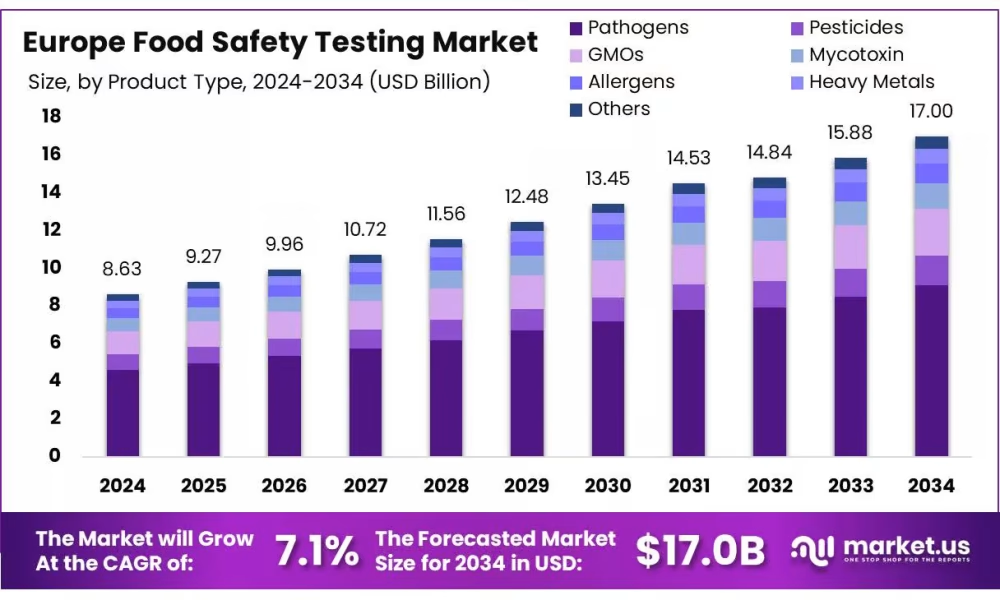
According to Market.us, Europe food safety testing market is projected to reach approximately USD 17.00 billion by 2033, rising from USD 8.63 billion in 2023. This growth reflects a compound annual growth rate (CAGR) of 7.1% during the forecast period from 2024 to 2033.
Government support for food safety testing in Europe has been substantial and sustained. Between 2014 and 2020, the European Union allocated a maximum budget of €1.89 billion under Regulation (EU) No 652/2014 for food chain, animal, and plant health programmes. This funding included €376.7 million dedicated to official controls and €140 million for emergency measures in animal and plant health, demonstrating a strategic focus on both proactive and reactive safety mechanisms
Looking ahead, under the 2021–2027 Multiannual Financial Framework, the EU has earmarked €1.68 billion through the Single Market Programme specifically for food safety measures. These funds are aimed at improving official controls, supporting EU reference laboratories, and financing surveillance, prevention, and crisis‑management activities for plant and animal health. Over the past decade, more than €3.3 billion has been spent by the EU on food safety initiatives, including €2.2 billion committed to dedicated programmes, reinforcing the EU’s sustained investment in systemic food safety infrastructure.
These public investments underpin a harmonized and risk‑based food safety testing system across Europe, supporting reference laboratories, official control frameworks, and emergency response capabilities. The funding levels reflect a rigorous, coordinated approach to protecting consumer health and maintaining high standards in food testing across member states.
Key Takeaways
- The Europe food safety testing market was valued at US$ 8.63 Bn in 2024.
- The Europe food safety testing market is projected to reach US$17.0 Bn by 2034.
- Among types of food safety testing, the pathogens type held the majority of the revenue share at 6%.
- Based on technology, traditional accounting accounted for the largest market share with 5%.
- Among food tested, meat & poultry, seafood accounted for the majority of the food safety testing market share with 0%.
- Among countries, Germany held the major market share of 22.6%.
Download Exclusive Sample Of This Premium Report (Including Full TOC, Table & Figures): https://market.us/report/europe-food-safety-testing-market/request-sample/
Factors Affecting the Growth of the Europe Food Safety Testing Market
Stringent EU Food Safety Regulations: The European Union maintains one of the world’s most rigorous food safety frameworks, including the General Food Law Regulation (EC) No 178/2002. Mandatory compliance with Hazard Analysis and Critical Control Points (HACCP) systems, along with strict maximum residue levels (MRLs), continues to drive demand for robust testing infrastructure.
Increased Government Surveillance and Monitoring Programs: National and EU-wide agencies such as EFSA and the European Commission regularly conduct food control programs targeting contaminants, pathogens, and labeling accuracy. These surveillance efforts have intensified following recent foodborne illness outbreaks and are accelerating the need for routine testing by producers and regulators.
Rise in Food Imports and Cross-Border Trade: With the expansion of intra-European and international food trade, there is heightened scrutiny on food products entering the EU. Import inspections and certification checks require extensive testing for microbial and chemical hazards, reinforcing the importance of standardized testing mechanisms.
Public Health Concerns and Consumer Awareness: Increased awareness of foodborne diseases and allergens among European consumers is prompting food producers to invest in preventive testing solutions. Concerns over antibiotic residues, GMOs, and allergens have further boosted testing across processed and fresh food segments.
Technological Advancements in Testing Methods: The adoption of rapid testing technologies such as PCR, biosensors, and immunoassays has improved accuracy and speed. These innovations are being encouraged through EU research funding programs under Horizon Europe, supporting the modernization of laboratory testing capacities.
Key Market Segmentation
Product Type Analysis
In 2024, the European food safety testing market was led by the pathogens segment, which accounted for 53.6% of the total revenue share. This dominance is attributed to heightened public health concerns over foodborne illnesses caused by pathogens such as Salmonella, E. coli, Listeria, and Campylobacter. These organisms are responsible for thousands of illness cases and hospitalizations annually across Europe.
Strict EU regulations—such as the EU Food Law and guidelines from the European Food Safety Authority (EFSA)—require routine testing for pathogens in food products. This regulatory enforcement, along with growing consumer awareness and the rising complexity of global food trade, has significantly boosted demand for microbiological testing. Detecting pathogens is essential not only for compliance but also for protecting consumer health and minimizing the risk of product recalls.
Technology Analysis
In 2024, traditional testing technologies held the leading position in the European food safety testing market, accounting for 54.5% of the total market share. This dominance is primarily due to the cost-effectiveness, accessibility, and proven reliability of traditional methods such as culture-based techniques and biochemical assays.
Traditional testing remains widely adopted despite the growth of advanced technologies like PCR and immunoassays. Its continued use is supported by minimal equipment requirements, making it suitable for laboratories with limited resources, especially in developing areas. Furthermore, regulatory bodies favor traditional methods due to their long-standing validation, reinforcing their application across food, pharmaceutical, and environmental sectors for routine quality control and compliance.
Food Tested Analysis
In 2024, meat and poultry emerged as the leading segment in Europe’s food safety testing market, capturing a 33.0% share. This dominance is driven by the high risk of contamination in these products, particularly from pathogens like Salmonella, E. coli, Listeria, and Campylobacter.
Due to their perishable nature, meat and poultry require intensive microbiological testing and strict quality control. Increased meat consumption, along with concerns over antibiotic residues, hormones, and adulteration, has further fueled the need for safety testing. The European Union’s regulatory frameworks, including EC Regulation 178/2002 and the RASFF system, mandate rigorous testing protocols, ensuring continuous monitoring and reinforcing the segment’s leading market position.
Key Market Segments
By Type
- Pathogens
- Salmonella
- coli
- Campylobacter
- Listeria
- Others
- Pesticides
- GMOs
- Mycotoxin
- Allergens
- Heavy Metals
- Others
By Technology
- Traditional
- Rapid
- Polymerase Chain Reaction (PCR)
- Convenience-based
- Immunoassay
- Chromatography & Spectrometry
- Others
By Food Tested
- Meat & Poultry, Seafood
- Dairy & Dairy product
- Cereals, Grains, & Pulses
- Fruits & Vegetable
- Processed Food
- Others
Geopolitical Impact Analysis
Geopolitical dynamics significantly influence the landscape of food safety testing across Europe. With rising global trade tensions, especially between major exporting and importing nations, European food authorities have strengthened border inspection protocols to ensure imported food products meet EU safety standards. Political uncertainty surrounding Brexit, for example, resulted in disruptions in regulatory alignment between the UK and EU, prompting separate testing and certification frameworks, which increased demand for local testing capacity in both regions.
Moreover, the Russia-Ukraine conflict has affected the supply chain of key agricultural commodities such as grains and fertilizers, leading to greater scrutiny over food quality and contamination risks. Imports from Eastern European countries are subject to more stringent testing for pesticide residues and heavy metals due to changing agricultural practices under constrained conditions.
Additionally, geopolitical sanctions and trade restrictions have caused Europe to diversify its import sources, requiring new compliance and safety validation for food from unfamiliar territories. This has expanded the scope of testing required at EU ports and border control posts.
Food fraud and biosecurity concerns are also heightened during geopolitical instability, compelling regulatory bodies like the European Commission and national food safety agencies to intensify surveillance and rapid alert mechanisms. This environment has increased reliance on verified testing infrastructure to ensure food safety, traceability, and compliance with evolving legal and political conditions.
Market Key Players
- Thermo Fisher Scientific Inc.
- SGS S.A.
- Eurofins Scientific
- Bureau Veritas
- Intertek Group plc
- TÜV SÜD
- Bio-Rad Laboratories, Inc.
- DNV GL
- ALS Limited
- Neogen Corporation
- NSF International
- Merieux Nutrisciences
- UL LLC
- Fera Science Ltd.
- Romer Labs Division Holding
- Other Key Players
Get in Touch with Us:
Market.us (Powered By Prudour Pvt. Ltd.)
Address: 420 Lexington Avenue, Suite 300 New York City, NY 10170, United States
Send Email: [email protected]



