

Solar Encapsulation Market Size, Share and Trend Analysis Report : Global Opportunity Analysis and Industry Forecast 2021-2030
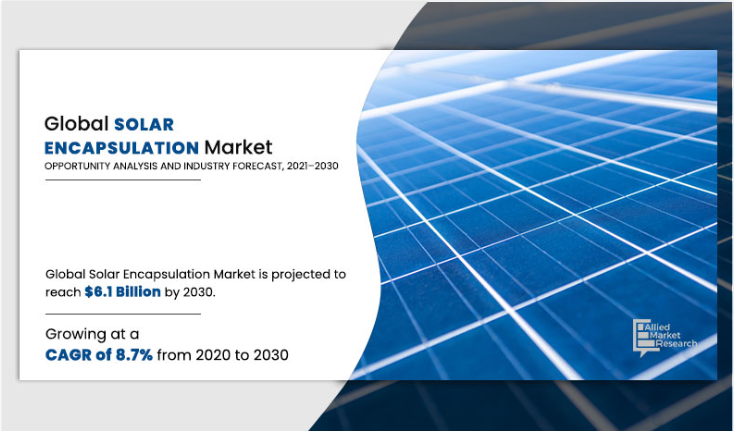
According to a new report published by Allied Market Research, The solar encapsulation market size was valued at $2.6 billion in 2020, and is projected to reach $6.1 billion by 2030, growing at a CAGR of 8.7% from 2021 to 2030.
Solar encapsulation is a critical process in the manufacturing of photovoltaic (PV) solar panels. It involves enclosing solar cells in protective materials to enhance durability, efficiency, and longevity. This process is essential to ensure that solar panels can withstand environmental conditions while maintaining their performance over time.
Download PDF Brochure: https://www.alliedmarketresearch.com/request-sample/422
Asia-Pacific dominated the global solar encapsulation market in 2020, and is projected to remain the fastest-growing segment during the forecast period. This is attributed to numerous factors such as a large consumer base and industrialization & urbanization.
The key players operating and profiled in the global solar encapsulation market report include 3M Company, AKCOME, STR Holding Inc., Bridgestone Corporation, DNP solar, Dow Inc., Dupont De Nemours Inc., First Solar, Hangzhou First PV Material Co. Ltd., and JGP Energy
The development of PV storage systems is essential to increase the ability of PV systems to replace the existing conventional sources. With rise in demand for PV installations, the adoption of storage grid is projected to increase, which fuels the demand for solar encapsulation and may act as the major driving factor for the solar encapsulation market.
According to technology, it is fragmented into polycrystalline silicon solar, cadmium telluride, copper indium gallium selenide, and amorphous silicon. As per the application, it is classified into construction, electronics, automotive, and others.
Encapsulation on solar photovoltaic (PV) modules includes insulation and protection, which alters the device performance as a function of wavelength of incoming light.
In addition, PV technology has evolved as the major renewable power resource in the worldwide green energy sector to meet the future challenge of energy needs.
Importance of Encapsulation
- Protection: Encapsulation safeguards solar cells from environmental damage, such as moisture ingress and physical impacts, which can lead to cell degradation or failure.
- Durability: Proper encapsulation enhances the mechanical strength of solar panels, allowing them to withstand extreme weather conditions, including hail, wind, and snow loads.
- Longevity: By preventing damage and maintaining the integrity of the solar cells, encapsulation contributes to the overall lifespan of solar panels, often extending beyond 25 years.
- Efficiency: A well-encapsulated solar panel maintains its efficiency by minimizing performance losses due to environmental stressors.
Depending on material, ethylene vinyl acetate segment holds the largest market share in 2020.
- Ethylene-Vinyl Acetate (EVA): The most common encapsulation material, EVA provides excellent transparency, flexibility, and adhesion properties.
- Polyvinyl Butyral (PVB): Sometimes used in lieu of EVA, PVB offers good adhesion and moisture resistance but is less common for solar applications.
- Thermoplastic Polyolefin (TPO): An emerging material that offers good durability and UV resistance, though still under research for long-term performance.
As per the technology, the polycrystalline silicon solar segment accounted for the largest solar encapsulation market share in 2020.
By application, the construction segment accounted for the largest market share in 2020.
Encapsulation Process
- Preparation: Solar cells are arranged on a glass substrate, and the encapsulating material is applied.
- Lamination: The assembly is placed in a lamination chamber, where heat and pressure are applied to bond the encapsulant to the cells and glass.
- Cooling and Cutting: After lamination, the panels are cooled and cut to the desired dimensions for final assembly.
Region wise, Asia-Pacific accounted for the largest solar encapsulation market share in 2020.
Buy This Report (392 Pages PDF with Insights, Charts, Tables, and Figures): https://bit.ly/3ZwBF73
COVID-19 impact on the market
The manufacturing of solar encapsulation was halted for a specific period due to high peak of COVID-19 situation, which impacted the sales of solar encapsulation.
COVID-19 impacted almost all industries by hindering various industrial operations and disrupting the supply chain. Maximum companies halted their operation due to less workforce. However, there is a sluggish decline in the global solar encapsulation market due to impact of COVID-19.
Sales of solar encapsulation is directly proportional to the demand for solar panels. Solar projects has been negatively impacted amid the lockdown imposed due to the COVID-19 outbreak and recorded a huge decline in solar encapsulation.
The COVID-19 pandemic negatively impacted the integrated construction industry. Factors include disruption due to migration of workers and unavailability of material. However, decrease in construction activity significantly impacted solar encapsulation market.
Future Trends
- Advanced Materials: Research is ongoing into new encapsulation materials that offer better durability, transparency, and environmental resistance.
- Recyclable Encapsulation: Innovations in recyclable materials aim to enhance sustainability and reduce waste in the solar industry.
- Quality Control: Improved manufacturing processes and quality control measures are being developed to ensure the reliability of encapsulated solar panels.
Conclusion
Solar encapsulation is a vital component in the production of durable and efficient solar panels. By protecting solar cells from environmental stressors, encapsulation enhances the longevity and performance of photovoltaic systems. As technology advances, ongoing improvements in encapsulation materials and processes will continue to play a crucial role in the growth of the solar energy industry.
Other Trending Reports:-
About Us:
Allied Market Research (AMR) is a market research and business-consulting firm of Allied Analytics LLP, based in Portland, Oregon. AMR offers market research reports, business solutions, consulting services, and insights on markets across 11 industry verticals. Adopting extensive research methodologies, AMR is instrumental in helping its clients to make strategic business decisions and achieve sustainable growth in their market domains. We are equipped with skilled analysts and experts and have a wide experience of working with many Fortune 500 companies and small & medium enterprises.
Pawan Kumar, the CEO of Allied Market Research, is leading the organization toward providing high-quality data and insights. We are in professional corporate relations with various companies. This helps us dig out market data that helps us generate accurate research data tables and confirm utmost accuracy in our market forecasting. Every data company in the domain is concerned. Our secondary data procurement methodology includes deep presented in the reports published by us is extracted through primary interviews with top officials from leading online and offline research and discussion with knowledgeable professionals and analysts in the industry.




