

Perovskite Solar Cell Market Overview
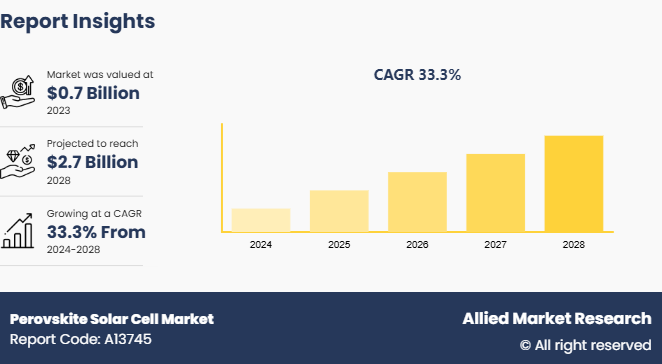
According to a new report published by Allied Market Research, the perovskite solar cell market size was valued at $0.7 billion in 2023, and is projected to reach $2.7 billion by 2028, growing at a CAGR of 33.3% from 2024 to 2028.
What is a Perovskite Solar Cell?
Perovskite solar cells (PSCs) are a type of photovoltaic cell that utilizes perovskite-structured materials to convert sunlight into electricity. The term “perovskite” refers to the crystal structure of the light-absorbing material used in these solar cells, which is typically a hybrid organic-inorganic lead or tin halide-based material.
Download PDF Brochure: https://www.alliedmarketresearch.com/request-sample/A13745
The rapid growth of solar PV capacity in the Asia-Pacific region, combined with surge in energy demand, urbanization, and industrialization, is a significant driving factor for the adoption of perovskite solar cell market.
Countries such as China, Japan, and India are leading the charge in renewable energy investments, providing substantial support through policies, subsidies, and research funding.
The major players operating in the perovskite solar cell industry report include Oxford Photovoltaics, Front Materials Co. Ltd., Xiamen Weihua Solar Co. Ltd., Saule Technologies, Hanwha Group, Toshiba Corporation, Panasonic Holdings Corporation, LONGi, SKY ENERGY INDONESIA, and Phono Solar Technology Co., Ltd.
The global emphasis on clean and renewable energy sources has accelerated the adoption of technologies that reduce carbon footprints without compromising performance.
Lightweight and flexible panels are gaining favor for both residential and commercial projects, as they are easier to install, more adaptable to different surfaces, and reduce the overall cost of installation.
The unique properties of perovskite materials, which include tunable bandgaps and ease of production through less energy-intensive processes, further add to their appeal.
Structure and Composition
- Perovskite Material: Named after the mineral with a similar crystal structure, these cells typically use a hybrid organic-inorganic lead or tin halide-based material (e.g., methylammonium lead iodide).
- Layered Design: They consist of multiple layers, including a perovskite light-absorbing layer, electron transport layer, and hole transport layer.
Innovation and commercialization efforts in the perovskite sector continue to gain traction, with a focus on overcoming challenges such as durability and long-term stability to unlock their full market potential.
The integration of perovskite solar cells into building materials presents a transformative opportunity for the solar energy market that offers immense potential to revolutionize how energy is generated and consumed in urban environments.
Perovskite cells’ lightweight, flexible, and customizable properties make them ideal for incorporation into building-integrated photovoltaics (BIPV), where energy-generating materials replace conventional construction elements such as windows, facades, and rooftops.
Perovskite solar cells are produced at relatively low temperatures using simpler manufacturing processes such as roll-to-roll printing, further enabling large-scale and cost-effective integration into building materials.
This manufacturing flexibility provides the opportunity to economically produce vast surfaces of energy-generating material, supporting the growth of smart cities and energy-independent infrastructure.
Increase in demand for lightweight and flexible solar panels has significantly driven demand and investment in perovskite solar cells.
Perovskite cells offer an impressive combination of efficiency, flexibility, and cost-effectiveness that makes them a preferable solution for a wide range of innovative applications.
Their ability to maintain high energy conversion rates while being lighter and thinner than their silicon counterparts allows for greater versatility in deployment.
This includes portable solar devices, flexible electronics, building-integrated photovoltaics (BIPV), and even applications in electric vehicles and drones.
Advantages
- High Efficiency: Perovskite solar cells have achieved efficiencies exceeding 25% in laboratory settings, rivaling traditional silicon solar cells.
- Low Production Costs: They can be manufactured using simpler processes like solution processing, which can lower production costs compared to silicon cells.
- Flexibility: Perovskite cells can be made on flexible substrates, allowing for a variety of applications, including lightweight and portable solar panels.
Procure This Report (380 Pages PDF with Insights, Charts, Tables, and Figures): https://bit.ly/3Bal965
This versatility makes perovskite solar cells ideal for locations and products where traditional, rigid solar panels are not suitable due to weight or form-factor constraints.
On the basis of structure, the perovskite solar cell market is bifurcated into planar perovskite solar cells and mesoporous perovskite solar cells. By product, the market is divided into rigid perovskite solar cells and flexible perovskite solar cells.
On the basis of method, the perovskite solar cell market is categorized into solution method, vapor-deposition method and vapor-assisted solution method. By end use, the market is segmented into aerospace, industrial automation, consumer electronics, energy, and others.
Applications
- Building-Integrated Photovoltaics (BIPV): Due to their flexibility and aesthetic potential, perovskite solar cells are ideal for integration into building materials.
- Portable Devices: Their lightweight and efficient design makes them suitable for portable charging solutions.




