
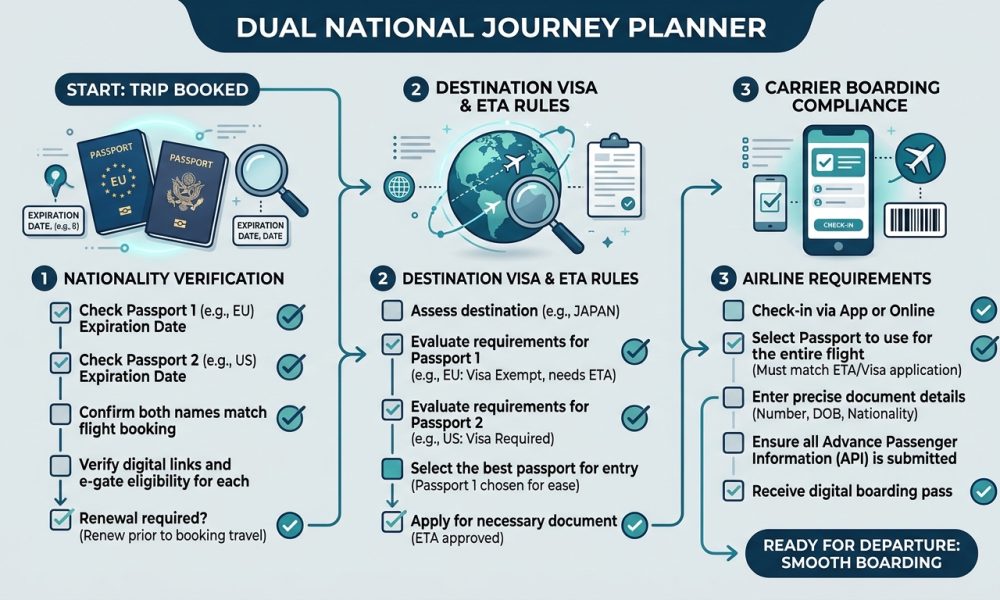
Travel preparation should reflect every nationality held, the destination’s entry rules, passport validity, transit requirements, and airline documentation checks, because holding two valid passports does not mean either document can substitute for the other throughout an international itinerary.
WASHINGTON, DC, November 4, 2026 — International travelers with two or more citizenships are discovering that the flexibility of additional passports comes with a practical responsibility: understanding which government documents to present at each stage of an overseas journey.
A traveler may need one passport to meet a country’s departure requirements and another to demonstrate nationality at the destination. At the same time, airlines must independently confirm that the passenger has valid permission to travel.
For American dual nationals, these distinctions can affect ordinary vacations, business trips, family reunification, emergency travel, and overseas relocation, especially when travelers assume that holding multiple valid passports automatically lets them choose either document without restrictions.
Two Passports Do Not Create One Universal Travel Permission
Dual nationality creates legal relationships with more than one country. Still, each government determines how its citizens establish identity, enter national territory, and comply with domestic requirements that apply when traveling internationally.
A passport can prove nationality and support access under visa-waiver arrangements. However, short-term visitor privileges do not necessarily grant permission to work, settle permanently, or disregard immigration conditions imposed by another country.
The practical question is which passport shows the status needed at each border, rather than which booklet offers the most advertised visa-free destinations or seems most convenient to carry, especially when different governments require different documentary evidence.
United States Citizens Must Use American Passports at Home
The U.S. Department of State’s guidance on dual nationality states that American citizens, including children who hold another nationality, must enter and depart the United States using a valid United States passport, even if the traveler also holds a valid foreign passport or lives overseas.
An American who also possesses Canadian, Irish, or British citizenship cannot substitute that foreign passport to apply for a United States visitor visa or electronic travel authorization, because American nationality remains legally relevant despite the additional citizenship.
Families should consequently keep United States passports current even when another nationality provides more favorable arrangements for particular destinations, especially if a traveler lives abroad and expects to return to America unexpectedly, including journeys involving several borders and multiple airlines.
The United Kingdom Illustrates a Different Passport Problem
A Reuters report published February 24, 2026, on Britain’s travel authorization enforcement described stricter airline checks beginning February 25 for qualifying visitors who need electronic permission before arriving in the United Kingdom, particularly when the documents held were issued years earlier.
British citizens, including British dual nationals, are ineligible for the electronic travel authorization, meaning they ordinarily need a valid British passport, a recognized Irish passport, or acceptable evidence of right of abode associated with another passport.
The rule can surprise British-American travelers accustomed to using only an American passport, because a foreign document may establish identity without showing the British citizenship status required to satisfy carrier checks under the current framework.
Carrier Requirements Can Matter Before Border Officers Decide
Airlines and other transport providers routinely examine passports and relevant travel permissions before allowing passengers to board, creating a separate operational stage before any government immigration officer reviews an individual’s claim at arrival.
A passenger may have a lawful right to enter the destination but still face difficulties if the carrier cannot verify that right through documents or electronic records accepted under the destination’s boarding requirements.
Travelers should therefore confirm airline procedures and government guidance together, rather than assuming that explaining their nationality at an airport counter will necessarily overcome missing paperwork or a mismatch in electronic travel authorization records during departure checks.
Entry and Departure Can Require Different Documents
A dual citizen traveling between the United States and another country of nationality may appropriately use the American passport for American border requirements and the other country’s passport where that government requires citizens to identify themselves as nationals.
That arrangement is not inherently contradictory because each passport documents an existing legal relationship, and relevant national authorities can apply their own entry and exit requirements to citizens under domestic law, regardless of which passport appears on an airline booking.
However, travelers should keep booking records and carrier information consistent with applicable rules, and be ready to present both valid passports when necessary to establish lawful admission and onward transportation eligibility, especially where one country mandates use of its own passport.
Transit Countries Add Another Layer of Documentation
An international itinerary involving a connecting airport can introduce immigration conditions that differ from those of either the departure country or the final destination, particularly when baggage collection or terminal changes require entering the transit country.
Airside transit exemptions, transit visas, electronic authorizations, and passport validity standards can depend on nationality, airport, route, and whether the passenger must clear immigration before boarding the next flight, rather than one uniform global rule.
The best passport for the destination may therefore differ from the document needed for the connection, making a route-by-route review more reliable than assuming one nationality removes every intermediate requirement, especially on complex itineraries.
Visa-Free Access Is Not Permission to Settle Abroad
Passport rankings highlight destinations accessible without obtaining conventional visitor visas beforehand. Still, these arrangements usually allow only limited purposes and durations, not unrestricted employment, residence, or commercial activity, regardless of how many national passports a visitor holds.
A dual national entering a third country as a tourist may still need separate authorization to work or establish long-term residence, even when another passport simplifies initial travel, because the intended activities determine the appropriate immigration status.
For travelers considering relocation, understanding the difference between entry permission and residence rights helps prevent costly mistakes involving housing commitments, professional plans, and family moves based on insufficient immigration authorization, regardless of how many nationalities they hold.
Passport Validity Requirements Can Restrict Available Routes
Travelers should review each passport’s expiration date independently, because some countries require several months of remaining validity beyond intended arrival or departure, even when the booklet has not yet expired, including for nonrefundable travel bookings.
The appropriate validity period depends on destination rules, nationality, visa category, and transit arrangements, so treating six months as a universal requirement can be as misleading as assuming expiration never matters before the printed date.
If one passport is nearing expiration, the other may serve as an alternative only if the traveler can lawfully use it at every relevant stage, including departure from countries that require citizens to use domestic passports.
Renewals Can Temporarily Reduce Travel Flexibility
Maintaining two nationalities creates two sets of renewal schedules, application requirements, and government processing procedures, making it especially important to check document readiness before committing to costly international travel or emergency contingency plans, especially if another country imposes longer passport validity requirements.
Some renewal services invalidate an existing passport during processing. In contrast, others require physical submission of the booklet, which can leave the holder unable to rely on that document until a replacement is issued.
Families should avoid synchronizing important renewals immediately before travel when official guidance advises otherwise. They should confirm whether the alternative passport can legitimately cover the planned itinerary without creating additional entry problems, particularly when international trips have already been scheduled months ahead.
Personal Names Must Remain Traceable Across Records
Changes following marriage, divorce, adoption, or a lawful court order can result in passports showing different names, and travelers may need authentic supporting records to explain those differences to transport providers or immigration authorities.
Using a passport with a former name does not erase a person’s identity history or authorize inconsistent disclosures, particularly when airline reservations, residence permits, and government records must match the relevant travel documents.
A coordinated approach to official updates can reduce preventable mismatches, especially when multiple countries have different procedures for recognizing a name change and replacing passports or associated digital permissions, while allowing adequate time for government processing and overseas delivery.
Children Require Their Own Nationality and Consent Review
A child may hold citizenship through one or both parents without having previously received every passport to which the child is entitled, making documentation preparation distinct from simply establishing biological or legal parentage.
Parents should verify the child’s status under each relevant nationality law, obtain the appropriate travel documents, and review requirements for custody orders, consent, and accompanying adults when international travel involves minors, particularly when consular procedures require additional civil records.
Because children’s passport validity and application rules can differ from adult procedures, a family itinerary may be disrupted even when both parents possess valid documents and have traveled internationally without difficulty, especially where the family is traveling on short notice.
Digital Authorizations Usually Follow a Specific Passport
Electronic visitor permissions are commonly linked to the passport details provided during the application, so a replacement passport may require updating the authorization or submitting a new request before the next journey, especially after a document is renewed or replaced.
A traveler holding multiple nationalities should identify which passport was used for an authorization and avoid assuming approval connected to one nationality automatically transfers to a different passport or document number, especially after renewal changes the underlying document number.
Keeping confirmation records accessible helps, but the key issue remains whether official electronic systems recognize the authorization linked to the travel document presented to the carrier, rather than assuming it based on a previous trip.
Passport Chips Verify Data, Not Every Immigration Right
Modern biometric passports contain electronic information and cryptographic protections that compatible readers can examine. Still, successful technical authentication does not confirm that every visa, residence status, or other travel permission is current, especially when automated airline checks depend on exact passport details.
Amicus International Consulting explains the distinction in its guide to scanning a passport’s NFC chip and interpreting the results, separating reading stored information from assessing electronic signatures and broader administrative validity, even when a booklet is physically intact.
An authentic passport may still be expired, canceled, or linked to an unresolved immigration issue, showing why travelers must verify official document status independently of a smartphone app’s technical results, even if the scan succeeds
Consular Protection Can Be Limited for Dual Nationals
A country may treat its dual citizen primarily as a domestic national while that person is present within its territory, potentially limiting the ability of another country’s diplomatic representatives to intervene or provide consular access.
Military registration, exit restrictions, and other legal duties may also apply under the country of additional nationality, making it important to research local obligations before travel rather than considering only tourist entry convenience.
Another passport can provide significant rights, but it does not cancel the responsibilities that accompany nationality or guarantee access to foreign consular assistance when domestic authorities apply their own laws, especially when a country treats the individual as its own citizen.
Lost Passports Call for Official Replacement Procedures
When a passport is lost or stolen, the holder should follow the issuing country’s reporting and replacement instructions, because a document reported missing may remain unsuitable for travel even after recovery.
Emergency travel documents can offer a limited solution in particular circumstances. Still, their validity and acceptance may differ from ordinary passports, especially when a traveler must transit through additional countries, even if they have another valid nationality document.
Dual nationals should therefore keep secure records of their document particulars and know the appropriate consular contacts, while understanding that photocopies are not normally substitutes for valid travel credentials, including routes involving several carriers and transit countries.
Family Relocation Needs More Than Correct Border Documents
A family planning permanent relocation must consider each member’s citizenship or residence status alongside housing, employment, schooling, healthcare, financial resources, and legal requirements imposed by the prospective destination, before committing to costly housing or education arrangements.
One parent may have unrestricted rights through nationality. At the same time, a spouse or adult child needs separate immigration permission, making the household’s travel readiness more complicated than the principal applicant’s passport eligibility, especially when dependents must obtain separate official approvals.
Coordinate documentation with realistic settlement planning, because boarding a flight does not automatically grant access to employment, public services, or long-term accommodation in another country, especially when the family expects a permanent rather than temporary move.
A Journey-Specific Checklist Preserves Practical Flexibility
Before booking a trip, dual nationals should identify each country of citizenship, review the passports required for departure and arrival, examine transit rules, and confirm any applicable carrier documentation or electronic permission requirements, especially when international travel involves several separate stages.
The same review should cover expiration dates, personal name consistency, family documents, and the treatment of children, with special attention to recent regulatory changes that might affect previously familiar itineraries.
Maintaining this information does not guarantee admission to every foreign country. Still, it can reduce avoidable disruption and help ensure that the additional nationality delivers the lawful flexibility for which it was obtained.
Two Nationalities Require Coordinated Travel Decisions
The central advantage of dual citizenship is additional legal relationships and potential residence rights. Still, those advantages work best when each journey reflects the requirements of the countries involved.
Ultimately, dual nationals need a passport plan for each journey because citizenship, carrier verification, and destination admission are distinct questions, and neither a second passport nor an electronic authorization replaces careful compliance with the applicable rules.




