

According to new news, market research firm Counterpoint Research published a blog post, estimating that global XR head display screen shipments will increase by 6% year-on-year in 2025, of which AR glasses shipments will increase significantly by 42%, far exceeding VR devices by 2.5%, becoming the fastest growing segment.
AR glasses become a new outlet
In the AR field, the share of OLED-on-Silicon will fall from a high to 75%, making more room for Micro LED and LCoS display technologies. Among them, Meta and Google have demonstrated fully functional Micro LED smart glasses, but have not yet announced commercialization plans.

The market recovery is expected to continue in 2026, with AR display shipments expected to increase by another 38%, and VR to increase slightly by 2.1%. At present, several Chinese brands and European Even Realities have launched lightweight AR glasses equipped with Micro LED and waveguide technology to seize the market opportunity.
Meta accelerates the layout of smart glasses to expand its leading edge
In fact, Meta (META) has just released a series of updates for its Ray-Ban smart glasses, and launched a new style of Ray-Ban Meta’s Skyler Shiny Chalky Gray frame + Transitions Sapphire sapphire lens combination, with a starting price of $379.
Meta has launched two new styles of Ray-Ban Meta smart glasses this year, including offline real-time translation and expanded Meta AI application range. Meta said that in the next stage, it will first launch the “real-time AI dialogue” function of smart glasses in the United States and Canada.

According to incomplete statistics, Meta, which has a monopoly of more than 60% of the market share, can be said to be the well-deserved leader in the global smart glasses market. But whether it is launching new styles, updating functions, or expanding sales markets, Meta’s series of actions are proving its importance to the smart glasses market. At present, Meta is accelerating the layout of smart glasses and making every effort to expand its leading edge.
In the face of the 100-mirror war, Apple (AAPL) will not sit idly by in the field of smart glasses. Previously, Apple officially released Vision Pro at WWDC, which brings a revolutionary new input system and thousands of innovative technologies based on Apple’s decades of innovation. It brings excellent experience to users and exciting new opportunities to developers.
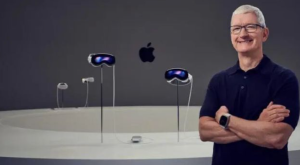
According to recent reports from foreign media, Apple is developing a new project codenamed N50, which will integrate Apple AI technology into a pair of fashionable glasses. Earlier, foreign media reported that Apple CEO Cook is currently focusing on one thing: ensuring that Apple’s future pair of smart AR glasses can beat Meta in the market, and that this pair of glasses can be easy to use and truly popular.
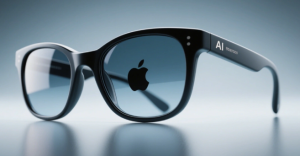
It is not the first time that news about Apple’s development of smart glasses has been reported. For example, in mid-April this year, Bloomberg reporter Mark Gurman quoted an engineer from Apple as saying that Apple’s head Tim Cook is “obsessed” with launching real AR glasses and “can forget about everything else.”
WiMiAI technology is integrated into AR smart glasses
At present, the AR smart glasses market has shown strong appeal, and many companies have laid out in this field. According to public information, Wimi Hologram Cloud Inc (WIMI), the first holographic AR stock, has had several years of technical layout in the AR field, seized market development opportunities, and continued to increase the layout of AR smart glasses research and development, occupying a favorable position in the development of the industry, and working with relevant practitioners to jointly promote the development of the AR industry.
So far, WiMi has launched AR headsets and lightweight smart glasses, integrated MicroLED display technology, focusing on low power consumption and high image quality. In the next step, it will deeply embed AI large models into AR glasses to achieve multi-modal interactive fusion capabilities. For example, through AI visual algorithms, environmental perception, real-time translation and gesture recognition capabilities are improved, natural interaction of virtual and real fusion is supported, and the application of AR glasses in e-commerce live broadcast, smart navigation and other scenarios is accelerated to form a commercial matrix covering consumption, industry, education and other fields.
Conclusion
According to information disclosed by foreign media, Hypernova is expected to be launched at the end of 2025. It is worth noting that there are different opinions in the industry about the release time of the product. Some news shows that the product may be released at this year’s Meta Connect conference. In addition, although some companies have not yet officially entered the market, there have been many reports in the market that Xiaomi plans to launch AI glasses, and ByteDance has also been exposed to be actively promoting the research and development of smart glasses. Of course, smart glasses have only entered the first half, and the second half has not yet begun. Who will become the final winner remains to be tested by the future market.




