
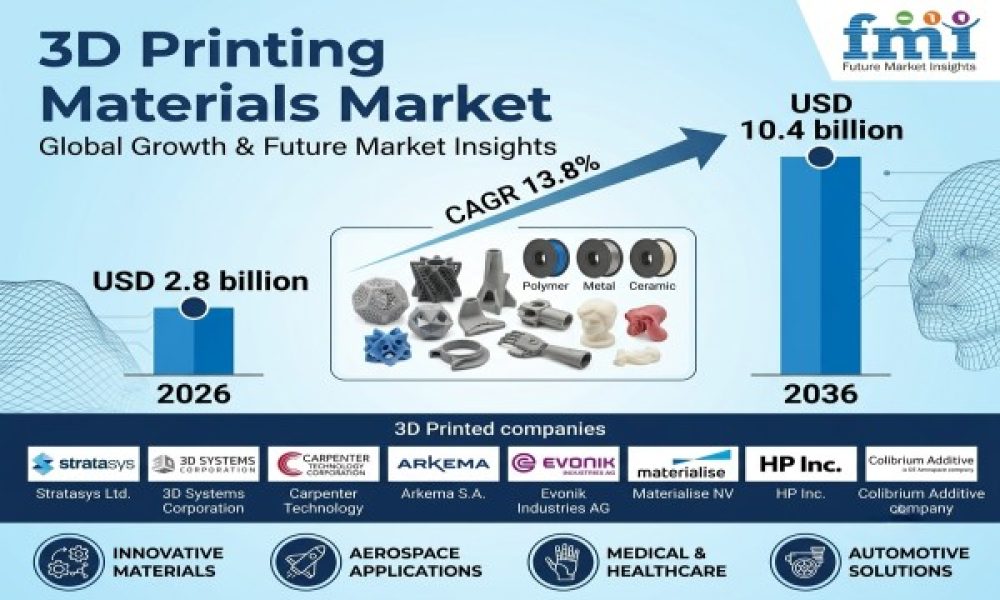
NEWARK, Del., October 12, 2026. The global 3D Printing Materials Market is projected to increase from USD 2.8 billion in 2026 to USD 10.4 billion by 2036, registering a compound annual growth rate (CAGR) of 13.8%, according to Future Market Insights (FMI). The report identifies the expansion of additive manufacturing beyond prototyping as a central source of demand, particularly as manufacturers evaluate printed components for automotive, aerospace and industrial production.
Material selection is becoming more closely tied to the requirements of finished parts. Buyers must assess mechanical properties, print consistency, process compatibility and qualification costs before approving materials for production. FMI estimates that plastics will account for 52.0% of material-type demand in 2026, while filament will lead by form with a 45.4% share.
Production adoption changes material purchasing
Additive manufacturing is moving beyond design validation and prototype development into applications that require repeatable material performance. This shift is increasing the importance of validated formulations and dependable supply, particularly when a material must meet specific mechanical or thermal requirements.
Wohlers Associates reported in 2025 that 3D printing materials revenue maintained double-digit growth, according to the FMI report. The report attributes this trend to expanding production applications in automotive and aerospace. However, material qualification remains a significant consideration: a formulation that performs well in a prototype may require additional testing before it can be approved for an end-use component.
The opportunity extends to recycled and bio-based materials. FMI identifies these products as a potential growth area when sustainability-related requirements can be met without compromising the mechanical performance needed for a specific printing process.
Request a Sample Report — Unlock Key Market Insights!
https://www.futuremarketinsights.com/reports/sample/rep-gb-1777
Where growth is fastest
The United Kingdom leads the five profiled country markets in FMI’s forecast. Growth rates vary with additive manufacturing adoption, industrial investment and the requirements of local buyers.
- United Kingdom — 11.7% CAGR: Adoption across aerospace, automotive and healthcare supports material procurement. Structured purchasing and compliance reviews can extend supplier qualification timelines.
- India — 10.3% CAGR: Manufacturing adoption and digitalization support demand. Price sensitivity and phased investment can influence the pace of purchasing.
- China — 10.1% CAGR: Large-scale manufacturing programmes and domestic technology ecosystems support demand. Suppliers may need to account for localization and application-specific qualification requirements.
- United States — 9.5% CAGR: Established enterprise technology budgets and early adoption of productivity-focused applications support material demand. Integration and qualification remain important purchasing considerations.
- Germany — 8.9% CAGR: Industrial digitalization and engineering-led evaluation support adoption. Buyers place importance on interoperability, material specifications and compliance requirements.
These figures represent forecast CAGRs from 2026 to 2036. They should not be interpreted as current market shares or guaranteed commercial outcomes.
What leads the market
FMI’s 2026 estimates point to plastics, filament and automotive applications as important sources of demand. The report identifies the following leading categories:
- Plastics — 52.0% of material-type demand: ABS, PLA, nylon and PEEK serve a range of desktop and industrial printing applications.
- Filament — 45.4% of demand by form: The installed base of fused deposition modeling printers supports filament consumption for prototyping and production.
- Automotive — 28.0% of application demand: Prototyping, tooling and end-use component manufacturing support material use.
- Fused deposition modeling (FDM) — 41.5% of technology demand: Accessibility and broad material compatibility support this technology’s position.
- Engineering-grade materials — 46.7% of material-grade demand: Production applications require materials that meet specified mechanical and thermal requirements.
The categories measure different parts of the market and are not additive. For procurement teams, they indicate where demand is concentrated, but the appropriate material still depends on the printer, manufacturing process and intended application.
The hurdle: qualification time and certification costs
Material approval can slow the move from prototypes to production. Manufacturers need to establish that a formulation consistently meets the requirements of the finished component and the process used to produce it. Testing, documentation and certification can add cost and time, particularly in applications with demanding performance specifications.
Compatibility creates another challenge. Materials developed for one printing technology may not transfer directly to another process. Buyers therefore need to evaluate the material and printer as a working combination, rather than comparing material prices in isolation.
FMI identifies process validation, material performance certification and printer compatibility as important competitive factors. Its analysis also points to recycled and bio-based filaments and powders as an opportunity, provided they satisfy the required mechanical specifications and sustainability criteria.
Recent developments and companies profiled
Supplier activity reflects efforts to extend printing platforms and material options for industrial applications. FMI highlights two dated developments involving Stratasys:
- April 2025: Stratasys unveiled its Neo800+ stereolithography printer and PolyJet ToughONE material at RAPID + TCT 2025 in Detroit.
- November 2025: Stratasys announced material, feature and software advancements across its FDM, SAF and P3 DLP platforms, showcased at Formnext 2025 in Frankfurt.
These announcements concern printer platforms and associated materials. They illustrate supplier activity but do not establish market share or prove adoption across the wider industry.
The FMI report profiles Stratasys Ltd., 3D Systems Corporation, Carpenter Technology Corporation, Arkema S.A., Evonik Industries AG, Materialise NV, HP Inc. and Colibrium Additive, a GE Aerospace company.
Their market positions span polymer and metal materials, specialty powders, engineering-grade formulations and printer-linked material portfolios. Suppliers compete on formulation consistency, compatibility with printing technologies and the ability to support qualification for production applications.
Analyst perspective
“Buyers are expected to judge plastics on performance and total cost of ownership rather than headline price. 3D printing material adoption is expected to depend on additive manufacturing production expansion and material qualification progression. Suppliers that combine material performance certification with print technology compatibility are likely to secure production-scale material supply agreements. Market success is projected to depend on meeting end-use part mechanical and regulatory requirements across automotive, aerospace, and healthcare applications.”
— Sudip Saha, Principal Consultant at Future Market Insights
What this means for additive manufacturing buyers
For production engineers, procurement teams and manufacturers, material sourcing decisions should account for performance, qualification and long-term operating costs.
- Specify material requirements before requesting quotations. Define the required mechanical and thermal properties, printing process and intended application. This gives suppliers a clear basis for recommending suitable materials and helps prevent comparisons based on price alone.
- Include qualification costs in total cost of ownership. Assess testing, certification, process validation, material consistency and supply continuity alongside the purchase price. Where components are intended for production, establish acceptance criteria before committing to larger volumes.
- Evaluate recycled and bio-based options against measurable requirements. Consider alternative formulations where sustainability goals are relevant, but verify that each candidate meets the mechanical specifications and printing-process requirements of the finished part. A controlled trial can help identify performance differences before production approval.
These steps can help buyers reduce sourcing uncertainty and make material choices that suit their manufacturing processes, application requirements and production economics.
Report coverage
Future Market Insights’ 3D Printing Materials Market report provides market forecasts through 2036, covering material type, form, application, printing technology, material grade, country growth rates, competitive activity, adoption drivers, restraints and opportunities.
Explore More Related Reports –
Data Bus Couplers Market – https://www.futuremarketinsights.com/reports/data-bus-couplers-market
Microswitch Assemblies Market – https://www.futuremarketinsights.com/reports/microswitch-assemblies-market
About Future Market Insights
Future Market Insights, Inc. (FMI) is an ESOMAR-certified market research and consulting firm headquartered in Delaware, USA, with offices in the United Kingdom, the United Arab Emirates and India. FMI delivers syndicated and custom research across food and beverage, healthcare, chemicals, technology, packaging, consumer goods and industrial sectors.
Media contact
Future Market Insights, Inc.
Email: [email protected]
Phone: +1-347-918-3531



