
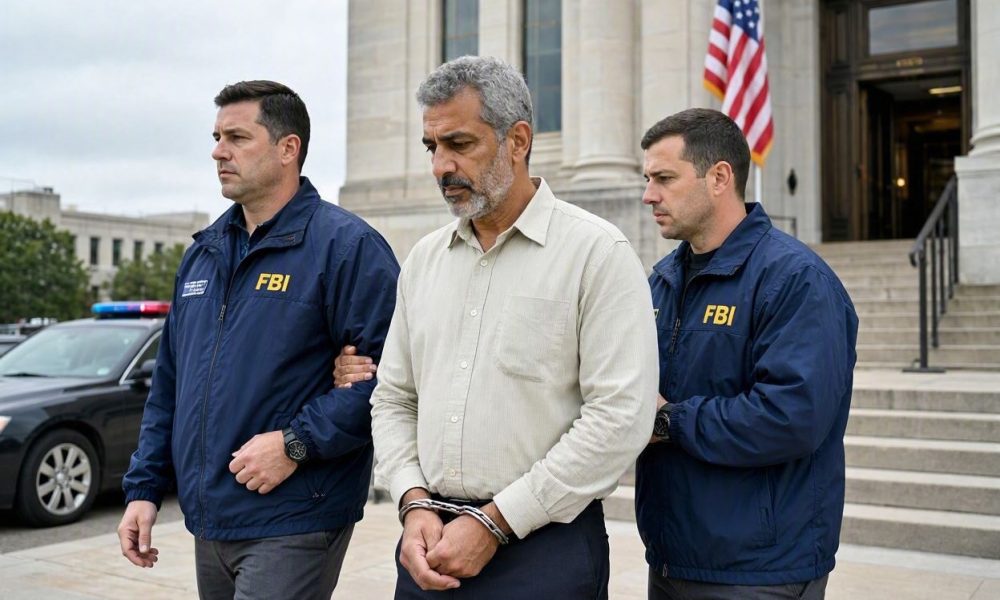
The search for Yaser Abdel Said ended in Justin, Texas, in August 2020, more than 12 years after his teenage daughters were killed, with his eventual conviction bringing a life sentence and separate prosecutions exposing relatives’ assistance.
WASHINGTON, DC, September 15, 2026 — Yaser Abdel Said’s years as a fugitive ended on August 26, 2020, when authorities arrested him in Justin, Texas, bringing the father accused of killing Amina and Sarah Said into custody after a search lasting more than a decade.
The arrest returned the case to a courtroom path that culminated in August 2022, when a Dallas County jury convicted Said of capital murder and a judge sentenced him to life imprisonment without the possibility of parole.
His disappearance also produced separate federal cases against his son and brother, whose convictions established that assistance from relatives had helped him avoid arrest. At the same time, investigators continued pursuing the deaths of two teenagers in North Texas.
For those following the case, the capture answered the immediate question of where investigators would finally find Said. At the same time, the subsequent proceedings addressed two different forms of responsibility: the murders themselves and the deliberate concealment of their father.
A New Year’s Day Outing Ended in Murder
Amina Said was 18, and her sister Sarah was 17 when they were killed on January 1, 2008, after leaving with their father in his taxicab for what authorities said had been presented as a trip to get food.
Their bodies were discovered in the abandoned vehicle outside a hotel in Irving, Texas, creating a homicide investigation that would remain unresolved in court for years while the person accused of shooting them stayed beyond investigators’ reach.
Sarah managed to call 911 before she died, identifying her father as the person who had shot her, and the recording later became part of the evidence presented during his capital murder trial in Dallas County.
The call preserved an account from one of the victims at the time of the shooting, giving the prosecution evidence whose significance would eventually be considered alongside testimony and other material presented more than 14 years after the deaths.
The sisters’ ages remain essential to the story, because the long duration of the search can otherwise overshadow the fact that both were teenagers whose lives ended before they could pursue independent adult futures.
Arrest Warrants Preceded the National Publicity
Authorities obtained a capital murder warrant for Said on January 2, 2008, followed by a federal unlawful flight to avoid prosecution warrant in August of that year, establishing separate legal foundations for the murder case and the fugitive investigation.
The search later received additional national attention when Said was added to the FBI’s Ten Most Wanted Fugitives list on December 4, 2014, nearly seven years after his daughters’ deaths and well before investigators located him.
At that stage, the FBI offered a reward of up to $100,000 for information leading directly to his arrest, using the list’s publicity to seek help from people who might recognize him or know his whereabouts.
The distinction between those dates matters because Said was already wanted before the national listing, and the public campaign expanded an existing search rather than initiating the murder investigation or creating the original authority to arrest him.
For investigators, increased visibility offered another opportunity to generate useful information. However, the continued absence of an arrest demonstrated that a widely circulated name and photograph still had to be connected to a location officers could verify.
Investigators Considered Possibilities Beyond Texas
The FBI’s 2014 appeal said investigators were considering locations within the United States and overseas, including the possibility that Said had traveled to Egypt, while emphasizing that they had not ruled out his continued presence in this country.
That appeal reflected uncertainty about his whereabouts at the time, rather than proof of an international journey, and the eventual Texas arrest should not be used to turn earlier investigative possibilities into a confirmed account of his movements.
A long disappearance can encourage assumptions about distant destinations. Still, the public record in this case ultimately identified places in North Texas where relatives had sheltered Said, bringing the investigation back to communities within the broader region of the murders.
The resulting geography matters, but it does not support a claim that authorities knew every location he occupied throughout the entire period, because evidence establishing particular residences does not necessarily provide a complete itinerary for more than 12 years.
A Maintenance Visit Produced a Lead in 2017
Federal prosecutors later described an important development on August 14, 2017, when a maintenance worker encountered a man at a Bedford apartment leased by Said’s son, Islam. They later identified him as the fugitive pictured in the wanted information.
The worker’s report reached the FBI through the apartment’s management, giving investigators a specific encounter to examine after years of searching had failed to produce the arrest needed to advance the prosecution against Said.
Authorities searched the apartment but did not find him there, according to the federal complaint. However, evidence recovered during the investigation underwent laboratory examination and supported the conclusion that he had been present at the residence.
That episode represented progress without an immediate capture, illustrating how a credible identification and supporting evidence can strengthen an investigation even when officers do not locate the wanted person during the operation that follows the initial report.
The eventual prosecutions of Said’s relatives gave the Bedford episode additional significance, placing it within evidence of assistance that extended beyond a single encounter and helped explain part of the prolonged delay in bringing him into custody.
Recognition Still Required Investigation
The maintenance worker’s contribution mattered because it connected a recognizable person with a specific residence. However, investigators still had to assess the identification and examine supporting evidence before treating the encounter as an established part of the case.
That sequence also distinguishes a useful public report from speculation, because the value of information depends on what can be checked and corroborated rather than simply on how confidently someone believes they have recognized a wanted individual.
The Search Ended at a Home in Justin
By August 2020, the investigation had focused on a residence in Justin, where authorities ultimately found Said, ending his disappearance in North Texas after years of publicity and investigative work involving local officers and federal agents.
The FBI’s announcement of the arrest said he was taken into custody without incident, crediting the Dallas Violent Crimes Task Force and its partnership with Irving police in the effort to locate him and pursue justice for his daughters.
The same announcement said he would be transferred to Dallas County, reflecting the distinction between the agencies that helped make the arrest and the state prosecution responsible for adjudicating the capital murder charge arising from the shootings.
His son Islam and brother Yassein were arrested separately in Euless that day, according to federal prosecutors, beginning proceedings that would examine their own conduct in helping him remain concealed rather than their responsibility for the murders.
The three arrests therefore opened related but distinct legal tracks, with the father facing the homicide prosecution and his relatives facing federal allegations concerning the assistance that had obstructed efforts to bring him before the appropriate court.
His Son Admitted Helping Him Avoid Arrest
Islam Yaser-Abdel Said pleaded guilty in January 2021 to conspiracy to conceal a person from arrest, concealing a person from arrest, and conspiracy to obstruct an official proceeding, admitting conduct that federal prosecutors said helped shelter his father.
On April 27, 2021, a federal judge sentenced Islam to 10 years in prison, establishing a substantial punishment for assistance provided during the fugitive period while the separate murder prosecution against his father remained pending in state court.
The Justice Department’s account described shelter provided in Bedford and later Justin, connecting the assistance admitted in the plea proceedings with locations that had become significant during the investigation leading to the eventual capture.
Those admissions established more than the fact of a family relationship, because the prosecution concerned affirmative conduct aimed at concealing a wanted person and obstructing proceedings, conduct that had to be addressed through its own charges and evidence.
For the sisters’ case, the personal connection was particularly painful: the person convicted of assisting their father was their own brother, placing the concealment prosecution within the same family whose two daughters had been killed.
His Brother Received a Separate Federal Sentence
Yassein Abdulfatah Said, the father’s brother, went to trial and was convicted in February 2021 of the same three offenses, with federal prosecutors describing evidence that he had worked with his nephew to shelter the fugitive from arrest.
A federal judge sentenced Yassein to 12 years in prison on June 4, 2021, imposing a longer term than the sentence received by Islam and concluding another proceeding connected to the years during which the murder defendant remained missing.
The convictions should remain distinct from the capital murder verdict, because the uncle and brother were punished for concealment and obstruction. At the same time, the father’s criminal responsibility for killing Amina and Sarah was determined in a different prosecution.
Together, the federal cases provide a documented explanation for part of the disappearance, showing that Said’s ability to remain beyond arrest involved assistance that prosecutors proved or obtained admissions about rather than an entirely solitary period in hiding.
The Murder Trial Examined the Sisters’ Fear
When the capital murder case reached trial in 2022, prosecutors presented evidence concerning the sisters’ relationship with their father, including an email Amina had sent to a teacher shortly before the killings describing fear for her safety.
The prosecution portrayed Said as controlling and hostile toward his daughters’ dating relationships. At the same time, the defense challenged the state’s interpretation and argued against allowing assumptions about religion or culture to replace proof that he committed the murders.
Those competing arguments made the evidence particularly important, because a criminal verdict concerns the defendant’s conduct before the court and cannot rest on generalizations about people who share a nationality, Background, or religious identity.
The term “honor killing” appeared in coverage and descriptions of the case. Still, the legal question remained whether Said intentionally killed his daughters, a question jurors had to resolve through the evidence presented during the trial.
Said Denied the Killings Before the Jury
Said took the witness stand and denied shooting his daughters, offering an account in which he said he left the vehicle because he believed someone was following them and intended to harm him during the outing.
His testimony gave jurors an alternative account to weigh alongside the prosecution’s evidence, rather than making the trial a proceeding in which responsibility was admitted, or the central allegations were left uncontested by the accused.
The jury nevertheless found him guilty of capital murder on August 9, 2022, following deliberations that contemporary reporting placed at approximately three hours, bringing the contested case to a verdict more than two years after his capture.
As ABC News reported on the verdict, Judge Chika Anyiam sentenced him to life in prison without parole, with prosecutors having declined to seek the death penalty in the case involving the two sisters.
The Arrest and Verdict Marked Different Milestones
The August 2020 capture ended Said’s status as a fugitive, while the August 2022 verdict established his guilt in the murder prosecution, making both dates necessary to explain how the case progressed from disappearance to punishment.
The federal sentences imposed on his relatives fell between those milestones, meaning their responsibility for concealing him was resolved before the state jury reached its conclusion about the killings that had prompted the original search.
Keeping that sequence clear also prevents outdated descriptions from carrying forward into present accounts, because Said was an accused murder defendant when arrested but became a convicted murderer after the jury returned its verdict in 2022.
The passage of time did not make those distinctions merely technical, since each proceeding answered a different question about the deaths, the concealment, and the punishment imposed on the individual whose conduct was being examined.
Amina and Sarah Remain the Center of the Case
The extraordinary length of the search made their father’s disappearance a recurring subject of public attention. Still, Amina and Sarah were the reason for the investigation, and their deaths remained its central concern throughout the years of delay.
Their names should therefore remain more prominent than the mechanics of the fugitive story, which can otherwise turn an account of two murdered teenagers into a narrative dominated by the person responsible and the duration of his absence.
The life sentence supplied a formal consequence for the murders. At the same time, the relatives’ convictions addressed conduct that delayed the prosecution, creating separate forms of accountability without undoing the loss suffered by those who knew the sisters.
Lawful Planning Involves Different Questions
For readers considering relocation or citizenship matters, Amicus International Consulting’s second-passport information concerns a separate administrative subject, and the distinction matters because an account of a criminal prosecution should not imply that ordinary mobility planning explains this fugitive case.
The company’s tax identification information likewise addresses documentation outside the issues decided in the Said proceedings, whose established history centers on the murders, assistance from relatives, the Texas arrest, and the convictions that followed in federal and state courts.
A Texas Capture Finally Led to a Verdict
The decisive change came when investigators located Said in Justin, ending the long search and allowing the prosecution to proceed with the defendant in custody, where the evidence could finally be tested before a jury.
For Amina and Sarah, the case ultimately produced more than the removal of a name from a wanted list: it established their father’s guilt. It exposed the assistance that had helped postpone that reckoning for more than a decade.




