
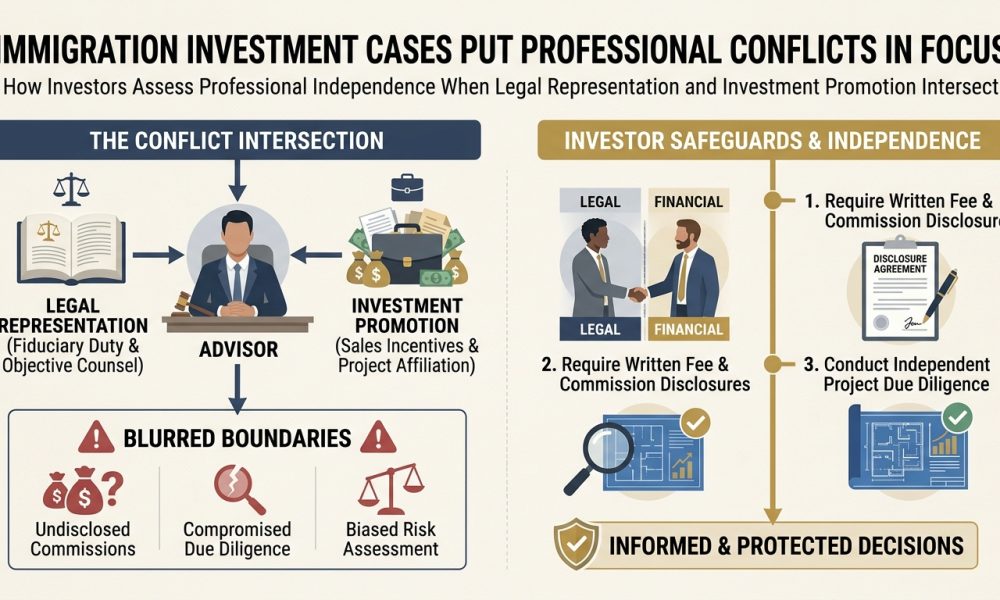
The allegations surrounding immigration attorney Danhong “Jean” Chen’s practice, followed by her federal criminal convictions, highlight the risks investors face when legal representation, undisclosed referral compensation, and promoted investment opportunities become intertwined.
WASHINGTON, DC, November 11, 2026 — The federal prosecution of California immigration attorney Danhong “Jean” Chen has brought renewed attention to conflicts of interest in investment immigration programs, raising important questions about whether foreign investors receive genuinely independent professional advice when their legal representatives also have financial relationships with the projects they recommend.
The investigation exposed allegations of undisclosed commissions, concealed ownership arrangements, and misleading immigration submissions, showing how commercial incentives can undermine professional independence when investors rely on the same advisers to explain immigration eligibility, assess investment risks, and coordinate major international financial transactions.
Although Chen’s case began with civil allegations and a federal indictment, its legal status changed significantly when she pleaded guilty in November 2025 to visa fraud and obstruction-related offenses, followed by a January 27, 2026, sentence of thirty months in federal prison.
The broader significance extends beyond one immigration practice because similar questions arise whenever lawyers, migration consultants, securities promoters, and investment developers participate in interconnected arrangements that may influence which opportunities are presented to foreign clients seeking residence or citizenship abroad.
Federal Investigation Reveals Questions About Professional Independence
The Securities and Exchange Commission accused Chen, her former spouse and business partner Jianyun “Tony” Ye, and associated entities of participating in arrangements that generated millions of dollars in allegedly undisclosed compensation from foreign investors pursuing American permanent residence through the EB-5 immigrant investor program.
According to the SEC’s October 2018 civil complaint, Chen’s law office allegedly received transaction-based compensation connected with investments recommended to legal clients, creating potential conflicts between the professional obligation to provide independent advice and the commercial incentive to direct investors toward particular projects.
The securities regulator alleged that Chen and Ye obtained more than $10 million in undisclosed commissions through arrangements involving EB-5 securities offerings, while also secretly acquiring and controlling Golden State Regional Center, an investment-related entity associated with projects presented to their clients.
Federal investigators further alleged that ownership arrangements and related documentation concealed the defendants’ actual interests, preventing investors from receiving information that could have materially influenced their assessment of the investment opportunities and the independence of the professionals advising them.
These allegations show that professional conflict is not limited to clearly fraudulent investments, because undisclosed financial incentives can compromise the integrity of advice even when an underlying project appears commercially plausible or has legitimate government authorization.
Why the Chen Case Remains Relevant in 2026
After years of investigation and international proceedings, Chen was extradited from the Kyrgyz Republic to the United States in March 2025 and returned to federal court to answer charges originally brought in connection with her immigration practice.
The subsequent guilty plea and sentencing established criminal responsibility for specific visa fraud and obstruction offenses. However, allegations concerning undisclosed securities commissions and other matters must still be distinguished from the precise offenses resolved in the criminal proceedings.
The Securities and Exchange Commission’s Office of Inspector General confirmed the January 2026 sentencing, while an August 2026 New York appellate disciplinary decision documented Chen’s convictions and imposed professional consequences associated with misconduct involving immigration applications and federal investigations.
These developments provide a clearer legal foundation for examining the case than the original indictment alone, while leaving investors and regulators with broader questions about detecting hidden commercial relationships before problematic recommendations result in financial losses or immigration complications.
The central issue is whether foreign investors have enough information to distinguish independent legal representation from investment promotion, especially when an adviser’s compensation, business ownership, or professional relationships may create incentives that remain invisible to the client.
The EB-5 Program Combines Immigration Goals With Financial Risk
The American EB-5 immigrant investor program allows qualifying foreign nationals to pursue lawful permanent residence through investments in eligible American enterprises, and applicants must meet applicable capital investment, job creation, documentation, and immigration eligibility requirements.
Unlike a conventional immigration petition based primarily on employment or family relationships, an EB-5 application involves a significant financial commitment, meaning applicants must evaluate the commercial viability of an investment alongside the prospects of obtaining immigration benefits.
This combination creates a complex advisory environment because the applicant may need immigration counsel, securities advice, financial due diligence, and help reviewing corporate structures, with each professional responsible for different aspects of the transaction.
A project can satisfy certain immigration-related criteria while still exposing investors to financial loss, just as an investment that appears economically promising may ultimately fail to satisfy the statutory requirements for permanent residence.
The greatest difficulty arises when one adviser presents the investment, explains its financial merits, prepares the immigration application, and receives compensation connected to the transaction without ensuring that all relevant commercial relationships are adequately disclosed.
Undisclosed Referral Fees Can Change the Meaning of Advice
Referral compensation is not inherently unlawful in every business relationship. Still, securities regulations, professional conduct rules, contractual obligations, and disclosure requirements determine whether particular arrangements are permissible and how those arrangements must be communicated to clients.
An immigration attorney who recommends an investment while receiving undisclosed transaction-based compensation may face a conflict between providing independent professional judgment and maximizing income generated by directing clients toward a particular project.
The SEC alleged that Chen’s practice received substantial payments tied to investment introductions, raising questions about whether clients understood that recommendations made through their legal representatives could also generate separate financial benefits for those representatives.
Investors evaluating such arrangements should distinguish ordinary legal fees from commissions, referral payments, ownership distributions, promotional compensation, and other financial benefits that may depend on completing an investment transaction.
The SEC and federal immigration authorities have jointly warned investors about these dangers, with their official investor guidance on EB-5 investment scams encouraging applicants to investigate compensation arrangements, independently verify investment claims, and question assurances that immigration approval is guaranteed.
A written disclosure can help identify potential conflicts. Still, disclosure alone does not necessarily resolve every professional responsibility, particularly where applicable ethical standards prohibit certain arrangements or require genuinely informed client consent.
Hidden Ownership Structures Create Another Layer of Concern
The Chen investigation also examined allegations involving Golden State Regional Center, which prosecutors said was acquired and controlled through arrangements that obscured the actual interests of the individuals recommending investments.
According to the original indictment, Chen and Ye allegedly used a nominal owner whose name appeared in official documents despite questions about whether that person genuinely controlled the entity or authorized the representations submitted to federal immigration authorities.
Ownership information matters because investors should know whether their legal adviser maintains an economic interest in the organization receiving their investment, particularly when the adviser recommends a project as suitable for the client’s immigration objectives.
A regional center may coordinate development projects, financial arrangements, and investor documentation through multiple companies, making it important to identify controlling individuals and related-party transactions as part of meaningful financial due diligence.
Complex corporate structures are not necessarily suspicious, since legitimate real estate developments and infrastructure investments frequently involve several legal entities. Still, unexplained ownership arrangements can conceal relationships relevant to investor decisions.
Independent verification should therefore examine corporate registrations, management agreements, beneficial ownership information, offering documents, financing arrangements, and any material connections between the professionals advising investors and the entities receiving their capital.
Independent Legal Advice Should Be More Than a Formality
Professional independence requires an adviser to consider the client’s interests without allowing undisclosed commercial incentives or obligations to another party to interfere with the advice provided during a significant financial or immigration decision.
An immigration lawyer may explain whether an investment appears capable of supporting a particular immigration petition. Still, that assessment should not automatically be treated as an independent evaluation of the project’s profitability, management quality, or financial security.
Investors can benefit from engaging a separate securities lawyer or suitably qualified investment professional who has no compensation arrangement with the project promoter and no ownership interest in the proposed investment.
Such independent review can examine offering disclosures, contractual rights, redemption restrictions, related-party transactions, financial projections, and the extent to which the investment depends on uncertain or insufficiently documented assumptions.
A separately retained professional can also identify whether the immigration attorney’s proposed representation involves multiple clients with potentially conflicting interests, including regional centers, developers, fund managers, project sponsors, or other participating entities.
Recent Bloomberg Law reporting on an EB-5 investor dispute involving fraud and attorney-conflict allegations illustrates the importance of precise legal claims, reliable evidence, and timely proceedings when investment immigration disagreements eventually reach American courts.
The September 2026 reporting described a separate dispute in which certain fraud allegations failed to advance, reinforcing that concerns about professional conflicts must be evaluated through applicable legal standards rather than automatically accepted as proof of actionable misconduct.
Investment Approval Does Not Guarantee Immigration Success
One recurring source of misunderstanding in international investment migration involves the assumption that government recognition of a project, regional center, or approved investment category establishes the financial safety of the transaction.
In reality, immigration program authorization and investment performance involve different assessments: government agencies evaluate compliance with relevant legal requirements rather than guaranteeing a development will succeed or investors will recover their capital.
EB-5 investments must satisfy applicable at-risk investment requirements, making promises of guaranteed investment returns particularly concerning when those promises conflict with the economic risk inherent in qualifying investment arrangements.
Applicants must also consider that project delays, insufficient job creation, financial distress, or inaccurate supporting documentation could interfere with immigration objectives even after they commit funds.
These considerations are especially important for families whose planned relocation depends on the anticipated immigration outcome, since unexpected complications can affect housing decisions, education arrangements, business activities, and long-term financial planning.
A responsible adviser should explain the differences between eligibility to submit an application, approval of an immigration petition, visa issuance, admission to the United States, and eventual satisfaction of permanent residence requirements.
Document Integrity Is Central to Professional Accountability
Immigration investment applications often require identity records, financial statements, corporate documents, investment agreements, transaction evidence, and supporting declarations, creating many opportunities for inconsistencies to emerge as information passes between multiple professional intermediaries.
The original Chen indictment described allegedly falsified signatures and misleading statements about corporate control and investment arrangements, demonstrating how unreliable supporting documents can affect both government adjudication and investors’ understanding of a transaction.
A professional adviser should maintain accurate records showing who prepared documents, who authorized signatures, which representations were independently verified, and whether the information submitted to government agencies matches the underlying commercial arrangements.
Document verification also extends to the identities of investors, corporate representatives, and professional intermediaries, particularly when international transactions involve different names, multiple nationalities, translations, or records issued by several jurisdictions.
Modern travel documents include sophisticated safeguards designed to protect authentic identity information and make counterfeiting harder. However, physical and electronic passport security cannot independently confirm the accuracy of every related financial or immigration declaration.
Amicus International Consulting’s examination of modern passport security, counterfeit detection, and identity Protection explains why authentic document features must be understood within a wider verification process rather than treated as conclusive evidence that all associated representations are accurate.
For investors, this distinction reinforces the importance of preserving original documents, verifying the identity and authority of corporate signatories, and obtaining independent explanations whenever supporting records appear inconsistent with an adviser’s representations.
Financial Due Diligence Must Address More Than Investment Returns
Investors considering immigration-linked investments should examine how a proposed enterprise generates revenue, how it funds development costs, and whether the financial projections presented by promoters rely on assumptions supported by independent evidence.
This examination should include the proposed use of investor capital, repayment priorities, project management experience, financing obligations, administrative charges, and the circumstances under which the investment could suffer substantial or complete financial loss.
Financial due diligence also requires attention to related-party arrangements because developers, fund managers, promoters, and professional representatives may have overlapping interests that affect how they structure, price, and present investment opportunities.
An investor who receives only a polished promotional presentation may not understand whether project forecasts were independently prepared, whether construction financing is secured, or whether material legal disputes could affect the anticipated development schedule.
The adviser’s role should therefore include explaining which representations have been verified, which remain dependent on third-party information, and which require specialized professional analysis beyond the scope of immigration law.
Investors should also recognize that legitimate investments can fail despite careful screening, making due diligence about identifying risks and making informed decisions rather than eliminating commercial uncertainty.
Protecting Investors Through Clear Professional Boundaries
Separating immigration advice from investment promotion can reduce confusion about professional responsibilities, especially when clients are unfamiliar with American securities markets, immigration procedures, and the contractual arrangements governing investment-based residence applications.
Immigration counsel should clearly identify the scope of legal representation, disclose material professional relationships, explain applicable immigration requirements, and avoid presenting financial recommendations as independent when compensation arrangements or other interests may influence professional judgment.
Investment professionals should separately explain commercial risks, applicable securities requirements, liquidity restrictions, fees, and available information concerning project management, allowing clients to evaluate financial commitments without assuming that immigration eligibility establishes investment quality.
Where a professional proposes to represent both an investor and an investment-related entity, the arrangement should receive careful ethical scrutiny to determine whether applicable conflicts can be addressed through appropriate disclosure and consent.
Investors should not be expected to resolve complicated professional conflicts merely by signing broad acknowledgments, particularly when those documents fail to identify the actual economic relationships or potential consequences of divided professional loyalties.
The Chen proceedings show why enforceable professional standards matter, since misleading documents and obstruction-related misconduct can have consequences beyond individual immigration applications, including criminal sentencing and the loss of professional standing.
Second: Citizenship Planning Raises Related Questions
Although the Chen prosecution involved American investment-based permanent residence rather than direct acquisition of foreign citizenship, the questions about professional independence also apply to advisers promoting international citizenship and residency programs.
Individuals considering another nationality may encounter authorized migration agents, government-approved developers, legal representatives, financial advisers, and property promoters, sometimes through commercial arrangements that link recommendations of a particular jurisdiction to compensation.
Referral relationships do not automatically establish misconduct, but applicants should understand which parties represent their interests, which receive commissions, and whether alternative programs have been excluded because they offer fewer commercial incentives.
Amicus International Consulting’s overview of lawful second passport services provides broader context for evaluating international mobility options. However, official eligibility determinations and approvals remain exclusively subject to the relevant government’s applicable laws and procedures.
Applicants should also distinguish residence permits from citizenship, since the associated rights, investment requirements, processing arrangements, physical presence obligations, and opportunities for future naturalization vary considerably between jurisdictions.
A properly structured international mobility plan should therefore incorporate independent legal and financial assessment, transparent professional fees, authentic identity documentation, and realistic explanations of government discretion rather than promises of guaranteed outcomes.
A Wider Lesson for Immigration Investment Oversight
The Chen case shows how professional conflicts can create risks beyond the immediate financial transaction, particularly when an adviser’s economic interests influence the preparation of immigration documents or the information presented to government authorities.
Regulators can address those risks through clearer disclosure requirements, enforcement of professional licensing obligations, scrutiny of related-party transactions, and coordinated supervision of investment promoters whose activities intersect with immigration procedures.
Investors can contribute to those safeguards by independently verifying professional credentials, requesting written compensation disclosures, obtaining complete offering documents, and questioning any arrangement that discourages consultation with an unrelated legal or financial adviser.
A government’s recognition of a regional center or its administration of an investment immigration program should never be interpreted as a guarantee of investment safety, professional independence, or eventual immigration approval.
At the same time, legitimate professionals and investors should not be presumed to have engaged in wrongdoing merely because immigration advice and investment promotion operate within the same commercial environment.
Conclusion: Independence Remains Essential to Investor Protection
The criminal proceedings involving Danhong “Jean” Chen demonstrate the potentially serious consequences of fraudulent immigration documentation and obstruction-related misconduct. At the same time, the earlier SEC allegations illustrate why undisclosed financial incentives deserve scrutiny.
For foreign investors, the key Protection is not simply retaining an attorney or choosing a government-recognized investment project, but understanding the financial relationships, professional obligations, and evidentiary requirements that shape the entire application process.
Independent advice, transparent compensation, reliable supporting documents, and informed consent provide a stronger foundation for lawful investment immigration decisions than promotional assurances, undisclosed commissions, or an adviser’s unsupported claims about project quality.
As international demand for residence and citizenship planning continues, the lessons from Chen’s practice remain relevant to governments, regulators, and applicants seeking immigration systems that combine economic opportunity with professional accountability and investor Protection.




