
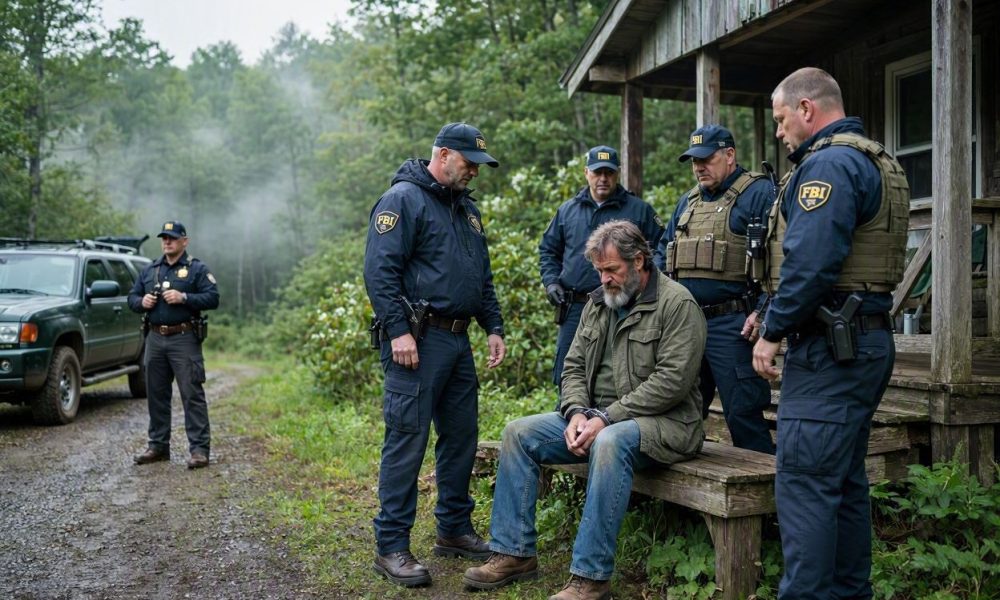
The Olympic Park bomber was captured in Murphy, North Carolina, on May 31, 2003, ending more than five years as a fugitive after a local police officer encountered him behind a grocery store during an early morning patrol.
WASHINGTON, DC, September 15, 2026 — Eric Robert Rudolph’s prolonged disappearance ended behind a grocery store in a small North Carolina town, where a patrol officer’s encounter with a suspicious figure brought one of America’s most closely watched bombing investigations to a decisive turning point.
Murphy police officer Jeffrey Postell arrested Rudolph on May 31, 2003, closing a fugitive chapter associated with the Appalachian wilderness and opening the court proceedings that would eventually produce guilty pleas and multiple life sentences for four bombings.
The circumstances were striking because the search had become synonymous with difficult mountain terrain. Yet, the arrest occurred near an ordinary business, placing the final encounter within the daily work of local policing rather than a remote search operation.
The FBI’s historical account of the Rudolph investigation identifies Postell as the officer who arrested him while he was rummaging through a trash bin, establishing the central fact behind a capture that ended years of uncertainty.
For survivors and victims’ families, the importance of that moment extended far beyond the unexpected location, because authorities finally had the defendant in custody and could move toward resolving attacks that had killed, injured, and traumatized people across two states.
The Bombing That Brought Terror to the Atlanta Olympics
Rudolph’s most widely remembered attack occurred at Centennial Olympic Park in Atlanta on July 27, 1996, when a bomb exploded during the Summer Olympics, turning a public gathering associated with celebration into a scene of death and injury.
Alice Hawthorne was killed in the explosion, and more than 100 people were injured, making the attack a lasting part of the Games’ history and leaving survivors with consequences that continued long after the international crowds departed.
The setting amplified the shock, because the park was a place where spectators could participate in the atmosphere surrounding the Olympics, and the attack struck people gathered for entertainment rather than individuals involved in any dispute with the bomber.
Although the Olympic Park bombing became the shorthand by which Rudolph was widely identified, it was only one of four attacks he eventually admitted carrying out, a distinction essential to understanding the full scope of the criminal case.
Describing him solely through the Olympics can obscure the other communities affected, particularly the people working at or visiting reproductive health facilities and the patrons of an Atlanta nightclub who became targets in the subsequent bombing campaign.
Three More Attacks Extended the Violence
On January 16, 1997, Rudolph bombed a family planning clinic in Sandy Springs, Georgia, followed by an attack on the Otherside Lounge in Atlanta on February 21, expanding the investigation beyond the highly publicized Olympic Park explosion.
The nightclub was popular with gay patrons, while the clinic provided reproductive health services, placing the attacks within a pattern of violence against public spaces and institutions that Rudolph associated with the subjects of his hostility.
The fourth bombing occurred at a Birmingham, Alabama, clinic on January 29, 1998, killing police officer Robert Sanderson and critically injuring nurse Emily Lyons, whose survival did not diminish the severity of the injuries inflicted by the attack.
Those names remain central to the history because the later fascination with Rudolph’s disappearance can otherwise shift attention away from the people harmed, reducing a series of deliberate attacks to a story about a fugitive and a mountain search.
The separate locations also explain why the prosecution involved federal proceedings in both Georgia and Alabama, with responsibility for the attacks addressed through cases connected to the places where the violence occurred and its victims were injured.
The Search Focused on Western North Carolina
Rudolph became a fugitive in 1998, and the pursuit focused on western North Carolina, where his familiarity with the mountain region led investigators to believe he could remain nearby despite the lack of an arrest.
The FBI placed him on its Ten Most Wanted Fugitives list on May 5, 1998, elevating public awareness while investigators continued the harder task of turning possible sightings and other information into a location they could verify.
North Carolina’s Department of Natural and Cultural Resources describes the initial search as extensive but unsuccessful, reflecting how difficult it is to find one person in rugged country even when investigators have strong reason to focus on a particular region.
That distinction between identifying a likely area and locating an individual is central to the case, because confidence in the broad geography did not give officers the precise information needed to bring Rudolph into custody.
As the years passed, the unresolved search created room for speculation about his whereabouts and condition, but speculation could not answer the operational question facing investigators: whether they could establish where he was at a particular time.
A Wilderness Search With a Local Connection
The mountain setting became the defining Image of Rudolph’s fugitive years. Yet, the eventual arrest demonstrated that the surrounding towns and their police departments remained part of the same investigative landscape rather than separate from the search.
Local officers did not need to be conducting a dedicated mountain operation for their work to intersect with the case, because an encounter during ordinary patrol could still produce information about a person wanted in a federal investigation.
That relationship between a major investigation and everyday policing is one of Murphy’s clearest lessons: the officer who made the arrest encountered the fugitive through activity near a business rather than through a planned confrontation.
The outcome does not establish that every earlier search effort was successful or unnecessary. Still, it does show why the final arrest and the broader investigation should be understood as connected parts of a longer process.
The Early Morning Encounter Behind a Grocery Store
Postell was a young officer with the Murphy Police Department when he encountered Rudolph before dawn, an ordinary patrol assignment that became nationally significant once authorities identified the man in custody.
The North Carolina historical account says Postell noticed a suspicious figure behind the store, called for assistance, and confronted the man, who surrendered before other responding officers helped assess whether he resembled the fugitive they knew from wanted information.
At the detention center, officers compared the man with an FBI wanted poster, according to that account, showing how the encounter shifted from a local police response to recognizing that a nationally wanted suspect had been found.
The essential sequence matters more than the dramatic imagery often attached to the story, because officers first encountered a person, secured the situation, and then worked through whether they had apprehended Rudolph.
His capture ended more than five years as a fugitive. However, it did not itself determine the outcome of the bombing charges, which still required resolution through the federal judicial process after the immediate question of custody was settled.
Why the Arrest Attracted Such Attention
The contrast between the scale of the search and the modest setting of the arrest made Murphy an irresistible headline, with a grocery store replacing the remote wilderness as the location associated with the investigation’s breakthrough.
Yet that contrast can be misleading if it suggests a wanted person’s arrest must resemble the public Image of the search, because investigations can end through circumstances quite different from those that dominate years of reporting.
A remote search area describes where authorities have concentrated their efforts, while an arrest location identifies where an encounter ultimately occurred. Those facts do not necessarily conflict even when their visual associations are very different.
For the community, the arrest also connected a small municipal police department to a case of national importance, showing that responsibility for public safety does not divide neatly by whether a suspect’s name appears in local or national headlines.
The larger significance was that Rudolph could now be brought before the courts, allowing prosecutors, defense lawyers and judges to address the charges through proceedings that his prolonged absence had prevented from resolving with him present.
The Guilty Pleas Came Two Years Later
In April 2005, the Justice Department announced agreements under which Rudolph would plead guilty to the four bombings, accept multiple life sentences without parole, and give up specified rights to challenge the resulting convictions and punishment.
He entered guilty pleas in federal court in Birmingham and Atlanta on April 13, 2005, resolving the cases through admissions rather than leaving responsibility for the attacks to be determined by juries after contested trials.
The agreements spared Rudolph the death penalty, while ensuring a punishment intended to keep him imprisoned for the remainder of his life. This consequential exchange later became central to litigation over his efforts to revisit his sentences.
This was a separate milestone from the arrest, because May 2003 established custody, while the 2005 proceedings established the admissions and sentencing framework through which the bombing prosecutions reached their principal legal outcome in federal court.
For anyone reconstructing the timeline, keeping those dates distinct prevents the years of investigation, fugitive pursuit, pretrial proceedings, and sentencing from being compressed into a single event that obscures how the cases actually progressed.
Hidden Explosives Added a Public Safety Dimension
As part of the plea agreements, Rudolph disclosed locations containing more than 250 pounds of dynamite in western North Carolina, allowing federal authorities to recover dangerous material that had remained hidden after his arrest and during the pending prosecution.
The Justice Department said FBI and Bureau of Alcohol, Tobacco, Firearms and Explosives personnel worked with other agencies to locate and safely dispose of the materials, including explosives situated near populated areas that presented an additional public safety concern.
That recovery gave the agreement an immediate consequence beyond the defendant’s punishment, because it addressed a remaining physical hazard whose existence was not eliminated simply by placing the person responsible for hiding it in custody.
The distinction is important in bombing cases, where apprehending a suspect and securing dangerous materials can involve different information and different operations, even though both objectives arise from the same underlying investigation and concern for public safety.
The Life Sentences Survived a Later Challenge
Rudolph received four consecutive life sentences in 2005, but nearly two decades later, he still pursued legal relief based on developments in federal criminal law.
As the Associated Press reported in February 2024, the Eleventh Circuit rejected his effort to obtain new sentences, holding him to the waiver contained in the plea bargain that had spared him the death penalty.
The decision illustrates the continuing significance of the original agreement, because the court’s analysis focused on Rudolph’s commitment when resolving the prosecution rather than treating a subsequent legal development as automatically reopening the negotiated outcome.
That ruling belongs near the end of the case’s judicial timeline. At the same time, the Murphy arrest remains the earlier turning point that made the guilty pleas, sentencing proceedings, and subsequent review possible after years in which Rudolph remained a fugitive.
Richard Jewell’s Experience Remains Part of the History
Any account of the Olympic Park bombing also carries the legacy of Richard Jewell, the security guard who discovered the suspicious package and helped move people away, only to become the focus of intense investigative and media scrutiny afterward.
Jewell was never charged in the bombing and was cleared as a suspect in 1996, long before Rudolph’s arrest, making it inaccurate to suggest that his innocence depended on the eventual capture of the man who admitted responsibility.
Rudolph’s guilty plea nevertheless added a definitive admission to the historical record. At the same time, Jewell’s experience remained a warning about the damage caused when suspicion receives the public force of a conclusion before the evidence supports it.
Together, those parts of the story require precision about legal status, because a person investigated, a fugitive charged, a defendant arrested, and an offender convicted occupy different positions that should remain clear throughout any account of the case.
Keeping the Victims at the Center. Rudolph’s years in hiding have often attracted attention because they present an unusual narrative. Still, the reason authorities pursued him was the violence associated with the charges and the need to establish responsibility through a criminal prosecution.
The victims’ experiences cannot be measured solely through the length of the search or the number of life sentences, because bereavement, serious injury and the disruption of ordinary life continued outside the milestones that typically define news coverage.
A complete account therefore gives the arrest its importance without allowing the fugitive story to eclipse the bombings, preserving the connection between the patrol encounter in Murphy and the people whose losses made accountability necessary in the first place.
A Separate Context for Lawful Relocation
For readers approaching fugitive stories through an interest in relocation, the distinction is straightforward: This case concerns criminal investigation and prosecution, while lawful residence and citizenship planning involve separate administrative questions and should be discussed on their own terms.
Amicus International Consulting’s second-passport information addresses citizenship planning, while its tax identification information concerns documentation in another administrative setting, and neither resource forms part of the historical record explaining Rudolph’s disappearance, capture, or prosecution.
Murphy Became the Turning Point
The lasting importance of May 31, 2003, is that a local officer’s encounter brought the wanted defendant into custody, shifting the investigation from a prolonged effort to locate Rudolph to a prosecution that could proceed in court.
The search ended behind a grocery store, but the case’s meaning rests in what followed: admissions to four bombings, life sentences, the recovery of dangerous explosives, and a formal measure of accountability for attacks whose consequences extended far beyond the arrest scene.




