
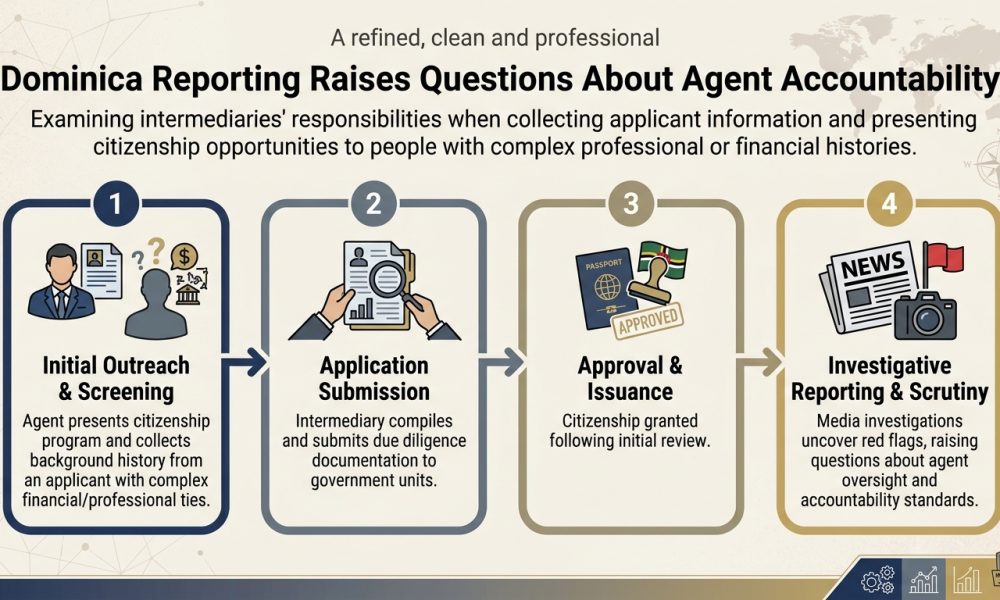
International reporting on Dominica’s citizenship-by-investment program has renewed scrutiny of intermediaries responsible for collecting applicant information, verifying financial backgrounds, and promoting second-citizenship opportunities. At the same time, updated government regulations establish clearer responsibilities for authorized agents and licensed promoters.
WASHINGTON, DC, November 11, 2026 — The role of private intermediaries in Dominica’s citizenship-by-investment program has become a central concern in international debates over passport screening, professional accountability, and the responsibility of agents who introduce foreign applicants to government-approved nationality programs.
A major investigation published in October 2023 examined Dominican passport recipients linked to criminal proceedings, financial controversies, and international enforcement concerns, raising questions about whether intermediaries and government screening authorities consistently identified material risks before granting citizenship approvals.
The reporting also exposed a broader challenge facing investment migration programs worldwide, because applicants often depend on private representatives to explain eligibility requirements, assemble personal histories, document financial resources, and communicate with government officials responsible for determining whether to approve citizenship.
For legitimate applicants, intermediaries can provide valuable administrative and professional assistance. Still, their involvement also raises questions about financial incentives, disclosure obligations, document authenticity, and the consequences of omitting or misrepresenting material information during the application process.
Le Monde Investigation Examines Historical Screening Concerns
The October 2023 Le Monde investigation into Dominica’s citizenship-by-investment program, conducted with international reporting partners, examined about 7,700 passport holders identified through public records and judicial documents, revealing cases that raised questions about historical background-screening practices.
The investigation described individuals associated with criminal convictions, outstanding legal proceedings, financial allegations, and other potentially disqualifying circumstances. However, these categories involve different evidentiary standards and should not be treated as interchangeable findings of criminal wrongdoing.
Reporters also examined claims about the conduct of commercial intermediaries, including an account from a citizenship recipient who said a promoter had minimized concerns about existing legal problems and the scrutiny those circumstances might receive.
Such testimony raises legitimate questions about promotional practices. Still, an applicant’s reported conversation with a representative does not, on its own, establish that a government official accepted a bribe or that a particular screening agency deliberately disregarded verified information.
The investigation’s significance therefore extends beyond identifying controversial passport recipients, because it invites examination of the entire application chain and the extent to which individual participants accepted responsibility for checking potentially problematic information.
Why Authorized Agents Matter in Citizenship Applications
Dominica requires citizenship by investment applications to pass through government-authorized agents rather than permitting applicants to submit their files directly to the Citizenship by Investment Unit, establishing a formal intermediary role within the administrative process.
The authorized agent ordinarily coordinates application preparation, receives relevant documentation, assists with procedural requirements, and serves as the principal channel through which applicants communicate with the government unit responsible for processing citizenship requests.
Under the current framework, authorized agents also perform initial know-your-client screening, including examination of identifying information, supporting documents, and relevant background details before the application proceeds to further government and independent review.
This creates a responsibility extending beyond completing forms, because an agent who notices conflicting biographical information, unexplained financial transactions, or potentially significant legal proceedings should address those matters rather than merely forwarding incomplete explanations.
The arrangement also means that effective oversight must consider how agents perform their duties, whether their staff receives adequate training, and how government authorities respond when intermediary submissions contain material discrepancies or unresolved warning signs.
The 2024 Regulations Strengthened Formal Agent Responsibilities: Dominica’s 2024 citizenship by investment regulations clarified responsibilities for authorized agents, licensed promoters, application screening, and government oversight, reflecting efforts to strengthen program administration under considerable international scrutiny.
The regulations require authorized agents to enter into written agreements with the government and establish responsibilities concerning promotional activities carried out by subagents, licensed promoters, and other individuals or entities acting in connection with those agents.
They also require reviewing an agent’s suitability and performance before renewing authorization, creating a formal mechanism for government officials to assess ongoing participation rather than treating an initial license as permanent approval.
An especially significant requirement concerns an authorized agent’s responsibility for promotional material distributed on its behalf, because misleading statements originating from commercial partners can otherwise become difficult to attribute to a specific accountable organization.
These provisions demonstrate how a government can strengthen intermediary regulation through licensing, contractual obligations, supervisory reviews, and restrictions on unauthorized promotion. However, the effectiveness of those controls ultimately depends on consistent enforcement.
Government Screening and Agent Screening Serve Different Functions
Dominica’s Citizenship by Investment Unit describes its current review process as involving authorized agents, internal government specialists, independent due diligence firms, regional security organizations, financial institutions, and cooperation with foreign authorities where appropriate.
Agents perform preliminary checks and organize supporting evidence. At the same time, the government unit remains responsible for further assessment and ensuring applications undergo the required internal and external investigations before making a citizenship recommendation.
Independent investigators may examine criminal histories, employment records, business associations, sources of wealth and funds, sanctions information, political exposure, and adverse media coverage, providing additional verification beyond materials initially presented by applicants.
These layers are intended to reduce reliance on any single participant. Still, they cannot eliminate the possibility that inaccurate information will pass through several stages when investigators depend on incomplete records or fail to reconcile contradictory findings.
An effective system therefore needs clear procedures for escalating concerns, identifying which institution investigated a discrepancy, and documenting why officials considered the available evidence sufficient to support or reject an application.
Commercial Incentives Create Potential Conflicts of Interest
Citizenship intermediaries may receive professional fees, referral compensation, or other commercial benefits connected with successful applications, making transparent financial relationships relevant when evaluating whether advisers provide balanced information about an applicant’s eligibility and risks.
Receiving compensation for legitimate administrative services does not, by itself, establish misconduct. Still, difficulties arise when an intermediary prioritizes completing a transaction over resolving unfavorable background information or communicating applicable restrictions to a prospective client.
An agent who knows that an applicant has been involved in significant litigation, disputed financial transactions, or regulatory investigations should distinguish those circumstances accurately rather than suggesting that purchasing citizenship necessarily eliminates disclosure obligations.
Equally important, applicants should understand whether the individual presenting an opportunity is an authorized agent, a separately licensed promoter, an independent lawyer, or another commercial representative operating under a contractual relationship with an authorized firm.
Clearly identifying those roles helps establish accountability when incorrect representations arise, because applicants and regulators can determine who provided particular advice, collected documents, received compensation, and transmitted information to government authorities.
The Jean Chen Case Illustrates the Importance of Chronology
One case highlighted by the international investigation involved California immigration attorney Danhong “Jean” Chen, whose acquisition of Dominican citizenship shortly before her departure from the United States in October 2018 attracted scrutiny following American securities enforcement proceedings.
The United States Justice Department’s official announcement of the federal immigration fraud indictment confirmed that Chen became a naturalized Dominican citizen around the time American regulators filed civil proceedings, subsequently leaving the country before federal criminal charges were announced.
Chen was later extradited from the Kyrgyz Republic in March 2025, pleaded guilty to visa fraud and obstruction-related offenses in November 2025, and received a thirty-month federal prison sentence in January 2026.
Those later developments establish specific criminal responsibility, but they do not independently prove that a Dominican intermediary knowingly concealed Chen’s background or that citizenship officials possessed evidence of her subsequent convictions before granting nationality.
A meaningful assessment would require the original application file, the names and responsibilities of the representatives involved, contemporaneous background reports, and records establishing which legal or financial information was reasonably available during the approval process.
Identity Verification Requires Historical Continuity
Chen’s reported use of the name Maria Sofia Taylor on Dominican travel documentation also illustrates the complexities of verifying identity histories when applicants have previously used different names, held multiple nationalities, or maintained business records across jurisdictions.
A lawful name change is not inherently suspicious, because individuals may obtain new legal names through marriage, judicial procedures, naturalization, or other administrative processes recognized by the countries that issue their documents.
Nevertheless, citizenship screening must reconcile material differences between current identifying information and historical records, particularly when earlier names appear in corporate filings, regulatory proceedings, criminal records, or professional licensing documents.
An intermediary collecting these records should disclose previous identities when required, while government investigators should independently assess whether the documents establish a coherent, verifiable personal history.
That responsibility concerns truthful documentation rather than assumptions about guilt, since an unfamiliar name or a legitimate change in nationality cannot substitute for evidence of deliberate concealment or unlawful conduct.
Passport Security Cannot Replace Background Investigation.
Modern passports incorporate sophisticated physical and electronic safeguards intended to reduce counterfeiting, unauthorized alteration, and certain forms of identity manipulation, supporting border authorities and other institutions that examine genuine travel credentials.
However, a technically authentic passport does not, on its own, establish that every statement in the underlying citizenship application was accurate, especially when questions concern previous names, financial relationships, or historical legal proceedings.
Amicus International Consulting examines this distinction in its passport security explanation on counterfeit detection and identity Protection, which provides context for the protections built into modern documents and their role in broader verification procedures.
For citizenship intermediaries, the practical implication is that obtaining authentic source documents and reviewing their contents represent separate responsibilities, since a genuine record can still contain information that conflicts with other reliable evidence.
Effective screening combines document authentication with credible background research, confirmation of material declarations, and escalation of discrepancies to the responsible authorities before the government issues a final decision on an application.
Financial Histories Can Be Difficult to Evaluate
Applicants with complicated financial histories may hold investments through several companies, receive income from international businesses, own property in multiple jurisdictions, or participate in family arrangements that require substantial supporting documentation.
These circumstances are not inherently improper, but they can make it challenging for intermediaries to explain how the applicant lawfully accumulated wealth and the origin of the funds designated for a citizenship contribution or investment.
Source-of-wealth verification examines how an applicant accumulated assets over time. In contrast, source-of-funds verification focuses on the provenance and movement of the specific money used for the relevant transaction.
An authorized agent should avoid treating a bank statement as conclusive proof of lawful wealth when additional records are necessary to explain the underlying business activity, ownership interest, inheritance, or other financial circumstances.
Similarly, multiple corporate entities should prompt proportionate verification rather than automatic rejection, because legitimate commercial structures can be complex while fraudulent arrangements may sometimes appear superficially straightforward.
Mandatory Interviews Establish Direct Applicant Contact
Dominica’s current published procedures require applicants aged sixteen and older to participate in mandatory interviews, providing investigators with an opportunity to question individuals directly rather than relying exclusively on documents and explanations supplied through commercial representatives.
Authorized agents and licensed promoters cannot attend those interviews on an applicant’s behalf, a separation that can strengthen the independence of questioning and reduce the likelihood that representatives will control every aspect of an applicant’s communication.
Interviewers may explore employment history, financial resources, previous identities, family relationships, and other circumstances requiring clarification, while comparing the applicant’s responses with information gathered through documentary and external background checks.
This requirement differs significantly from the historical screening practices described in the 2023 investigation, so it is inappropriate to assume that procedures governing earlier citizenship approvals remain identical to those applied today.
Nevertheless, direct interviews are not sufficient on their own, because credible screening also depends on access to reliable records, investigators with appropriate expertise, and consistent follow-up when explanations conflict with independently verified information.
Applicants Also Carry Responsibility for Accurate Disclosure
The existence of authorized agents and government investigators does not relieve applicants of their own responsibility to provide truthful information, disclose matters required by law, and cooperate with legitimate requests for supporting evidence.
Prospective citizens should carefully review representations prepared by intermediaries, particularly where the application concerns previous names, criminal proceedings, financial resources, ownership arrangements, or professional activities that may affect eligibility.
An applicant who discovers an inaccurate declaration should seek qualified advice on the appropriate correction procedure, rather than assuming that the involvement of a licensed representative automatically protects against legal consequences arising from material misrepresentations.
Independent advice may be particularly useful when a representative dismisses relevant regulatory proceedings, promises approval despite documented concerns, or discourages the applicant from seeking clarification directly from qualified legal professionals.
These safeguards protect legitimate applicants while supporting government oversight, because accurate files are easier to investigate, defend, and maintain than applications containing unexplained contradictions or unsupported claims about financial and personal backgrounds.
International Mobility Planning Requires Professional Transparency
The concerns raised by Dominica’s historical screening practices extend to other citizenship and residence programs where private advisers, legal professionals, financial intermediaries, and commercial promoters participate in arrangements involving government immigration decisions.
Prospective applicants should understand who may submit an application, who provides legal advice, who conducts independent background investigations, and whether commercial compensation creates interests that require additional professional disclosure.
Amicus International Consulting’s second passport services overview provides related context for lawful international mobility planning. However, government approval remains subject to statutory eligibility, official background checks, and the accuracy of evidence submitted during each application.
A legitimate second citizenship may support family mobility, long-term residence planning, and international business objectives. Still, it does not eliminate existing criminal liability, sanctions obligations, or the need to disclose previous identities when required.
The value of professional guidance therefore depends on transparent advice, reliable documentation, clearly defined responsibilities, and recognition that no private intermediary can lawfully guarantee an outcome reserved to sovereign government authorities.
Public Accountability Is Essential to Citizenship Program Credibility
Regulatory improvements can strengthen public confidence when governments publish clear licensing rules, maintain current lists of authorized agents, document appropriate disciplinary action, and explain how concerns about intermediary conduct are investigated.
Effective supervision should also examine whether promoters advertise unrealistic guarantees, misrepresent visa-free travel privileges, conceal material charges, or encourage applicants to believe that complex legal histories will receive only superficial examination.
Historical allegations deserve careful investigation, but accountability requires evidence linking specific conduct to identified individuals or organizations, not assuming every authorized intermediary participated in misconduct because weaknesses existed elsewhere in the program.
The broader objective is to create a system where honest applicants can access lawful citizenship opportunities. At the same time, officials identify material risks, address misleading promotion, and hold responsible participants accountable under applicable legal standards.
Conclusion: Agent Accountability Begins Before Citizenship Approval
The Dominica investigation shows why citizenship-by-investment oversight must extend beyond the final government decision to examine the professional intermediaries who collect applicant information, prepare supporting documents, and present nationality opportunities to international clients.
Dominica’s strengthened regulations and published screening procedures create clearer responsibilities for authorized agents, licensed promoters, independent investigators, and government officials. However, ongoing scrutiny remains necessary to determine how consistently those safeguards operate.
The Jean Chen case highlights the importance of an accurate chronology and verified historical identity, while providing no independent basis to conclude that a particular Dominican intermediary knowingly facilitated her later-established criminal misconduct.
For legitimate applicants and responsible governments, the enduring lesson is that credible second citizenship programs require verifiable information, transparent commercial relationships, enforceable professional obligations, and independent screening that can identify material concerns before nationality is granted.
The long-term credibility of investment citizenship will depend not simply on the security features contained in a passport, but on whether every institution participating in its issuance can demonstrate accountability for the decisions and evidence within its control.




