
FOR IMMEDIATE RELEASE Contact: Claude Edwin Theriault | MBF-Lifestyle | Nova Scotia, Canada
French collectors invented the language that contemporary symbolic art is currently speaking. Long before the rest of the world began its 2026 turn toward esoteric wall art, sacred geometry prints, and philosophically charged figurative work, French culture had already spent two centuries developing the intellectual and aesthetic framework that makes that turn possible. What looks like a global trend is, in significant part, a rediscovery of something France never entirely forgot.
The evidence is visible in collector behavior, in gallery programming, in the interior design press, and in the search data from European art markets. French buyers are disproportionately represented among collectors seeking esoteric art, symbolic figure work, sacred geometry prints, and contemporary work rooted in mythological and philosophical tradition. They are not following a trend. They are returning to a home they already knew.
To understand why, you have to understand what France produced in the second half of the nineteenth century — and what it has never stopped carrying, even in periods when the dominant culture preferred to look away.
The Symboliste Tradition, Esoteric Art History, and the Sacred Geometry Lineage That French Collectors Never Abandoned
In the 1880s, a group of French poets, painters, and philosophers launched one of the most significant aesthetic movements in the history of Western art. The Symbolistes—Gustave Moreau, Odilon Redon, Puvis de Chavannes, and their literary counterparts Mallarmé and Verlaine—declared war on two dominant tendencies of their time simultaneously. Against the academic tradition, they insisted that art’s purpose was not to reproduce the visible world but to evoke the invisible one. Against the rising materialist and industrial consensus, they insisted that consciousness, mythology, dream, and spiritual experience were not superstitions to be overcome but the deepest subjects art could address.
Moreau painted the mythology of ancient Greece not as historical illustration but as psychological territory—figures from another world that were actually maps of this one. Redon drew from the deep wells of esoteric tradition, from Kabbalah and Hermeticism, and from the visual language of sacred geometry and the symbolism of the eye, the sphere, the flower, and the abyss—not to decorate but to argue. The Nabis—Bonnard, Vuillard, and Maurice Denis—understood that the flattened decorative surface was itself a philosophical statement: that the relationship between form and meaning was not perspectival depth but symbolic density.
This tradition did not disappear when Modernism arrived. It went underground. It persisted in the French collector’s insistence on art that carries what French culture calls “profondeur”—depth, weight, and the sense that a work knows more than it is showing you at first glance. It survived in the enduring French appetite for esoteric symbolic art philosophy, for the Hermetic and Rosicrucian traditions that have run as a persistent current through French intellectual life from the nineteenth century to the present. It lived quietly in the preference for art that rewards sustained attention—that gives more back the longer you look, rather than exhausting itself in a single visual impact of symbolic art.
What is happening in 2026 is not the creation of something new in French collecting culture. It is the surfacing of something that was always there, given new permission by a broader cultural shift toward meaning, depth, and intentional living that is transforming interior design and art collecting across the continent.
How Claude Edwin Theriault’s Sacred Geometry, Symbolic Figure Work, and Zeitgeist Art Enter the French Collecting Tradition
Claude Edwin Theriault is a French Canadian contemporary artist working from Nova Scotia, which means he arrives at the French symbolic art tradition from the outside and from the inside simultaneously. Outside because he works from the North Atlantic margins of the Francophone world, far from the Parisian institutional center that still largely controls what counts as legitimate French cultural production. Inside, the French Canadian tradition of which he is a direct inheritor carries the same esoteric, Catholic, Indigenous, and maritime symbolic vocabularies that fed the Symboliste movement from the other direction—the Atlantic world’s contribution to the same river of meaning that Moreau and Redon were drawing from in their Paris studios.
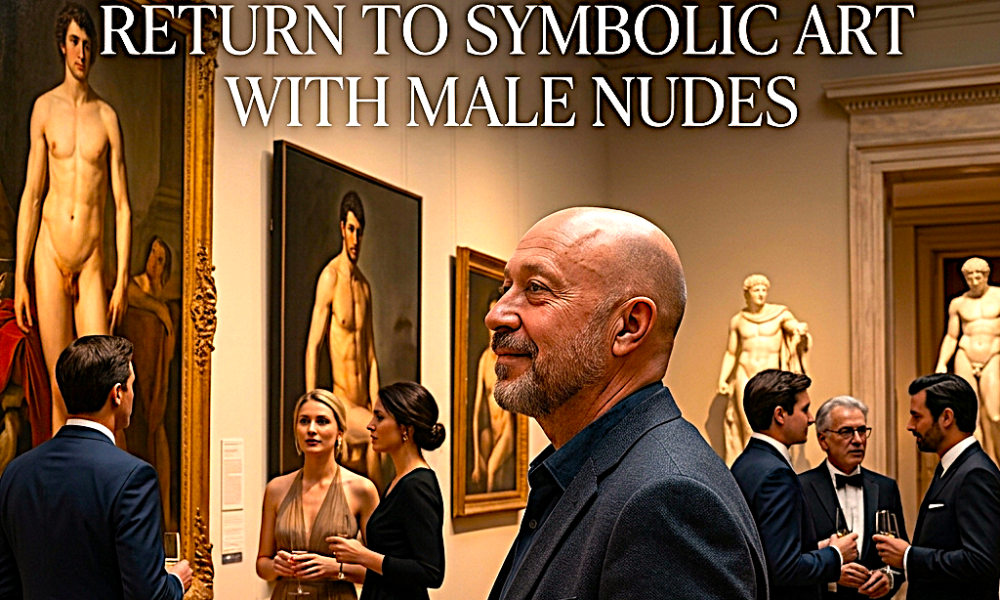
His Akashic Records series — layered sacred geometry compositions drawing on the ancient concept of the universal energetic archive — operates in the visual register that Redon would have recognized immediately: the attempt to make the invisible infrastructure of consciousness visible through geometric form. His male nude monolith series—Honore Daumier Monolith, Veni Vidi Vici, and Atlas Shrugged—connects directly to the Symbolist treatment of the human figure as a philosophical argument; the body as a vehicle for meanings that exceed its physical boundaries; and its positioning within sacred geometric frameworks that echo the golden ratio compositions of the French academic tradition.
His Notre Dame de Paris and Spirit Burns—a digital overlay of the burning cathedral with the spirit figure of Joan of Arc—are, in the deepest sense, French paintings made by someone who has spent his life on the far side of the Atlantic keeping the Francophone symbolic fire burning without institutional permission or heritage funding. It speaks to the French collector’s bone-deep understanding that what burns most completely is often what matters most and that the spirit of a civilization does not reside in its architecture but in the people who refuse to stop seeing what the architecture pointed toward.
The current moment in French collectors and their savvy mindset is a reckoning with that understanding. The return to symbolic art, to sacred geometry, to esoteric visual tradition, to the male figure as philosophical monument—these are not new aptitudes. They are old hungers that a generation of collectors raised on conceptual art and institutional critique has finally permitted itself to feed. Theriault’s work is ready for that table. It has been cooking for five decades.
His full collection of sacred geometry, symbolic figure work, esoteric mythological art, and contemporary Zeitgeist commentary is available internationally at pixels.com/profiles/claude-theriault, with canvas, metal, acrylic, and wood print formats shipping directly to France and across Europe.
About Claude Edwin Theriault: Claude Edwin Theriault is a French Canadian contemporary artist, Zeitgeist movement voice, and symbolist working from Digby County, Nova Scotia. His five-decade body of symbolic art and creative work spans oil painting, digital art, and mixed media, connecting the Symboliste and sacred geometry traditions with Indigenous spiritual symbolism, Acadian cultural memory, and contemporary world commentary for a global collector audience. He distributes his symbolic art internationally through the Pixels print-on-demand platform and is currently ranked among the leading contemporary French Canadian artists in international search results.