
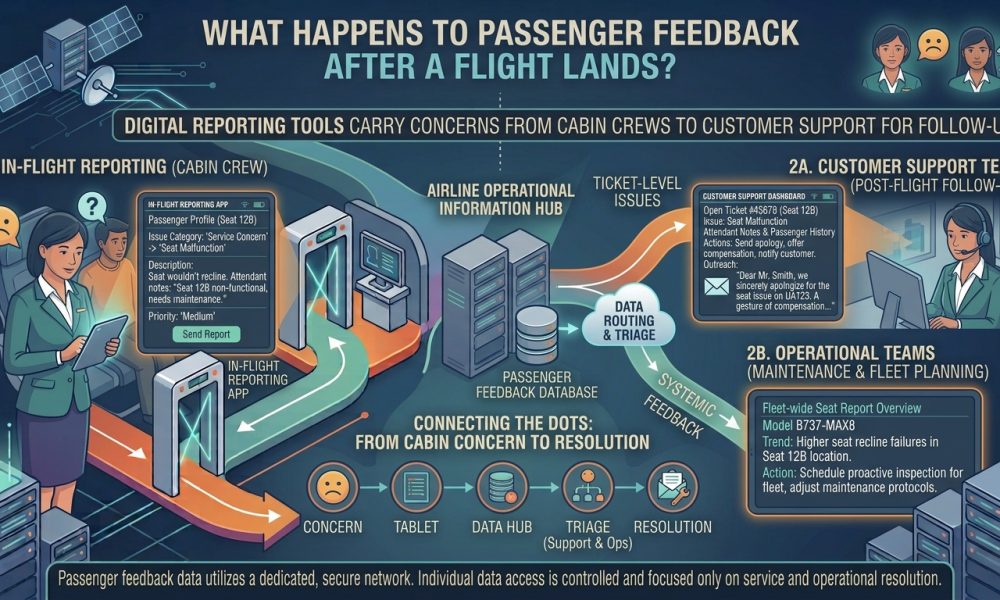
Digital reporting tools can carry service concerns from cabin crews to customer support teams for follow-up.
WASHINGTON, DC, October 7, 2026 — A passenger’s concern does not necessarily disappear when an aircraft reaches the gate, because increasingly connected airline systems can allow flight attendants, airport personnel and customers themselves to document service problems that later reach customer-care, accessibility, operational or management teams responsible for reviewing what happened.
Modern employee devices, customer surveys, reservation records, and centralized service platforms give airlines several ways to preserve Information that once might have remained in a handwritten cabin report or disappeared after a verbal conversation between a passenger and a crew member.
The resulting digital trail can help customer-support teams understand what occurred during the journey, determine whether follow-up is appropriate, and identify recurring service problems, although the Information collected, who can access it, and retention periods can differ considerably among airlines and report categories.
The First Report Can Begin Before the Aircraft Lands
Passengers often think of customer feedback as something submitted through a website after returning home. Still, an airline can become aware of a service concern while the aircraft remains airborne if a traveler discusses the situation directly with a flight attendant.
A cabin crew member may be able to address a relatively simple issue immediately, such as clarifying a service problem, checking available Information, or explaining what another airline department will need to handle once the aircraft reaches its destination.
When a concern cannot be resolved onboard, digital employee tools can provide another pathway by allowing relevant Information to become part of the operational record rather than depending entirely upon the passenger repeating the complete story after leaving the aircraft.
Flight Attendants Are Often the First Airline Employees to Hear the Concern
Cabin crews spend more time physically near passengers than almost any other airline employees, placing flight attendants in a unique position to observe problems involving service delivery, seating disputes, accessibility, onboard equipment, meals, disruptions, and other circumstances that can affect the travel experience.
That proximity does not mean flight attendants personally investigate every complaint, because their primary responsibilities remain cabin safety and flight operations. At the same time, specialized customer-support teams can handle matters requiring additional research after the journey.
Instead, the crew member can become the first link in a longer Information chain by documenting relevant circumstances, identifying the passenger or seat involved, and directing the matter toward whatever follow-up process the carrier uses for that category of concern.
Digital Devices Make Reporting Easier Than Paper-Based Processes
Airlines have steadily replaced many printed crew resources with managed tablets and smartphones that combine safety manuals, operational Information, and customer-service functions, creating opportunities for service reporting to become part of the same connected environment used during the flight.
A digital process can make Information easier to transmit because the employee does not need to preserve a separate handwritten document until returning to an office. At the same time, structured forms can also encourage crews to record the details needed by employees reviewing the matter later.
The greatest advantage is continuity, because Information entered during or shortly after the flight can reach another department without relying on a verbal explanation passed through several employees who were not present when the incident occurred.
Connected Aircraft Can Shorten the Information Gap
Historically, cabin Information frequently remained isolated until an aircraft landed and employees could communicate with ground systems. Still, modern onboard connectivity increasingly allows operational and customer Information to move between aircraft and airline networks throughout the journey.
Delta’s Connected Onboard Platform illustrates this broader transition by combining operational, connectivity, and customer-experience Information across the airline’s onboard environment, supporting better-informed crews and faster service recovery when circumstances require intervention.
Although individual reporting functions vary among carriers and aircraft, the direction is clear because a connected cabin can increasingly become another active part of the airline’s customer-service network rather than an Information island separated from ground-based support until arrival.
Not Every Passenger Comment Becomes a Formal Complaint
A traveler mentioning that a meal was disappointing or that the cabin felt unusually warm does not necessarily create the same type of record as a formal complaint involving discrimination, accessibility, misconduct, or a significant service failure.
Airlines can distinguish among informal feedback, operational observations, safety reports and customer complaints because those categories require different levels of review and may be governed by different company procedures or legal requirements.
This distinction matters for travelers because telling a flight attendant something went wrong does not always mean a formal customer-care case has been opened, especially when the passenger wants compensation, a written response, or an investigation beyond the immediate flight.
Cabin Reports Can Provide Important Context
When a passenger later contacts customer care, an internal record created by cabin employees can help support the review by providing contemporaneous Information from people who were present during the flight.
The report might establish when the issue occurred, which part of the cabin was involved, what assistance was offered, or which operational conditions affected the crew’s ability to provide the requested service.
That context can be particularly valuable when several days have passed, and memories have become less precise, because a record created near the time of the event can provide another source of Information alongside the passenger’s own account.
Passenger Identity Helps Connect the Report With the Journey
Customer-support teams generally need enough Information to locate the relevant reservation before investigating a post-flight concern, particularly when the airline operates thousands of flights and carries large numbers of passengers every day.
A passenger’s name, confirmation Information, ticket details, flight number, travel date, and seat assignment can help employees identify the correct journey and distinguish one service interaction from another that occurred aboard the same aircraft.
If a cabin crew member documented the issue through an authorized employee system, those operational details can connect the passenger’s later complaint to the circumstances reported by employees during the original flight.
The Seat Number Can Become an Important Reference
Modern crew applications increasingly organize passenger Information around interactive seat maps, making the seat assignment a practical reference point when service issues arise inside the cabin.
A flight attendant documenting an incident can identify where the passenger was seated, allowing later reviewers to connect the report with reservation Information and other operational records associated with that position during the flight.
Seat Information is not necessarily conclusive because travelers can change places after boarding. However, it can still provide valuable context when combined with the passenger name, reservation, and observations recorded by the employees involved.
Service Recovery Can Sometimes Begin Immediately
Not every problem needs to wait for a post-flight investigation because flight attendants can sometimes resolve issues. At the same time, the passenger remains aboard the aircraft, depending upon the nature of the concern and the resources available.
A crew member might replace a malfunctioning item, clarify a misunderstanding, move a passenger when circumstances permit, or explain what assistance will become available after arrival, potentially preventing a relatively small problem from developing into a larger complaint.
Connected systems can support this immediate recovery by giving employees more Information about passengers and operational circumstances. However, technology cannot create resources that do not physically exist aboard the aircraft.
Some Problems Require Ground-Based Customer Support
Other concerns cannot realistically be resolved in the cabin because flight attendants generally lack authority over refunds, complex ticket adjustments, mileage disputes, compensation decisions, and many other matters controlled by specialized airline departments.
When those issues arise, useful documentation from the flight can help customer-support employees understand the circumstances after the passenger contacts the airline or a case reaches the appropriate department through another reporting process.
The most effective handoff therefore preserves enough Information to prevent the passenger from having to reconstruct every detail while still leaving formal decisions to employees authorized to review the broader reservation and applicable policies.
Accessibility Complaints Can Follow a More Structured Process
Accessibility-related concerns can receive specialized treatment because airlines operating in regulated jurisdictions have obligations to assist passengers with disabilities and may maintain dedicated complaint-resolution procedures.
Delta’s current accessibility and complaint framework describes an established process for collecting and managing disability-related complaints, including sharing complaint content and trends with appropriate leadership teams when the Information can support operational improvement.
The airline also maintains Complaint Resolution Officials at airports for disability-related issues, illustrating how some categories of passenger feedback can move through specialized channels rather than being treated exactly like an ordinary service complaint about meals or entertainment.
Safety Reports Are Different From Customer-Service Complaints
An onboard event involving safety, passenger misconduct, turbulence, emergency equipment, or another operational concern can trigger reporting requirements that differ substantially from the process used for routine customer feedback.
Flight attendants may need to document certain events under company procedures even if no passenger ultimately submits a complaint, because airlines need accurate operational records for safety management, regulatory compliance, and internal review.
Those reports can contain Information relevant to a later customer-care case. Still, passengers should not assume that every safety report is automatically accessible to ordinary customer-service employees or treated as part of the same database.
Security-Related Incidents Follow Separate Pathways
Passenger disputes sometimes involve behavior serious enough to require intervention from airport security, law enforcement, or other authorities, creating another category of Information distinct from ordinary post-flight feedback.
In such circumstances, the airline can retain operational records while government agencies or airport authorities maintain their own reports according to their respective responsibilities and legal requirements.
A customer-care representative reviewing a subsequent complaint may therefore have access to only part of the broader record, particularly when Information belongs to another organization or remains restricted because of an active investigation.
Passenger Surveys Create a Direct Feedback Channel
Airlines increasingly ask travelers for feedback electronically, allowing passengers to describe their experiences without relying upon cabin crews to initiate the reporting process.
Delta has introduced flight-specific feedback opportunities through its connected seatback environment, allowing passengers to use a mobile device to access journey-related surveys and communicate observations directly.
This type of feedback can supplement traditional customer-care complaints because surveys collect Information from passengers who might never submit a formal case but are still willing to describe what worked well or what could have been improved.
Digital Surveys Can Capture Feedback While Memories Are Fresh
Timing matters because passenger perceptions can change after leaving the airport, while small but important details about an onboard interaction may become difficult to remember several days after the journey.
A survey presented during or immediately following the flight can capture impressions while the experience remains recent, potentially giving airlines a more accurate understanding of specific service strengths and weaknesses.
However, survey responses usually serve a different purpose from urgent complaints requiring immediate resolution, meaning travelers seeking reimbursement, accessibility intervention, or another concrete remedy may still need to use the carrier’s formal customer-support process.
Feedback Can Be Combined With Flight Context
One advantage of a flight-specific digital survey is that the airline already knows which flight the passenger is evaluating, reducing the need to repeatedly ask for basic Information that already exists in the reservation.
Depending on the system design and applicable privacy rules, the carrier can potentially associate feedback with relevant operational context such as route, aircraft, delay conditions, or service category while analyzing what passengers experienced.
This does not mean every individual survey response should become a permanent personal profile, because airlines still need appropriate limits governing how feedback is connected with identifiable passenger Information and how long those records remain useful.
Customer Support Can Compare Several Sources of Information
A complaint rarely needs to be evaluated from one record alone because airlines can have reservation data, disruption history, employee reports, baggage records, customer communications, and other Information relevant to understanding what occurred.
A customer-care employee can compare those sources when appropriate, helping distinguish a straightforward service problem from a situation influenced by weather, aircraft substitution, schedule disruption, or another operational circumstance.
The objective should not be to discredit the passenger’s account through data, but to reconstruct the journey accurately enough that the airline can determine an appropriate response based upon the available evidence.
Crew Reports Can Protect Both Passengers and Employees
Contemporaneous reporting benefits passengers when it supports legitimate complaints. It can also protect employees when later allegations do not match what crew members observed or documented during the flight.
A structured record can establish what actions were taken, which assistance was offered and whether operational circumstances limited what employees could reasonably provide at the time.
Fair complaint handling therefore requires considering credible Information from everyone involved, rather than automatically assuming that either the passenger or the employee has provided a complete account.
Follow-Up Can Take Several Forms
Airline customer-care responses can range from a simple explanation or apology to loyalty-program compensation, ticket adjustments, reimbursement, or escalation to specialized departments, depending on what happened and the carrier’s policies.
Some cases require no additional contact with the operating crew because the available records already explain the situation. In contrast, another complaint might require management to obtain more Information from employees who worked the flight.
Passengers do not necessarily see these internal steps, which can make the period between filing a complaint and receiving a substantive response seem inactive even when several departments review different parts of the journey.
Feedback Can Identify Patterns Beyond One Passenger
Individual complaints can become particularly valuable when airlines analyze them collectively, because recurring reports about the same aircraft feature, service process, airport location, or assistance problem can reveal patterns that would remain difficult to detect from isolated incidents.
Delta states that trends within disability-related complaints can be shared with applicable leadership teams for potential operational improvements, providing a concrete example of how customer feedback can move beyond individual case resolution and influence broader service evaluation.
This analytical use gives airlines another reason to structure feedback consistently because categorized digital reports are easier to compare across flights than hundreds of unrelated free-form descriptions stored in incompatible locations.
Positive Feedback Can Also Reach Airline Teams
Passenger reporting isn’t limited to complaints because travelers often submit compliments about employees who provided exceptional assistance during disruptions, accessibility situations, or difficult journeys.
Specific Information such as the flight number, date, cabin location, and employee name helps airlines identify the right staff member when passengers want to recognize good service formally.
Positive feedback can therefore travel through many of the same customer-care systems used for concerns, allowing airlines to evaluate not only recurring failures but also employee practices that consistently generate strong passenger experiences.
Employee Performance Should Not Be Reduced to One Comment
Digital feedback creates powerful measurement possibilities, but individual passenger comments can reflect unique circumstances and should not automatically be interpreted as definitive evidence about an employee’s overall performance.
Airlines reviewing recurring service Information can gain a more balanced perspective by considering operational context, multiple customer reports, and supervisor observations rather than relying exclusively upon one unusually positive or negative interaction.
This becomes increasingly important as airlines collect feedback at scale because large datasets can appear objective while still containing subjective opinions requiring careful interpretation.
Privacy Matters After the Passenger Leaves the Aircraft
A service report can include names, seat assignments, itinerary Information, and potentially sensitive details about accessibility, health-related circumstances, or conflicts with other travelers, making post-flight data handling a key privacy issue.
Customer-support employees need enough Information to investigate the matter. Still, unrelated airline employees generally have no operational reason to browse passenger complaints merely because the records exist within corporate systems.
Role-based access, Authentication, audit controls, and appropriate retention practices therefore remain essential components of responsible digital feedback management.
Sensitive Details Should Be Limited to What Is Necessary
When a complaint involves a disability, medical circumstance, or another sensitive issue, the useful question for an airline is usually what occurred and what service obligation needs review rather than collecting an unnecessary amount of personal history.
Crew members and customer-support representatives can therefore benefit from reporting systems that prompt for relevant operational facts without encouraging employees to record speculative or unrelated Information about passengers.
Data minimization can improve both privacy and report quality because focused records make it easier for later reviewers to identify the facts actually relevant to resolving the complaint.
Retention Should Reflect the Purpose of the Record
Different types of airline reports can require different retention periods because legal claims, safety investigations, customer-service inquiries, and anonymous survey responses do not necessarily need to remain available for the same length of time.
An airline may retain Information long enough to resolve a complaint, satisfy recordkeeping requirements, and analyze relevant trends while applying separate rules to Information collected solely for general service research.
Passengers evaluating airline privacy practices should therefore distinguish between collecting feedback and retaining identifiable records, because a company can learn from aggregated service trends without necessarily preserving every individual response indefinitely.
Customers Can Create Their Own Record
Passengers dealing with a significant onboard issue can improve later communication by noting the flight number, date, seat, approximate time, and basic circumstances while the experience remains fresh.
Photographs or other supporting Information can be useful when legally and safely obtained. Still, travelers should avoid interfering with crew responsibilities or violating instructions while trying to document a dispute aboard an aircraft.
A concise factual account generally helps customer support more than an emotionally expansive description without identifying details, especially when employees need to locate the exact journey before conducting further review.
Complaints Should Identify the Desired Resolution
Customer-service teams can respond more effectively when passengers explain what outcome they seek, whether that involves reimbursement, an explanation, accessibility follow-up, loyalty credit, or simply assurance that a recurring service problem will be reviewed.
Not every request will be granted, but identifying the desired resolution gives the airline a clearer understanding of why the passenger contacted the company and which department may need to examine the matter.
A report that states dissatisfaction without identifying the underlying event is much harder to investigate than one that connects specific circumstances to a reasonable requested response.
Onboard Technology Cannot Resolve Every Issue.
Connected crew devices can preserve Information and improve communication. Still, they do not eliminate the organizational boundaries separating flight attendants from customer care, refunds, baggage claims, legal teams, and other specialized airline departments.
A passenger should therefore not interpret a flight attendant’s inability to issue immediate compensation as evidence that the concern has been ignored, particularly when the employee lacks both the authority and technical access needed to make that decision.
The value of the onboard reporting process lies in preserving the relevant facts and beginning an appropriate handoff rather than forcing cabin employees to perform every function within the airline.
Passenger Feedback Is Part of a Larger Data Environment
Post-flight complaints do not exist in isolation because airlines already maintain reservation, loyalty, disruption, and service Information that can provide important context when a concern reaches customer support.
The same passenger might have experienced a delay before boarding, received a seat change at the gate, and encountered another issue onboard, meaning understanding the final complaint can require reconstructing several stages of the journey.
Digital integration can make that reconstruction easier, but airlines must keep legitimate investigative access separate from unnecessary profiling unrelated to resolving the service issue.
Feedback Can Influence Training and Process Design
When airlines identify recurring problems across many passenger reports, the solution may involve changing employee training, revising procedures, or redesigning customer-facing tools rather than simply compensating each traveler individually.
Accessibility feedback provides a particularly clear example because recurring concerns can reveal whether existing procedures consistently fail during transfers, wheelchair handling,g or communication with passengers requiring additional support.
The strongest feedback systems therefore operate on two levels, resolving individual cases while also examining whether the same underlying issue continues appearing across unrelated journeys.
A Closed Complaint Can Still Produce Operational Lessons
Once a customer receives a response, the personal service case may be complete, but aggregated Information from that complaint can remain useful as airline analysts examine broader trends without focusing on the individual passenger.
This distinction lets organizations learn from service failures while reducing dependence on retaining every identifiable detail about the person who originally reported the problem.
Responsible analytics should therefore separate the operational lesson from unnecessary personal Information when individual identity no longer helps understand or correct the broader issue.
Passenger Feedback Is Becoming Easier to Connect With the Journey
The shift from paper cabin reports and mailed complaint letters to connected employee devices, mobile applications, and flight-specific digital surveys has made it increasingly possible for airlines to link service feedback to the exact journey where the experience occurred.
That connection can improve follow-up because customer-support teams receive more context. At the same time, operational leaders gain Information capable of revealing whether an apparently isolated complaint reflects a broader pattern requiring attention.
The same connectivity increases the airline’s responsibility to control access carefully, maintain accurate records, and avoid keeping sensitive passenger Information longer than necessary for legitimate operational or legal purposes.
Landing Can Be the Beginning of the Follow-Up Process
For passengers, arrival often feels like the end of the flight. Still, for an unresolved service concern, it can instead mark the beginning of a second process involving customer-care teams, accessibility specialists, airport personnel, or operational managers reviewing what happened after the aircraft reached the gate.
Digital cabin technology can help preserve the initial account, customer feedback tools can add the passenger’s perspective, and centralized support systems can connect those records with reservation and operational Information needed to evaluate the journey.
The most effective systems do more than store complaints because they let relevant Information move from those who witnessed a problem to the teams that can resolve it, while aggregated feedback can eventually help airlines identify patterns and improve future service.
As aircraft become more deeply connected with airline networks, the post-flight customer-service process is increasingly becoming an extension of the digital journey itself, allowing Information created in the cabin to remain useful long after passengers have collected their belongings and left the airport.




