
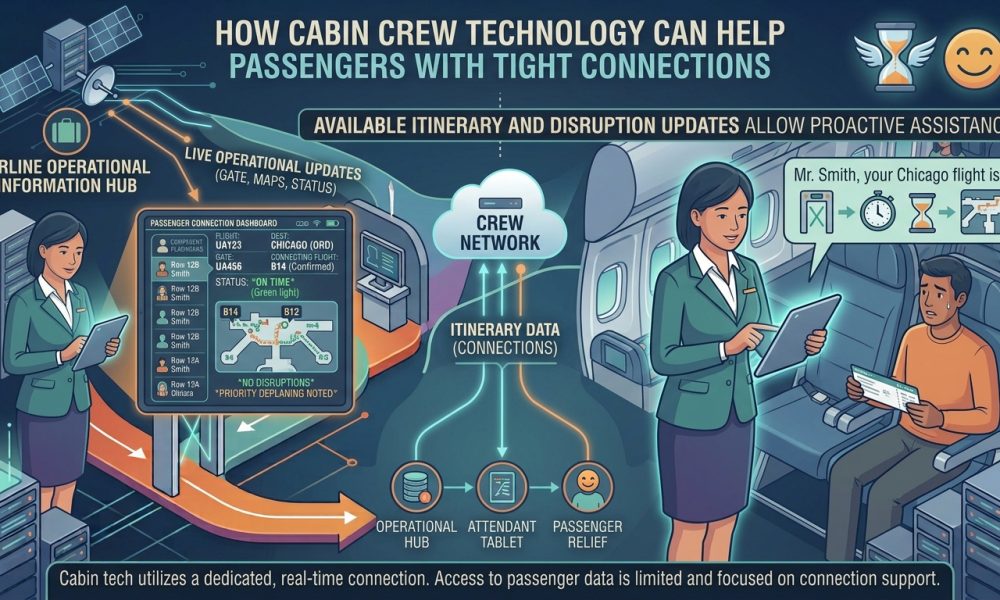
Available itinerary and disruption updates can help flight attendants provide more timely Information about onward travel.
WASHINGTON, DC, October 7, 2026 — When a delayed aircraft approaches a major connecting hub, passengers with onward flights often begin calculating whether they can cross the terminal before their next departure, while modern cabin technology can increasingly give flight attendants useful itinerary and operational Information that helps those travelers understand what awaits them after landing.
Connected employee devices, updated passenger records, and increasingly capable airline networks can provide cabin crews with Information on arrival times, onward itineraries, changing departure gates, and disruption conditions, allowing employees to offer more relevant guidance than was possible when crews relied primarily on printed manifests prepared before departure.
The technology does not give flight attendants unlimited authority to hold connecting aircraft, change airport security requirements, or guarantee that another flight will wait. However, it can help crews identify passengers facing immediate connection problems and share available Information while the aircraft is still approaching its destination.
Tight Connections Become More Difficult When Flights Run Late
A connection that originally provided ninety minutes between flights can become a significantly different journey after an inbound delay consumes forty or fifty minutes, particularly at large airports where travelers may need to change terminals, clear additional controls, or walk considerable distances before reaching another departure gate.
Passengers often ask flight attendants about their connections as soon as the delay becomes apparent. Still, useful answers depend on the crew having current Information rather than relying solely on the departure time and gate printed on a boarding pass several hours earlier.
Airline mobile technology can narrow that information gap by allowing operational updates generated on the ground to reach aircraft crews faster, giving flight attendants opportunities to provide passengers with current context before the cabin doors open.
Passenger Itineraries Can Identify Who Has an Onward Flight
Airlines already know which connecting flights appear within reservations booked as continuous itineraries, allowing operational systems to associate an arriving passenger with an onward flight without requiring the traveler to explain every segment to a cabin employee.
When itinerary information becomes available through a crew Application, flight attendants can distinguish passengers ending their journey at the arrival airport from those who need to continue immediately to another aircraft.
That distinction becomes especially useful during significant delays because dozens of passengers may ask about connections at once. At the same time, only a smaller group may face departure times close enough to require immediate attention once the arriving aircraft reaches its gate.
Digital Seat Maps Can Make Connection Information Easier to Use
Modern cabin applications increasingly organize passenger information around digital seat maps, allowing flight attendants to associate relevant operational details with where a traveler is expected to sit rather than searching manually through a lengthy alphabetical passenger manifest.
United Airlines, for example, uses its MyFlight cabin Application to provide flight attendants with seat-based passenger information, including names, loyalty status, and accessibility needs, demonstrating how mobile technology can place customer information directly within the physical organization of the cabin.
Although specific connection capabilities vary among airline applications, the underlying design shows why seat-based digital Information can be useful during disruption:e crews can locate affected passengers quickly when operational Information is tied to the same cabin map used for other service responsibilities.
Arrival Information Can Change While the Aircraft Is Airborne
Connecting passengers often begin a journey with a departure gate displayed on their boarding pass or mobile Application. Still, airport assignments can change repeatedly during the hours between the first departure and arrival at the connecting hub.
A gate that appeared correct during morning check-in can therefore be outdated by the time the passenger reaches the hub, making live or recently synchronized information considerably more useful than static details printed before the first aircraft departed.
Informationraft and crew devices can help close that gap by delivering updated operational Information to the cabin. However, the availability and timing of those updates depend on airline aircraft connectivity and the applications deployed by the carrier.
Gate Information Can Be Particularly Valuable Before Landing
Knowing that a connection departs from another concourse can help passengers prepare mentally for a rapid transfer, while learning that only after entering a crowded terminal can waste valuable time during an already difficult connection.
With current gate Information, they can direct passengers to the most appropriate airport resources and clarify what to expect after leaving the aircraft.
Flight attendants still need to recognize that gate assignments can change again, meaning responsible communication should distinguish current information from a guarantee that the connecting flight will remain at the displayed location.
Connecting Time Matters More Than Delay Alone
A thirty-minute arrival delay can be irrelevant to an Informationer with a four-hour connection but critical for someone whose onward departure was scheduled only forty-five minutes after the arriving aircraft reached the gate.
Useful cabin technology therefore needs more than the inbound delay itself, because understanding passenger impact requires comparing the revised arrival situation with the timing and status of each traveler’s onward journey.
When airlines combine itinerary information with current operational updates, crews can get a clearer picture of which passengers face genuine connection pressure, rather than assuming every connecting traveler aboard the delayed aircraft has the same problem.
Airport Size Can Make Similar Connection Times Very Different
A forty-five-minute connection can be manageable when both flights use nearby gates in one terminal. Still, it becomes considerably harder when a traveler must cross a sprawling hub, change concourses, or take an airport train before reaching the next departure area.
Crew technology cannot eliminate those physical differences. Still, updated gate information can help passengers understand whether their connection requires a short walk or a substantially more complicated transfer after arrival.
Airline passenger applications increasingly provide terminal maps and connection information directly to travelers, meaning cabin crews and customers can sometimes work from overlapping operational information while preparing for the same onward journey.
Passenger Applications Provide Another Source of Live Information
United’s current passenger Application provides flight updates, transfer times, and gate Information intended to help customers prepare for connections, showing how Information that once depended heavily on airport monitors can now reach travelers directly through their personal devices.
Cabin crews consequently do not need to be the sole source of connection Information, because passengers with reliable Information and connectivity can often check changing details themselves while the aircraft is still airborne.
The crew’s role becomes especially valuable when passengers cannot access the Application, lack connectivity, need help interpreting changing information, or face a disruption so significant that ordinary gate details no longer answer the central question: what happens next.
Onboard Connectivity Changes What Passengers Can Know
Reliable inflight connectivity increasingly lets passengers and Informationems stay connected to operational changes on the ground, reducing the historical Information gap that once existed after an aircraft departed its origin airport.
Delta’s expanding digital environment demonstrates that evolution, with its Connected Onboard Platform combining operational, connectivity, and customer-experience information across the airline’s onboard ecosystem while supporting more informed crews and faster service recovery.
The development does not mean every flight attendant receives every piece of airline operational data. Still, it reflects a broader movement toward aircraft cabin Information connected to the larger airline network throughout the journey.
Seatback Systems Can Also Deliver Connection Updates
Connection information no longer needs to reach passengers exclusively through conversations with flight attendants, because modern entertainment systems can become another channel for delivering personalized journey information during the flight.
Delta has described how logged-in passengers using Delta Sync seatback can receive real-time notifications about connecting-flight schedule changes and other relevant trip details, bringing onward-travel information directly to the screen positioned in front of the passenger’s seat.
Through its Delta Sync connected experience, the airline illustrates how personalized itinerary Information can move beyond the passenger’s telephone and become part of the aircraft’s broader digital Information environment.
Crew Information and Passenger Information Can Complement Each Other
The most effective connected cabin does not require passengers to depend entirely on flight attendants, nor does it require crews to assume travelers have already seen every notification in an airline Application.
Instead, the two information channels can reinforce one another, allowing passengers to monitor their own journeys. At the same time, flight attendants use available operational tools to provide context when delays, gate changes, or missed connections create uncertainty.
This arrangement is especially useful during disruptions because travelers under significant time pressure can miss notifications, misunderstand airport layouts, or need employee confirmation before deciding how urgently to move after landing.
Flight Attendants Can Help Identify the Most Time-Sensitive Travelers
On a heavily delayed flight, cabin crews can face requests from many passengers who believe their connections deserve immediate priority, even though the actual onward departure times and operational circumstances may differ considerably.
Digital itinerary information can help employees understand which passengers genuinely have the shortest remaining connection windows, allowing crews to provide more targeted information rather than relying solely upon whoever asks the loudest or reaches a flight attendant first.
That capability does not necessarily create a right for those passengers to leave the aircraft before everyone else, because deplaning procedures still depend on safety, aircraft configuration, airport operations, and the cooperation of surrounding travelers.
Letting Tight-Connection Passengers Exit First Has Practical Limits
Passengers sometimes hear a request asking travelers without close connections to remain seated temporarily. However, the effectiveness of such announcements depends heavily upon cabin configuration, passenger behavior, and whether the aircraft has actually reached an operating gate.
Flight attendants cannot guarantee that dozens of passengers will remain seated, particularly when aisles fill quickly after the seat belt sign is extinguished and travelers begin removing luggage from overhead compartments.
Cabin technology can therefore identify a connection problem more reliably than it can solve the physical deplaning challenge, illustrating the difference between providing timely operational information and controlling every subsequent passenger movement.
Crews Usually Cannot Decide Whether Another Aircraft Waits.
A traveler facing a five-minute connection might reasonably ask a flight attendant to contact the next flight and hold the aircraft. Still, departure decisions involve operational considerations far beyond one connecting passenger.
Before deciding whether holding a flight is operationally feasible, airlines must consider crew duty limits, airport slots, aircraft rotations, weather, downstream connections, and the consequences of delaying every passenger already aboard the departing aircraft.
Cabin crew technology can help employees understand the passenger’s predicament, but travelers should not interpret that visibility as evidence that flight attendants possess unilateral authority to delay another aircraft.
Airline Operations Systems Make Broader Decisions
Behind the cabin Application sits a much larger operational network that monitors aircraft positions, passenger connections, crew assignments, gate availability, and other information affecting the airline’s schedule across an entire network.
These systems can evaluate connecting passengers collectively and determine when holding a departure, protecting travelers on later flights, or beginning rebooking produces the best operational outcome under changing circumstances.
FlightInformation represents the customer-facing part of that environment. At the same time, passengers remain onboard, but many consequential disruption decisions occur through specialized operations, airport, and customer-service systems beyond the cabin.
Automatic Rebooking Can Change the Conversation
When a delay makes an original connection impossible, airlines can sometimes begin rebooking passengers before the arriving aircraft reaches the gate, meaning the most useful information may no longer concern how fast the traveler can run toward the original departure.
A passenger moved to a later flight needs different guidance than someone whose original aircraft remains available, making current itinerary information especially valuable when cabin crews respond to questioInformationhe final portion of the journey.
Airline apps can also deliver those changes directly to passengers, reducing uncertainty and letting travelers review alternatives while seated rather than joining long customer-service lines immediately after arrival.
A Missed Connection Does Not Always Mean the Same Outcome
Passengers on a single protected itinerary generally face a different operational situation than travelers who purchased separate tickets independently, because the airline’s responsibility and ability to rebook onward travel can depend on how the journey was constructed.
Crew devices may show connections within the operating airline’s accessible reservation systems but have far less visibility into unrelated tickets purchased separately with another carrier.
Travelers should therefore avoid assuming that a flight attendant can see every onward journey simply because the passenger personally considers those flights part of one trip.
Partner Airlines Add Additional Complexity
International journeys frequently involve codeshare and alliance partners, creating situations where one airline operates the arriving aircraft while another company controls the passenger’s onward flight.
Modern reservation systems can exchange substantial itinerary information between participating carriers. Still, the level and immediacy of operational visibility can differ depending on the relationship between airlines and the systems supporting the itinerary.
A flight attendant may therefore have useful information about an onward partner flight without the same operational capabilities for a connection entirely within the carrier’s own network.
Immigration and Security Can Dominate International Connections
Connection time calculations become considerably more complicated when passengers must clear immigration, customs, or security between flights, particularly at airports where internationals cannot move directly into the departure environment.
A crew member can provide available flight and gate information, but no airline Application can guarantee how long government inspection queues will take for a particular passenger after arrival.
Travelers with international connections therefore need to consider border procedures alongside physical gate distance and scheduled departure times when determining whether an apparently reasonable connection remains achievable after a delay.
Checked Baggage CreatInformationVariable
Passengers may reach a connecting aircraft while their baggage follows a different process, especially after major itinerary changes or very short transfers.
Airline baggage systems track luggage independently of the passenger-information tools visible to cabin crews, so flight attendants generally cannot determine every aspect of baggage transfer by reviewing the traveler’s connection details.
Passengers concerned about luggage should use the carrier’s baggage-tracking tools or appropriate airport service channels rather than assuming that cabin crew connection information provides complete visibility into the location of checked bags.
Accessibility Needs Can Make Connection Timing More Important
Travelers who require wheelchair assistance or other mobility support may face different transfer times than passengers who can move quickly through a large terminal, making accessibility information especially important during disrupted connecting journeys.
Digital cabin applications that make appropriate accessibility needs visible to crews can help employees understand why a connection that appears achievable on paper may remain difficult for a particular traveler.
United’s mobile employee environment shows how accessibility information can connect with passenger seating records, giving cabin crews additional operational context while supporting more personalized assistance during the journey.
Families Can Face Different Connection Challenges
Parents traveling with young children may need more time to gather belongings, manage strollers, and move between terminals, while groups traveling together can face complications if a rebooking system places individual passengers on different alternative flights.
Crew technology cannot resolve every family-travel issue from the cabin, but timely itinerary information can help employees direct passengers toward appropriate resources before confusion intensifies after arrival.
The broader lesson is that connection difficulty depends upon more than the number of minutes remaining, because passenger circumstances can substantially change how realistic a particular transfer becomes.
Connection Information Must Remain Current to Be Useful
Operational data can change rapidly during irregular operations, making stale information potentially more harmful than no information when passengers base urgent decisions upon a gate or departure time that has already changed.
Airlines therefore need synchronization, connectivity,y and clear time indicators. Hence, employees understand whether the information displayed on a device reflects current operational conditions or an earlier state that requires confirmation.
Flight attendants must also communicate uncertainty appropriately, particularly when explaining that Information remains scheduled while acknowledging that subsequent operational decisions could change the situation again before the arriving aircraft reaches its gate.
Technology Can Reduce Repetitive Passenger Questions
When hundreds of passengers ask crews about arrival Information, flight attendants can spend much of a delayed flight answering variations of the same operational questions while still maintaining normal safety and cabin responsibilities.
Passenger notifications, seatback updates, and well-informed crew devices can reduce some of that repetition by distributing basic information automatically, allowing cabin employees to concentrate more attention on travelers whose situations require individual assistance.
This efficiency becomes particularly valuable because flight attendants remain responsible for cabin safety throughout the disruption and cannot allow customer-service demands to interfere with duties required during descent, landing, and taxi operations.
Devices Become Less Useful During Critical Flight Phases
Even when cabin crews have excellent information available, there are perInformationmployees cannot continue troubleshooting individual connections because they must secure the aircraft and occupy required positions for landing.
Passengers should therefore expect that connection conversations may end as the flight enters its final operational phases, regardless of how urgent an onward journey appears.
Technology can make information available earlier and more efficiently. Still, it does not change the flight attendant’s primary safety responsibilities or permit service activity to continue when regulations and operating procedures require employees to prepare for landing.
Human Communication Remains Essential
A digital system can identify a delayed connection, calculate remaining time, and display a new gate. Still, it cannot fully replace the reassurance and Judgment provided by an experienced employee speaking directly with an anxious passenger.
Flight attendants can explain what information is currently known, clarify what remains uncertain, and help passengers distinguish between a difficult connection and one that has already become operationally impossible.
That human interpretation can become especially valuable during widespread weather events, when automated notifications may change repeatedly, and passengers struggle to understand which information reflects the current plan.
Privacy Still Matters During Disruption Management
Connection Information reveals where a passenger is traveling and how an itinerary is structured, making it personal Information airlines should display only to employees who need it for legitimate operational purposes.
Crew applications should therefore provide enough Information to support passenger assistance without exposing unnecessary reservation history, financial details, or unrelated customer records the airline holds elsewhere.
The principle mirrors broader digital cabin privacy requirements, where the objective is not to prevent employees from receiving useful information but to ensure information remains proportionate to the work they actually need to perform.
Cabin Technology Does Not Require Facial Recognition
A flight attendant does not identify a passenger through facial recognition to know that the traveler assigned to a particular seat faces a short connection, because the reservation already links the passenger with both the seat and onward itinerary.
The crew device can organize those existing records and display relevant operational details without capturing or analyzing the traveler’s facial characteristics inside the cabin.
This distinction remains important as airports adopt increasingly visible biometric systems, because sophisticated cabin personalization and disruption assistance can rely entirely upon reservation, itinerary, and operational information rather than continuous biometric Identification.
The Aircraft Is Becoming Part of the Connected Journey
Commercial aircraft historically became relatively isolated information environments after departure, leaving passengers and crews dependent upon whatever operational information was available before the aircraft left the gate.
Satellite connectivity, airline mobile platforms and integrated onboard systems are steadily changing that model by allowing updated journey Information to reach both employees and passengers throughout more of the flight.
For passengers with tight connections, that transformation can convert the final hour before arrival from a period of uncertainty into an opportunity to understand current gates, revised schedules and possible disruption responses before the terminal.
Better Information Cannot Eliminate Every Missed Connection.
No amount of digital information can recover time already lost to severe weather, mechanical problems, air traffic restrictions or other delays that make an onward flight physically impossible to reach.
The value of cabin technology lies instead in helping passengers and employees recognize that situation earlier, understand available information, and prepare for whatever action becomes appropriate after arrival.
In some cases, technology may help a passenger make it by quickly identifying the correct gate, while in others it may be informing the traveler that the original connection is gone and a revised itinerary is already taking shape.
Timely Information Can Still Make a Significant Difference
For a passenger watching the remaining connection time disappear during descent, knowing where to go, whether the onward connection remains scheduled, and whether the airline has already changed the itinerary can dramatically reduce uncertainty even when technology cannot control the underlying delay.
Cabin crew devices give airlines another way to place that information where passengers need it, connecting reservation and operational systems with employees who remain immediately accessible. At the same time, travelers are still confined inside the arriving aircraft.
The most useful technology therefore does not promise that every connection can be saved, but gives flight attendants better context for explaining what is happening and helps passengers begin the next stage of a disrupted journey with more timely information.
As airline aircraft become increasingly connected to information networks managing the wider journey, the cabin is gradually changing from an information gap between airports into another place where passengers can receive meaningful updates about what awaits them after landing.




