
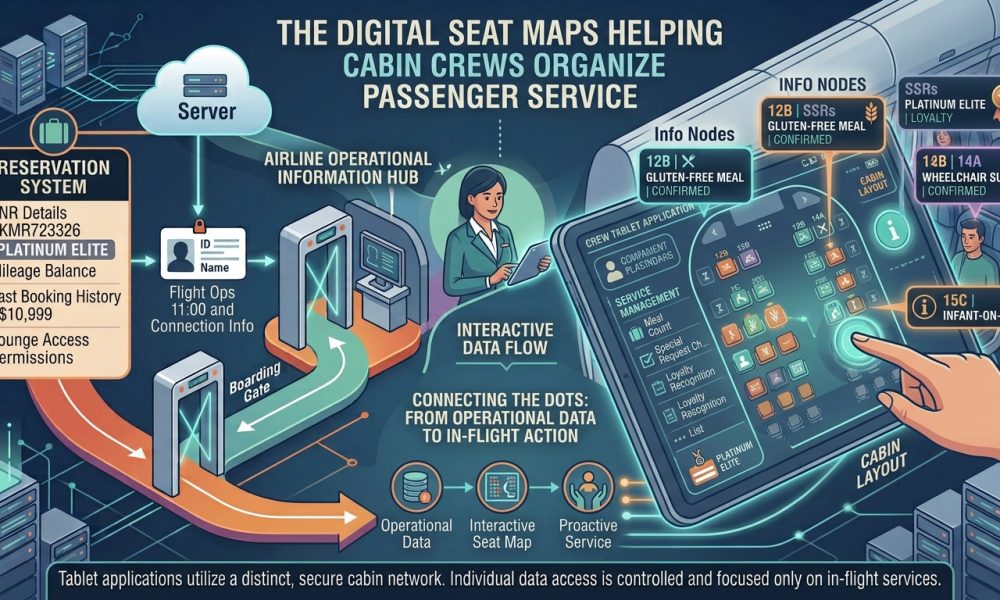
Interactive cabin layouts can connect seat assignments with operational information and individual assistance needs.
WASHINGTON, DC, October 7, 2026 — The familiar aircraft seat map is becoming more than a booking tool for passengers because airlines increasingly use interactive cabin layouts on flight attendant tablets and handheld devices to connect individual seats with passenger names, loyalty information, accessibility requirements, meal selections, and other operational details needed during a flight.
For cabin crews, these digital layouts can turn a static list of seat numbers into an organized service interface that helps employees see where passengers are sitting, which travelers may need extra help, and what customer information matters for a particular section of the aircraft.
The technology can make service appear highly personalized. Still, the underlying process generally depends upon reservation and operational information already associated with each seat rather than continuous facial recognition or automated biometric Identification taking place inside the aircraft.
A Seat Map Can Become an Operational Dashboard
Passengers usually see a seat map when selecting a seat during booking or check-in. Still, the version used by cabin crews can serve a very different purpose by linking the aircraft’s physical layout to the information employees need while managing hundreds of travelers in a confined space.
A flight attendant can select a seat on an authorized crew Application and view relevant information about the passenger expected to occupy that location, reducing the need to search separately through passenger lists, service documents, and other records whenever assistance is required.
United Airlines provides a prominent example through its MyFlight Application, which uses seat maps to let flight attendants view passenger names, loyalty status, and accessibility needs while delivering onboard service, according to Apple’s United Airlines enterprise case study.
The approach shows how the digital seat map can serve as an organizational layer that connects the physical cabin with information already stored in airline reservation, loyalty, and customer-service systems.
Seat Assignments Provide the Organizing Structure
Every commercial aircraft cabin is divided into clearly defined seat positions, making the seat assignment a practical way for airlines to organize passenger information without requiring cabin crews to identify travelers through an entirely separate technology.
Once boarding and seat assignments are largely complete, the airline generally knows which passenger is expected in each occupied seat because the reservation, check-in, and boarding systems have already linked individual travelers to specific cabin locations.
A digital crew Application can use that relationship to place relevant information directly onto the cabin layout, allowing flight attendants to navigate passenger records geographically by row and seat rather than alphabetically through a lengthy manifest.
This arrangement is especially valuable on widebody aircraft carrying several hundred passengers, where finding the right person through a traditional passenger list can take much longer than selecting the seat where that traveler is expected to be sitting.
Digital Maps Can Reflect Different Cabin Sections
Modern aircraft often include several cabin products with different service expectations, including international first class, business class, premium economy, extra-legroom seating, and standard economy, making the physical layout important to how crews organize their work.
An interactive seat map can help flight attendants immediately identify which passengers belong to each service area while maintaining awareness of galleys, exits, lavatories, and other aircraft features that affect how employees move through the cabin.
The map can also support dividing responsibilities among crew members, since airlines commonly assign individual flight attendants to particular doors, cabin zones, galleys, or service sections during different phases of flight.
Connecting passenger information to that familiar cabin structure can therefore make digital tools easier to use under operational pressure, because the software presents information according to the same physical environment flight attendants already manage.
Passenger Names Can Be Linked With Individual Seats
One of the simplest but most useful functions of an interactive cabin map is displaying the name associated with a particular seat, allowing flight attendants to identify the passenger the airline expects to be sitting there without searching separately through a printed manifest.
That information can support routine customer service, particularly when a crew member needs to speak with a traveler about a meal request, connection, seat issue, or other matter already associated with the reservation.
It can also make personalized greetings possible because a flight attendant can see the passenger’s name before approaching, creating a more individualized interaction without the employee having previously met the traveler.
This type of recognition remains fundamentally different from biometric Identification because the system starts with the assigned seat and retrieves the attached reservation rather than analyzing the person’s face and trying to determine their identity.
Loyalty Status Can Appear Alongside the Seat
Frequent-flyer status can represent another information layer within cabin applications, particularly when airlines want crews to recognize customers whose loyalty benefits or travel history make personalized service operationally relevant.
United’s MyFlight implementation, for example, lets flight attendants view loyalty status directly through its seat-map interface, showing how customer-account information can be available at the exact cabin location where an employee interacts with the passenger.
Delta has also used handheld technology to help cabin crews recognize frequent travelers, with earlier versions of its SkyPro and Guest Service Tool platforms providing flight attendants with information about passenger status and selected customer experiences.
For travelers, this can explain why a crew member sometimes acknowledges loyalty status without asking for a membership card: the information may already appear alongside the reservation on the employee’s authorized device.
Accessibility Needs Can Be Placed Where Crews Need Them
Accessibility information represents one of the clearest examples of how digital seat maps can support practical cabin operations, because flight attendants may need to know where passengers requiring assistance are seated before takeoff, during service, and particularly during an emergency.
When a traveler has requested wheelchair assistance or another accessibility-related accommodation through the airline, the airline can associate appropriate information with the reservation and make it available to employees whose responsibilities require awareness of that need.
United’s MyFlight Application specifically connects accessibility information with the seat-map environment, helping flight attendants understand where customers needing particular assistance are located without requiring those travelers to explain circumstances already communicated before departure repeatedly.
Because accessibility information can involve sensitive personal circumstances, responsible system design should limit what appears on the device to information genuinely required for safety and service, rather than exposing broader personal records with no operational purpose inside the cabin.
Special Service Requests Can Become Easier to Locate
Airline reservations can include standardized service messages that identify a range of passenger requirements, from accessibility accommodations to certain meal selections and other requests made before travel.
Traditionally, cabin crews might have received those details through separate printed documents or lists, requiring employees to cross-reference a passenger name, seat assignment, and requested service before beginning a particular phase of the flight.
Digital applications can simplify that process by linking service information directly to the passenger’s location on the seat map, allowing crews to see where relevant requests are concentrated before starting meal service or other cabin activities.
The result is not simply a more attractive version of the passenger manifest, but a different way to organize operational information around the aircraft’s physical geography.
Meal Preorders Can Be Matched With the Correct Seat
Advance meal ordering has become increasingly common in premium cabins and on longer routes, letting passengers choose from available dishes before departure while helping airlines plan catering more precisely.
Cabin crews still need to ensure that the correct meal reaches the correct traveler, particularly when limited quantities of particular selections have been loaded, and passengers expect the choice they made before arriving at the airport.
American Airlines says its latest generation of Cabin Electronic Flight Bag devices makes customer status, preferences and preorder information easier for flight attendants to access, illustrating how current mobile technology can consolidate service details that once depended much more heavily on separate paper records.
Associating a preorder with a digital seat position can therefore help crews prepare service efficiently, while still requiring employees to confirm circumstances whenever passengers have moved, or operational changes have altered the original cabin assignment.
Seat Changes Can Complicate the Digital Picture
Digital seat maps are only as accurate as the underlying reservation and operational information, so last-minute upgrades, aircraft substitutions, and seat changes can temporarily complicate what cabin crews see on their devices.
Passengers can receive new seats at the gate shortly before departure. At the same time, operational considerations involving families, accessibility requirements, or aircraft changes can cause agents to move travelers even after an original assignment has been established.
American Airlines’ reservation guidance acknowledges that equipment or schedule changes can require passengers to be reseated. At the same time, airport personnel can withhold certain seats until departure day to accommodate operational passenger needs.
Crew systems therefore need timely updates whenever possible, and flight attendants must continue using direct observation and communication rather than assuming every digital seat assignment reflects who is physically sitting in that location.
Passengers Sometimes Move Without Changing the Record
Another complication occurs after boarding when travelers exchange seats informally, perhaps because family members want to sit together or one passenger agrees to trade an aisle seat for another location.
If the airline system has not formally recorded that change, the digital seat map may continue showing the passenger originally assigned to the seat, even though someone else is now physically occupying it.
This limitation shows why cabin applications should be understood as operational aids rather than biometric tracking systems: the tablet generally knows who should occupy a seat according to the reservation, not the biological identity of the person actually sitting there.
Experienced crews consequently combine digital information with normal cabin awareness, updating their understanding whenever the physical situation differs from what appears on the device.
Real-Time Updates Increase the Value of the Map
The usefulness of a cabin seat map increases significantly when information can update close to departure or during the flight, because airline operations continue changing after passengers have initially selected their seats.
Gate upgrades, standby clearances, missed connections, and boarding changes can alter the final passenger distribution. At the same time,e flight delays can affect onward journeys and generate new service priorities before the aircraft reaches its destination.
Connected crew devices can bring updated operational information into the cabin faster than paper manifests printed before final changes, potentially reducing the gap between what ground teams know and what flight attendants can see.
This shift toward better-connected cabin technology also lets airlines treat the flight as part of one continuous customer journey rather than an information island disconnected from the reservation and airport systems that operate before departure.
Connection Information Can Add Another Service Layer
A seat map becomes even more useful when crews can combine passenger location with onward travel information, particularly on delayed flights where some travelers face considerably tighter connections than others.
Delta has previously described onboard tools that give flight attendants information about travel disruptions and connecting flights, allowing crews to identify passengers who may need extra assistance or information before arriving at the gate.
For cabin employees, knowing where those passengers are seated makes it easier to provide relevant updates without making broad announcements that apply to only a small portion of the aircraft.
The technology cannot guarantee that a connecting flight will be held or that a disruption can be solved onboard. Still, it can help crews identify which passengers face the most immediate onward-travel challenges.
Digital Maps Can Help Organize Service Before It Begins
One practical advantage of combining service information with a cabin map is that crews can review patterns before starting their work, rather than discovering each special requirement only when they reach an individual passenger.
A flight attendant responsible for a particular section might review the digital layout and see where meal preorders, accessibility needs, or other relevant requests are located, helping the crew organize the order and timing of service more efficiently.
This preparation can be particularly useful on large aircraft, where multiple carts, galleys, and crew positions must operate together. At the same time, passengers sleep, move through aisles,s or request assistance during the same period.
The digital seat map therefore turns passenger information into a spatial planning tool, connecting service demands with the physical environment in which flight attendants must deliver them.
Cabin Maps Can Support More Consistent Personalization
Airlines want customer experiences to remain reasonably consistent even though passengers encounter entirely different crews on almost every journey, creating a challenge because individual employees cannot personally remember millions of travelers.
Digital passenger information solves this by allowing relevant parts of the airline’s existing customer relationship to follow the traveler onto the aircraft, where flight attendants can use that context during service.
A crew member may therefore know that a passenger holds high loyalty status, requested a particular meal, or requires assistance even though the employee has never met that person before boarding began.
This type of personalization depends upon reservation and loyalty data rather than personal memory, allowing airlines to provide continuity across the journey. At the same time,e cabin employees remain focused on the specific flight they are operating.
Flight Attendant Devices Serve Safety Functions as Well
Digital seat maps exist within broader cabin technology platforms whose responsibilities extend well beyond personalized customer service, because flight attendants remain responsible first for passenger safety, emergency procedures, and regulatory compliance.
American Airlines’ Cabin Electronic Flight Bag evolved from electronic flight attendant manuals introduced over the past decade, replacing heavy paper materials with mobile devices that deliver current safety information and operational resources more efficiently.
American became the first major U.S. airline to receive approval for a flight attendant Cabin Electronic Flight Bag in 2014, and the carrier says its current generation now combines those traditional operational functions with easier access to customer status, preferences, and preorder information.
The seat-map interface should therefore be understood as one component of a much larger professional toolset, not the sole purpose of the tablet carried by flight attendants.
Not Every Data Point Belongs on the Seat Map
Airlines possess far more information about some passengers than cabin crews need, making data minimization an important principle when designing onboard applications.
A flight attendant may reasonably need a traveler’s name, seat assignment, relevant loyalty information, meal choice, or accessibility requirement, but has no legitimate operational reason to see full payment records, detailed account history, or unrelated correspondence with customer-service departments.
Well-designed applications can therefore present only the information required for a particular job function, using role-based permissions and interface design to prevent unnecessary personal data from becoming visible merely because broader airline systems contain it.
This distinction becomes increasingly important as customer databases grow more sophisticated, because technological ability to consolidate information does not automatically create a legitimate reason to display every available detail to every employee.
Privacy Remains Important Inside the Aircraft
Passenger information displayed on a crew tablet remains personal data even when used for legitimate operational purposes, requiring airlines to protect devices and applications against unauthorized access as employees move through terminals, crew rooms, and aircraft cabins.
Managed tablets can use Authentication, encryption, automatic locking, and other security controls to help prevent passenger information from being exposed if a device is lost, misplaced, or viewed by someone without authorization.
Airlines must also consider physical privacy because screens in narrow aircraft aisles can be visible to nearby passengers, making sensible interface design and employee training as important as technical security protections.
The transition away from paper records can offer advantages because centrally managed digital access can be restricted or revoked, while information printed on a lost paper manifest cannot be remotely locked after leaving an employee’s possession.
Passenger-Facing Seat Maps Serve a Different Purpose
Travelers also increasingly interact with sophisticated seat maps on airline websites and mobile applications. However, those passenger-facing tools serve a different function than the operational maps cabin crews use.
American Airlines recently introduced a feature allowing eligible AAdvantage members to specify preferred seat characteristics, after which its Application can monitor availability and automatically move qualifying passengers when an eligible seat matching those preferences becomes available.
The carrier has separately tested interactive three-dimensional seat maps designed to help customers understand the cabin experience before boarding, showing how the basic concept of an aircraft map can support both passenger decision-making and employee operations.
Behind the cabin door, however, the crew version focuses less on selling or selecting a seat and more on understanding the people and service requirements associated with positions that have already been assigned.
Facial Recognition Is Not Required for a Digital Cabin Map
The personalization created by interactive seat maps can sometimes be mistaken for biometric recognition, particularly when passengers have already encountered facial verification elsewhere during the airport journey.
A cabin map generally does not need to analyze a passenger’s face because the airline already established the relationship between a reservation, boarding record, and assigned seat before the aircraft departed.
The Application can retrieve the information associated with that seat and display relevant details to the authorized employee, making the passenger recognizable operationally without performing a new biometric comparison.
This distinction helps explain why highly personalized onboard service can continue even on flights where no facial recognition system is operating inside the cabin.
The Seat Number Becomes a Digital Reference Point
In practical terms, the most important innovation may be remarkably simple because a seat number provides an intuitive reference point that connects the passenger, reservation, and physical cabin location within one interface.
Flight attendants already think spatially when performing safety checks, preparing cabins, conducting meal services and dividing responsibilities, making a seat-based digital interface more natural than requiring employees to navigate databases organized around unfamiliar account identifiers.
The system can therefore translate complex passenger records into a format immediately understandable during cabin operations, showing relevant information where the passenger is expected to be rather than forcing crews to reconstruct that relationship manually.
This combination of digital information and physical location explains why the seat map has become such a powerful interface for modern cabin service.
Human Interaction Still Determines the Passenger Experience
No digital seat map can fully describe the person sitting in a particular location, nor can an Application predict precisely what kind of assistance or interaction a traveler will want during every stage of a flight.
A status indicator does not reveal whether a frequent traveler wants conversation or quiet, and an accessibility notation cannot replace respectful communication with a passenger about the assistance needed in that moment.
The strongest use of cabin technology therefore gives flight attendants useful context without attempting to replace professional Judgment, empathy, and direct communication with automated instructions.
Crew members can use the information to arrive better prepared. However, the quality of the passenger experience still depends heavily upon how employees interpret that information and respond to circumstances occurring around them.
The Digital Cabin Is Becoming an Extension of Airline Systems
Aircraft cabins were once comparatively isolated from the airline’s broader information environment after departure, leaving flight attendants with whatever printed information and operational updates had been supplied before the aircraft left the gate.
Connected mobile devices increasingly change that relationship by moving passenger and operational information more efficiently between ground systems and onboard employees, helping the cabin become a better-integrated part of the overall travel journey.
Interactive seat maps provide a useful interface for that development because they organize information around the physical aircraft environment where cabin crews perform their duties.
As connectivity and crew applications continue to advance, airlines will likely find additional ways to place timely passenger information alongside seat positions where it becomes operationally relevant.
A Familiar Diagram Is Becoming a Powerful Crew Tool
To passengers, an aircraft seat map may still look primarily like the diagram used to choose between a window and an aisle seat before departure. Still, for cabin crews, the same basic layout can become an increasingly sophisticated interface for organizing service across an entire aircraft.
By connecting seats with names, loyalty status, accessibility requirements, preorders, and other relevant operational information, digital maps can help flight attendants understand the cabin more quickly without searching through several disconnected records.
The technology also highlights an important distinction in modern aviation data: airlines can create a highly personalized onboard experience through reservation and service information without needing to identify every passenger continuously through facial recognition.
As digital cabin systems continue evolving, the seat map is likely to remain a particularly effective bridge between complex airline databases and the practical reality of serving individual travelers one row at a time.




