
Recording service choices can improve future journeys while raising questions about accuracy, access, and retention.
WASHINGTON, DC, October 7, 2026 — Airlines increasingly remember far more than a passenger’s name and itinerary, because saved seat preferences, meal requests, communication choices, loyalty activity and previous service interactions can help carriers tailor future journeys while simultaneously expanding the amount of personal information retained across reservation and customer-service systems.
For travelers, that personalization can make flying more convenient when an airline remembers an aisle preference, recognizes a preferred language, or presents services that reflect previous choices. However, those same capabilities raise important questions about whether stored information remains accurate, who can access it, and how long it should continue influencing future travel.
The issue is growing as airlines integrate reservation systems, loyalty accounts, mobile applications, and employee devices, creating environments where information from one journey can affect another trip months or years later if the underlying preference remains tied to the customer’s profile.
Passenger Preferences Can Begin With Ordinary Travel Choices
Some of the most useful passenger information appears relatively simple, including whether a traveler prefers an aisle or window seat, wants a particular communication method,s or routinely selects particular services during booking and check-in.
When travelers deliberately save those preferences within an airline account, the carrier can use them to reduce repetitive data entry and present more relevant options the next time the customer books a journey.
Delta’s current Global Privacy Policy specifically identifies seating preferences, dietary requests, special assistance needs, and flight, hotel, and car preferences as categories of information that can be processed to deliver and personalize travel services.
This convenience can be substantial for frequent travelers because a preference entered once can simplify many later transactions. Still, that same persistence creates the need to distinguish temporary requests from choices passengers genuinely want airlines to remember.
A Preference Is Different From a Requirement
Not every item associated with a passenger should be treated as a permanent preference, because the circumstances influencing one journey may have little relevance to what the traveler wants during another trip.
A passenger who chooses an aisle seat on a long overnight flight might prefer a window seat on a short daytime journey, while someone requesting a special meal for one trip may not want that same selection automatically applied to every future reservation.
Airline systems therefore need to distinguish carefully between enduring profile preferences, itinerary-specific choices, and operational requirements that apply only to a particular journey, because collapsing those categories together can turn helpful personalization into recurring errors.
This distinction matters most when systems use historical behavior to anticipate what a passenger might want, since an earlier choice does not always indicate a continuing preference that should automatically shape future recommendations.
Airlines Can Use History to Anticipate Likely Preferences
Personalization becomes more sophisticated when carriers move beyond information explicitly saved by travelers and consider previous bookings, transactions, and communications when deciding which services or offers may be relevant.
Delta states that it may tailor products and services by considering previous travel, transactions, or communications and combining those records with other information held about the customer, illustrating how airline personalization can involve inference as well as direct passenger instructions.
A traveler who repeatedly chooses similar seats, buys comparable products, or follows particular travel patterns can therefore generate information that systems may use to predict what services the passenger is likely to value on a later journey.
This capability can improve convenience, but it also raises an important transparency question: passengers may understand that an explicitly saved seat preference will be remembered, while being less aware that historical behavior can independently influence what the airline presents.
Seat Preferences Can Become Increasingly Automated
Airline technology is moving beyond simply displaying a preferred seat category, using customer instructions to actively search for better matches as cabin availability changes before departure.
American Airlines, for example, has introduced functionality that lets eligible travelers specify desired seat characteristics so the carrier’s system can monitor availability and automatically move qualifying passengers when an appropriate seat becomes available.
That approach demonstrates the practical value of stored preferences because the airline can keep acting on the passenger’s stated choice without requiring repeated searches in the days or hours before departure.
However, automation also increases the importance of accuracy because an outdated preference can cause a system to make a change the traveler no longer wants, particularly when passengers have forgotten what settings remain associated with their profiles.
Meal Choices Can Reveal More Than Culinary Preference
Food selections are a particularly sensitive category because a request that seems operationally straightforward can sometimes suggest information about health, religious practice, or other aspects of a passenger’s circumstances.
Delta’s policy recognizes this possibility by noting that some requests, including particular meals, can potentially imply sensitive personal information depending upon the surrounding circumstances, making consent and purpose limitations especially important when airlines process such details.
Other carriers may classify similar information differently, and American Airlines’ privacy policy notes that it does not reliably consider meal preferences or wheelchair requests to imply sensitive personal information in every instance.
The difference shows why travelers should not assume every airline categorizes the same preference the same way, especially since privacy rules vary by jurisdiction and companies make their own determinations within applicable law.
Assistance Requests Require Additional Care
Wheelchair assistance, mobility support and other passenger-service requests can improve travel significantly when airline employees receive appropriate information early enough to coordinate assistance throughout the airport and aircraft journey.
Those requests can also involve deeply personal circumstances, so the value of making information accessible to employees must be balanced against the need to prevent unnecessary disclosure to people whose responsibilities do not require it.
A gate agent preparing boarding might need to know that a passenger requires a particular type of assistance. At the same time, an employee working in an unrelated commercial department may have no legitimate operational reason to see the same detail.
Role-based access therefore becomes an essential privacy safeguard, allowing relevant information to reach employees responsible for providing the requested service without turning a passenger preference or assistance request into unrestricted company-wide knowledge.
Communication Preferences Can Shape the Digital Journey
Passenger preferences extend beyond physical service to how airlines communicate, including whether travelers want notifications through email, text messages, mobile applications, or other channels supported by the carrier.
These settings can improve disruption management by ensuring flight changes, gate updates, and check-in reminders reach passengers through channels they are likely to notice, especially when operational circumstances change quickly.
Communication preferences can also separate service messages from marketing choices, because travelers may need essential operational notifications regardless of whether they want promotional offers or personalized advertising from the airline.
Airlines consequently need clear controls that help customers distinguish necessary travel communications from optional commercial messaging rather than presenting every category of contact as though it served the same purpose.
Frequent Flyer Accounts Create Persistence
Loyalty profiles make personalization particularly powerful because they provide a continuing account that keeps preferences associated with the traveler across numerous reservations.
A passenger who flies only occasionally may provide information for a single trip and rarely interact with the airline again. At the same time, a frequent flyer can accumulate years of preferences, transactions, status history, and service interactions within one persistent account.
That continuity lets carriers provide increasingly consistent customer experiences. Still, it also increases the consequences of outdated information because a preference entered years earlier can remain available long after the circumstances around the original choice have changed.
Airlines should therefore make preference management accessible enough that travelers can review, update, or delete information without contacting customer service every time an account detail becomes inaccurate.
Accuracy Is Essential for Useful Personalization
Personalization works only when the information being used still represents the traveler accurately, making data quality a practical customer-service concern rather than merely a technical privacy issue.
An incorrect seat preference can lead to an undesirable assignment, an outdated contact method can cause important notifications to disappear, and an obsolete service request can confuse employees preparing assistance the passenger no longer needs.
Errors can also arise through system migrations, duplicate customer profiles, incorrectly merged reservations, or information entered by travel agencies and other intermediaries rather than by the passenger directly.
Giving travelers reasonable mechanisms to inspect and correct stored information therefore benefits both privacy and operational reliability because an accurate profile reduces unnecessary service mistakes while giving customers greater control over how personalization affects them.
Employee Access Should Follow Operational Need
The usefulness of passenger information does not mean every airline employee should see every preference, because different roles require different levels of access to support legitimate responsibilities.
Flight attendants may need access to relevant meal selections and certain assistance information. At the same time, gate agents may need seating and boarding details, and customer-service employees may need broader reservation context when resolving disruptions.
Employees responsible for advertising, finance, or unrelated functions generally need different information, showing why modern airline systems should apply access controls based on job responsibilities rather than making complete customer profiles universally available.
This principle becomes particularly important as airlines consolidate information from multiple systems because technical integration can make data easier to retrieve without necessarily making broader access appropriate.
Crew Tablets Bring Selected Preferences Into the Cabin
Modern flight attendant devices illustrate how carefully selected preference information can become useful after passengers board the aircraft.
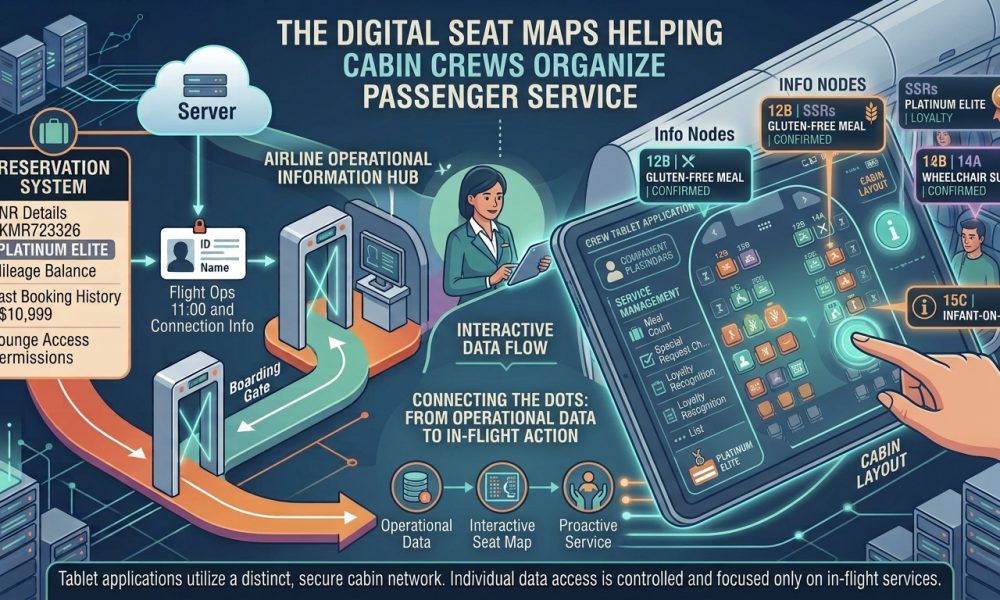
American Airlines says its Cabin Electronic Flight Bag platform gives flight attendants easier access to customer status, preferences, and preorder details, allowing cabin crews to organize service with information already linked to passengers and their assigned seats.
These devices can make onboard interactions appear highly personalized when a crew member already knows a meal choice or relevant service detail. However, the tablet should ideally display only the information needed for the employee’s immediate duties.
Passenger personalization therefore depends not simply upon collecting information but upon deciding which information should appear at each operational stage and which details should remain elsewhere within the airline’s systems.
Personalization Can Extend Into Airline Applications
Mobile applications create another environment where saved preferences and historical information can influence what passengers see, because airlines can display relevant bookings, check-in options, upgrades, airport services and other features based upon account and itinerary information.
Application activity can also become a data source, particularly when airlines analyze which features passengers use and combine those interactions with reservation or loyalty information to improve digital products.
The result is a continuous feedback loop in which passenger behavior influences service design while new digital features generate additional information about how customers engage with the airline.
This can create genuinely useful products, but travelers should be able to distinguish functionality necessary to operate the Application from optional tracking or personalization mechanisms used primarily for analytics and marketing.
Preference Data Is Separate From Biometric Data
As airport facial recognition becomes more visible, travelers may assume personalized service and biometric Identification are part of the same technological system. However, the two categories generally serve very different functions.
Biometric systems can help determine whether a person physically present at a checkpoint matches an expected identity. In contrast, preference systems answer questions about what an already identified customer has requested or may want.
An airline does not need to analyze someone’s face to know that their account contains an aisle-seat preference or that they previously ordered a particular meal, because reservation and loyalty systems already maintain those records independently.
Keeping those categories separate matters for privacy analysis because passengers might accept one form of personalization while making a completely different decision about voluntary biometric processing.
Consent Can Depend on How the Information Is Used
Some passenger information is necessary to operate the journey, while other information supports optional personalization, meaning the legal and practical basis for processing can differ depending upon the purpose.
Airlines may need basic reservation information to perform the transportation contract. At the same time, customers can separately consent to marketing communications or other optional uses that are not necessary for physically transporting them.
Delta’s current policy explicitly distinguishes among contractual necessity, legal obligations, consent, and legitimate business interests when describing different categories of data processing, reflecting the complexity behind apparently simple customer profiles.
Travelers should therefore examine the purpose associated with a particular preference rather than assuming that providing information once creates unrestricted permission for every possible future use.
Third Parties Can Introduce Additional Complexity
Airline reservations frequently involve travel agencies, corporate travel departments, partner airlines, hotels, car-rental companies, and other organizations that can supply information to the carrier or receive limited information needed to complete the journey.
A traveler may therefore discover that a preference did not originate directly from the airline account but arrived through another organization involved in arranging travel.
Corporate travelers may experience this more often because employer booking systems may set policy-based settings or travel-profile information that becomes associated with reservations purchased through approved channels.
Understanding where information originated matters when a passenger wants to correct it, since changing a preference in one airline profile may not automatically update a separate record maintained by an employer or travel-management company.
Inferred Preferences Create a Different Privacy Question
Explicitly telling an airline “I prefer aisle seats” represents a clear expression of choice, while a system deciding that the passenger probably prefers aisle seats because they selected them on previous flights represents an inference.
Those two forms of information can produce similar results. Still, they create different expectations because travelers generally understand information they deliberately supplied more easily than conclusions generated algorithmically from historical behavior.
Airlines increasingly use analytics, automated tools, and machine-learning techniques to improve service and personalize experiences, making inferred preferences more common as digital customer systems become more sophisticated.
Transparency becomes especially important in this environment because passengers should understand when a recommendation reflects something they expressly requested and when it results from a prediction generated from previous activity.
Retention Determines How Long a Preference Can Follow the Traveler
Perhaps the most important privacy question surrounding airline personalization is duration, because the convenience of remembering a preference depends directly on the information remaining available after the original transaction ends.
If an airline deletes every seating preference immediately after arrival, passengers must provide the same information repeatedly, while retaining information indefinitely can create unnecessary records long after those preferences have become irrelevant.
Delta states that it retains personal information for business purposes, record-retention policies, and legal or regulatory requirements, and that passengers can submit privacy requests to learn about specific retention periods.
American similarly states that it retains personal information for as long as reasonably necessary, considering legal requirements, applicable limitation periods, and the duration of the customer’s use of airline services.
Different Information Can Need Different Retention Periods
A sensible retention framework does not necessarily treat every passenger preference identically because some information can remain useful for years while another detail may matter only during one journey.
A preferred language might remain relevant across many trips. At the same time, a request tied to a temporary mobility limitation may become inappropriate if it carries over automatically into future journeys without confirmation.
Likewise, a passenger might want an enduring seating preference preserved while expecting a sensitive service request to disappear once the purpose for which it was provided has ended.
Airlines therefore face a design challenge: deciding not only how long to retain customer information, but which categories deserve periodic reconfirmation before continuing to influence future service.
Travelers Need Practical Ways to Correct Their Profiles
Privacy rights have limited practical value when customers cannot easily find the controls needed to update incorrect information, making account design an important component of responsible personalization.
Airlines can improve transparency by giving passengers clear places to manage contact methods, communication permissions, travel preferences, and other profile information rather than scattering those settings throughout several unrelated sections of an Application or website.
More complex information can still require formal privacy-request procedures, particularly when passengers want to understand broader categories of information held about them or exercise jurisdiction-specific legal rights concerning access, deletion, or correction.
The objective should be to make routine preference management simple while preserving more comprehensive privacy mechanisms for customers who need deeper visibility into their records.
Personalization Should Not Become Permanent Assumption
One of the greatest risks of persistent preference systems is that historical choices can gradually be treated as permanent characteristics, even though people routinely change their habits, circumstances, and priorities.
Travelers age, families change, jobs change, dietary preferences evolve, and physical needs can be temporary, meaning a customer profile should not become an unchangeable digital description constructed from earlier journeys.
Effective personalization should therefore remain adaptable, using historical information as helpful context rather than unquestionable truth whenever the passenger’s current choices indicate something different.
Airlines that design systems this way can preserve the convenience of remembered preferences while reducing the likelihood that customers become trapped by obsolete information they supplied years earlier.
Better Privacy Can Produce Better Customer Service
Data Protection and personalization are sometimes presented as competing objectives. Still, accurate, limited, and transparent information can improve the customer experience because employees get more useful context while passengers gain greater confidence in how their choices are handled.
Removing obsolete preferences reduces errors, restricting employee access decreases unnecessary exposure, and clear retention rules prevent irrelevant information from following customers indefinitely.
These practices also help airlines distinguish meaningful customer signals from accumulated digital clutter, allowing systems to focus on information that genuinely contributes to the present journey rather than everything the company has ever recorded.
Responsible privacy management therefore does not necessarily require abandoning personalization; it requires deciding carefully which information deserves to be remembered and under what conditions it should continue shaping service.
The Most Useful Preference Is One the Passenger Still Wants
Airline personalization works best when remembered information reflects what the traveler currently values, allowing carriers to eliminate repetitive questions without replacing passenger choice with assumptions based on outdated records.
A saved aisle preference, meal choice, or communication setting can make future journeys more convenient. Still, that value declines rapidly when passengers cannot see it, change it, or understand why it keeps influencing their experience.
As airlines connect loyalty systems, reservation records, employee applications and customer analytics more closely, the central privacy challenge will increasingly concern control rather than collection alone, including who can see preference information, how confidently the airline knows it remains accurate and when it should finally disappear.
The future of personalized air travel will therefore depend not merely upon how much airlines can remember about passengers, but upon whether they can remember the right information for the right purpose while giving travelers meaningful control over what follows them from one journey to the next.




