

The Wearable Sleep Trackers Market is projected to grow significantly, from US$ 15.1 billion in 2024 to US$ 41.7 billion by 2034, expanding at a CAGR of 10.7%. North America remains the leading region, holding a 43.2% market share with a valuation of US$ 6.5 billion. The increasing demand is driven by greater public awareness of sleep health. These devices offer individuals valuable tools to monitor sleep patterns, detect disorders, and enhance sleep quality, aligning with growing health-conscious behavior across both developed and emerging markets.
The adoption of wearable sleep trackers is fueled by advancements in sensor technologies. Improved heart rate variability tracking and movement detection have increased device accuracy. Users now benefit from real-time sleep data that syncs with mobile apps for personalized insights. Moreover, the rise in sleep-related conditions, such as insomnia and sleep apnea, has intensified the demand for both consumer and clinical applications. The integration of wearable technology with wellness platforms continues to grow, offering users actionable feedback for better sleep management and holistic health improvement.
Growing awareness of sleep disorders significantly drives the market. According to the American Sleep Association, over 50 million Americans experienced chronic sleep disorders in 2023. The Sleep Health Foundation noted a rise in adults tracking their sleep—from 25% in 2022 to 32% in 2023. Major brands like Fitbit reported an 18% increase in sleep-tracker revenue in 2023. The CDC linked poor sleep to chronic illness, encouraging increased device adoption. Global awareness and clinical interest in managing sleep apnea are also contributing to market expansion.
However, affordability and privacy concerns remain key restraints. Premium wearable sleep trackers like the Oura Ring and Fitbit Sense, priced above US$ 299, are often unaffordable for budget-conscious consumers. In regions such as India, high import duties, including an 18% GST on wearables, limit accessibility. Furthermore, concerns over the misuse of personal sleep data have made many consumers wary. Without improvements in pricing models and stronger data protection frameworks, market penetration in price-sensitive and privacy-focused regions may remain limited.
The future of wearable sleep tracking is closely tied to healthcare integration. In 2023, 65% of U.S. hospitals partnered with tech firms for remote monitoring. Devices like ResMed’s Somnoware, approved by the FDA, gained traction among providers. Insurance incentives, such as UnitedHealthcare’s wellness discounts for device users, are further boosting adoption. Economic factors like inflation and trade policy shifts influence pricing and supply. Yet, innovations in non-contact sleep tech, such as under-mattress sensors, and AI-driven insights continue to drive growth and transform the competitive landscape.
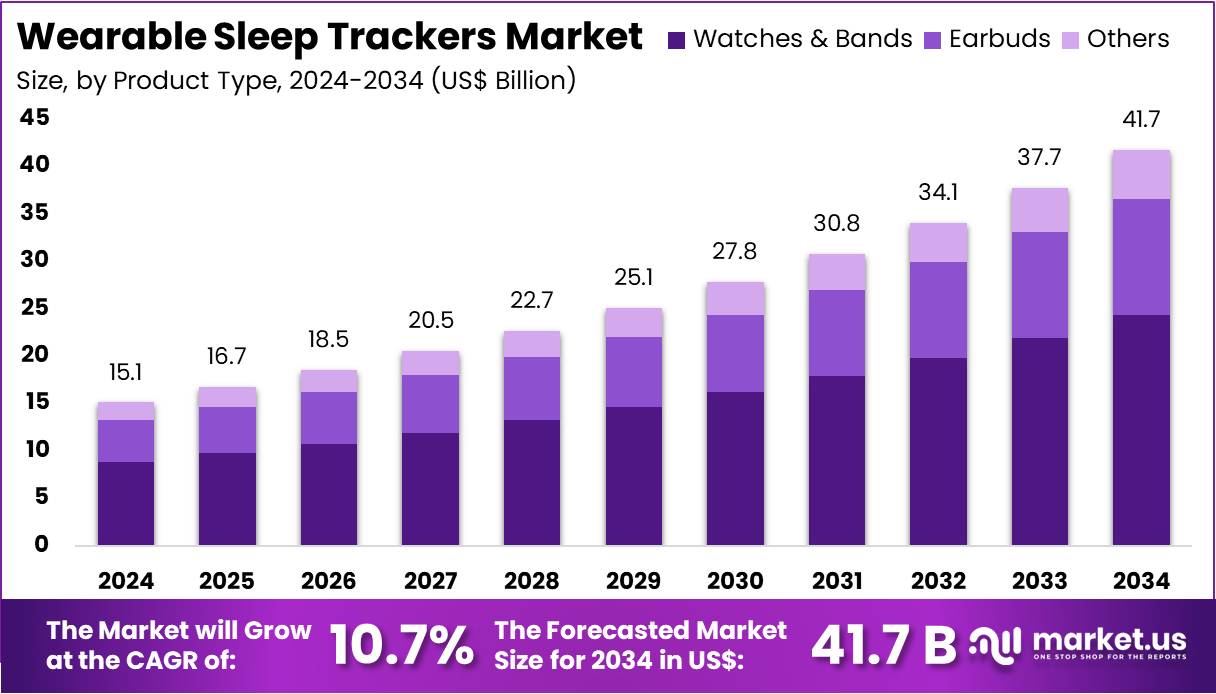
Key Takeaways
- In 2024, the global wearable sleep trackers market recorded revenue of US$ 15.1 billion, growing steadily at a CAGR of 10.7%.
- The market is projected to reach US$ 41.7 billion by 2034, indicating strong long-term demand for wearable sleep monitoring solutions.
- Watches and bands dominated the product type segment in 2024, accounting for 58.2% of total market share due to their wide adoption.
- Earbuds and other wearable sleep devices formed the remaining share, but watches and bands maintained clear dominance among consumers.
- Insomnia applications led usage in 2024, contributing 52.3% of the total market, reflecting rising awareness about sleep disorders.
- Other applications, including sleep apnea and general wellness tracking, also contributed, but remained secondary to insomnia-related use.
- North America held the largest regional share of 43.2% in 2024, driven by high consumer awareness and early technology adoption.
Get Sample https://market.us/report/global-wearable-sleep-trackers-market/request-sample/
Regional Analysis
North America is currently leading the wearable sleep trackers market, holding the largest revenue share of 43.2%. This dominance is supported by increasing health awareness and a rise in diagnosed sleep disorders. According to the CDC, over 70 million adults in the U.S. face chronic sleep problems. Additionally, the National Sleep Foundation reported that 35% of Americans tracked their sleep in 2024, compared to 28% in 2022. This growth in personal health monitoring reflects strong regional adoption of wearable technologies focused on sleep analysis and biometric health metrics.
Technological progress continues to drive market expansion in North America. Companies like Apple and Fitbit are improving device features to enhance user experience. Apple Watch sales rose by 40% year-over-year in Q1 2024 due to upgraded sleep-tracking capabilities. In 2023, the American Academy of Sleep Medicine supported consumer sleep technology, reinforcing adoption trends. Insurance programs by providers such as UnitedHealthcare now reward users for wearing sleep trackers. These efforts have widened awareness and increased user engagement, strengthening North America’s leadership in this market segment.
Meanwhile, the Asia Pacific region is expected to register the highest CAGR during the forecast period. Contributing factors include rising disposable income, urban growth, and government investment in digital health. China reported a 25% rise in sleep disorder cases from 2022 to 2024. In India, ₹500 crore (US$60 million) was allocated for wearable health technologies in 2023. Japan’s aging population and South Korea’s technology adoption have further boosted demand. Government awareness campaigns, like Australia’s 2024 Sleep Health initiative, are also driving regional market growth.
Segmentation Analysis
The watches and bands segment dominated the market in 2024, holding a 58.2% share Wearable Sleep Trackers market in the product type section. This growth is driven by rising consumer interest in health and wellness. Devices such as smartwatches and fitness trackers with built-in sleep tracking features are gaining popularity. These products offer users simple access to sleep-related data, enabling better monitoring of sleep quality. As awareness increases around the role of sleep in overall health, demand for user-friendly, wearable sleep tracking solutions is expected to rise steadily in the coming years.
The insomnia application segment accounted for 52.3% of the market in 2024. This is due to a growing global focus on sleep health and rising cases of sleep disorders. As more people seek to understand and improve their sleep patterns, wearable trackers are being adopted to detect possible disruptions. These devices help individuals track their habits, monitor progress, and make informed changes. With growing attention to self-care and mental health, the insomnia segment is likely to experience further demand for non-invasive, technology-based sleep solutions.
By Product Type
- Watches & Bands
- Earbuds
- Others
By Application
- Insomnia
- Sleep Apnea
- Others
Key Players Analysis
Key players in the Wearable Sleep Trackers market are focusing on innovation, partnerships, and international expansion to drive growth. They are developing advanced features that offer precise sleep pattern tracking and integration with health metrics. This improves user engagement and boosts data accuracy. Collaborations with healthcare providers and research institutions help expand market applications. Growing health awareness in emerging regions presents new opportunities. Companies are strategically investing in these markets to strengthen their global footprint and improve accessibility to wearable technologies.
Fitbit, founded in 2007 and acquired by Google in 2021, is a major player in this market. It offers a wide range of devices that track sleep, heart rate, and activity levels. Fitbit’s products are designed to help users improve their health through real-time insights. With availability in over 100 countries, Fitbit has established a strong global presence. Google’s acquisition has allowed Fitbit to integrate its technology into a broader hardware ecosystem. Continued innovation and feature development remain central to Fitbit’s strategy, supporting its leadership in the wearable sleep tracker segment.
Leading Key Players in the Wearable Sleep Trackers Market
- Xiaomi
- ResMed
- ŌURA
- Garmin Ltd
- Fossil Inc
- Fitbit
- Earable
- Apple Inc
Buy Directly: https://market.us/purchase-report/?report_id=145410
Conclusion
In conclusion, the wearable sleep trackers market is growing fast due to rising health awareness and better sleep technology. People are now more focused on improving sleep quality and managing sleep disorders through easy-to-use wearable devices. Brands are adding smart features and connecting devices with health platforms, which makes them more useful in daily life. Though high prices and data privacy issues remain concerns, strong demand in both developed and emerging regions supports long-term growth. Continued innovation, support from healthcare providers, and rising interest in wellness will keep driving the market forward. Wearable sleep trackers are becoming a trusted tool for better sleep and healthier lifestyles.
Get in Touch with Us:
Market.us (Powered By Prudour Pvt. Ltd.)
Address: 420 Lexington Avenue, Suite 300, New York City, NY 10170, United States.
Contact No: +1 718 874 1545 (International), +91 78878 22626 (Asia).
Email: [email protected]
View More



