
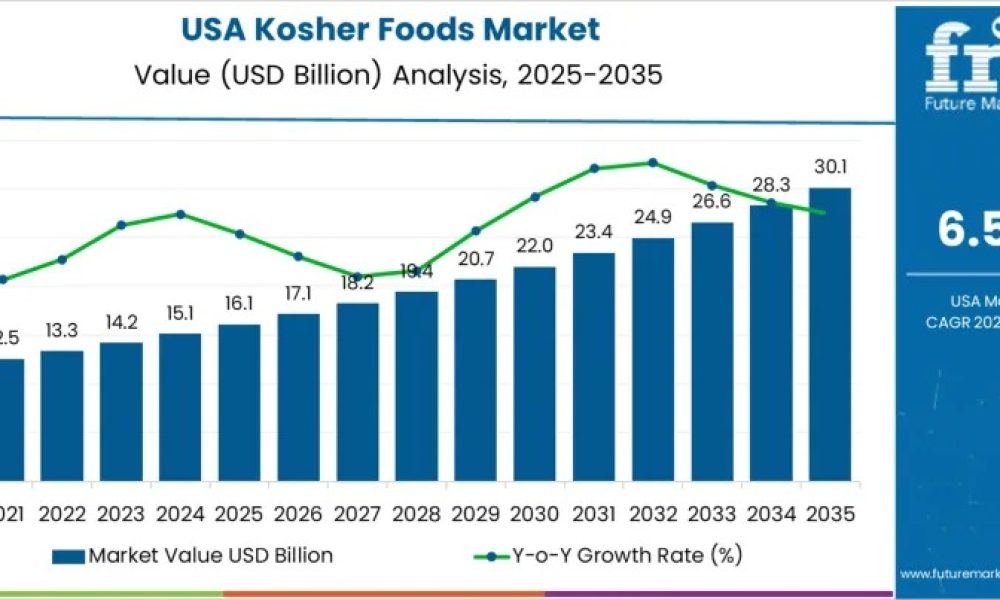
The demand for kosher foods in the USA is entering a strong growth phase, with market value projected to rise from USD 16.1 billion in 2025 to USD 30.1 billion by 2035, registering a compound annual growth rate (CAGR) of 6.5%. Once considered a niche category serving primarily Jewish consumers, kosher food is now firmly positioned in the mainstream, driven by rising consumer preference for certified, high-quality, and ethically produced food products.
Kosher certification, rooted in Jewish dietary laws, is increasingly associated with food safety, traceability, and ingredient transparency. A broader consumer base — including health-conscious, clean-label, and ethically driven shoppers — is fueling industry expansion. The perception that kosher-certified foods undergo stricter inspection and processing standards continues to strengthen demand across multiple retail categories.
Explore trends before investing – request a sample report today!
From 2025 to 2030, the market is forecast to expand from USD 16.1 billion to USD 22.0 billion, adding nearly USD 5.9 billion in incremental value. This period will be shaped by wider product penetration in mainstream supermarkets, improved labeling transparency, and growing online retail availability. Consumers increasingly view kosher certification as a symbol of purity and controlled sourcing, aligning with broader trends in organic, non-GMO, and minimally processed foods.
Between 2030 and 2035, the industry will gain an additional USD 8.1 billion, reaching USD 30.1 billion. Growth will be supported by continued product innovation, increased dietary inclusivity, and expansion of kosher-certified options across foodservice and ready-to-eat segments. Sustainability concerns and ethical sourcing practices are expected to further reinforce long-term demand.
Key Market Metrics
- Market Value (2025): USD 16.1 Billion
- Forecast Value (2035): USD 30.1 Billion
- CAGR (2025–2035): 6.5%
- Leading Product Segment: Kosher Meat
- Dominant Sales Channel: Supermarkets/Hypermarkets
Why Demand Is Accelerating
A central growth driver is the cross-demographic appeal of kosher certification. Beyond religious adherence, consumers associate kosher labeling with better hygiene standards, ingredient screening, and responsible production. As food recalls and safety concerns influence purchasing decisions, certified products offer reassurance.
Additionally, the rise of dietary restrictions — including lactose intolerance, allergen sensitivities, and plant-based eating — has increased interest in certified food categories where ingredient oversight is strict. Kosher certification often overlaps with clean-label and ethical food positioning, strengthening its appeal in modern retail.
Segment Insights
Kosher meat leads the product landscape, accounting for 46% of total demand. Strict slaughtering standards, traceability, and growing preference for hormone-free and antibiotic-free meat options have positioned kosher meat as a premium, trusted protein choice.
Supermarkets and hypermarkets represent 33% of distribution, driven by convenience and the expansion of dedicated kosher sections. Major retail chains now integrate kosher products alongside everyday grocery items, improving accessibility and supporting mainstream adoption.
Trends Shaping the Industry
Innovation is widening the scope of kosher-certified offerings across snacks, beverages, dairy alternatives, confectionery, and ready-to-eat foods. E-commerce is also reshaping distribution, enabling consumers in non-traditional markets to access certified products easily.
Technological advancements in supply chain traceability and digital certification verification are further building consumer trust. Transparent labeling and QR-based sourcing data are becoming competitive differentiators.
Challenges to Monitor
Despite strong momentum, higher production and certification costs can result in premium pricing, potentially limiting uptake among price-sensitive consumers. Compliance with kosher processing standards also adds operational complexity for manufacturers. Additionally, while awareness is growing, broader consumer education remains necessary to fully unlock non-religious market segments.
Get the full scoop—view the complete report!
Competitive Landscape
The U.S. kosher foods industry features both large ingredient suppliers and specialized food brands. Companies such as Archer Daniels Midland Company, Blommer Chocolate Company, BASF SE, Brooklyn Cookie Company LLC, and Ice Chips Candy, LLC contribute across ingredients, confectionery, and packaged food categories. Ingredient-focused players hold significant influence due to their role in supplying certified inputs across food manufacturing.
As consumer priorities shift toward food safety, ethical sourcing, and ingredient transparency, kosher certification continues to evolve from a religious requirement into a mainstream quality benchmark. With sustained innovation, retail expansion, and growing cross-demographic appeal, the U.S. kosher foods market is set for steady, long-term expansion through 2035.
Key Players in USA Kosher Foods Demand
- Archer Daniels Midland Company
- Blommer Chocolate Company
- BASF SE
- Brooklyn Cookie Company LLC
- Ice Chips Candy, LLC
About Future Market Insights (FMI)
Future Market Insights, Inc. (FMI) is an ESOMAR-certified, ISO 9001:2015 market research and consulting organization, trusted by Fortune 500 clients and global enterprises. With operations in the U.S., UK, India, and Dubai, FMI provides data-backed insights and strategic intelligence across 30+ industries and 1200 markets worldwide.



