
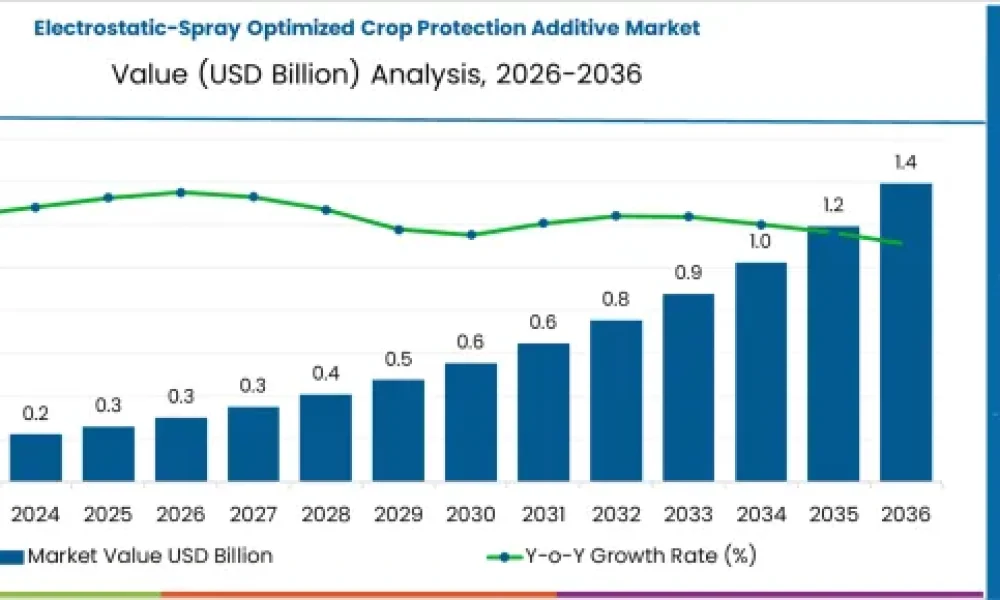
The global Electrostatic-Spray Optimized Crop Protection Additive Market is positioned for extraordinary growth over the next decade, expanding from an estimated USD 0.3 billion in 2026 to approximately USD 1.4 billion by 2036, at a compound annual growth rate (CAGR) of 16.6 %. This robust forecast highlights accelerating demand for advanced application chemistries that improve agricultural efficiency, reduce chemical waste, and support eco-conscious farming practices worldwide.
As agribusinesses intensify focus on sustainable food production and input optimization, electrostatic spray additives are emerging as essential enablers of precision crop protection. These additives enhance spray droplet charge stability, improve adhesion to plant surfaces, and minimize drift, delivering better coverage with fewer active ingredients. Adoption is particularly strong in regions with large-scale row crops and high-value horticulture, where yield protection and environmental stewardship are top priorities.
Key Market Insights at a Glance
The market’s projected CAGR of 16.6 % through 2036 reflects strong adoption of precision agriculture technologies, with key performance drivers including reduced agrochemical usage, enhanced pest control efficacy, and alignment with environmental compliance goals. Electrostatic spray additives optimize deposition on complex crop canopies, which is increasingly important for high-density cultivation systems facing regulatory restrictions on chemical drift and runoff.
Among additive function types, charge-stabilizing deposition enhancers lead the market due to their critical role in ensuring uniform droplet charge and effective target coverage. Advanced formulations combining these enhancers with spreaders and conductivity modifiers are gaining traction, especially as growers seek multifunctional products compatible with a wide range of crop protection chemistries.
Segment Overview
The electrostatic-spray optimized additive market is categorized by additive function and application compatibility. Charge-stabilizing deposition enhancers hold the largest share of the additive function segment, capturing roughly 37 % of the market, driven by broad applicator confidence and demonstrable performance improvements. Electrostatic boom sprayers dominate the application segment, accounting for about 34 % of demand, as they are widely used in large field operations where effective coverage and minimal drift are mission-critical.
Emerging segments include additives tailored for electrostatic UAV/drone sprayers, which are gaining momentum in specialty crop production due to their precise application and ability to navigate difficult terrain. Other innovation areas include leaf-adhesion polymers that improve wrap-around coverage and spray-charge modifiers that adapt performance to varying environmental conditions.
To access the complete data tables and in-depth insights — Request Your Sample Report Now
Regional Overview
Geographically, North America leads the market’s expansion, with the U.S. showing strong growth driven by precision agriculture investments, sustainability mandates, and advanced spraying infrastructure. The region’s CAGR outpaces many others, underscoring early adoption of electrostatic technologies by commercial growers. Brazil is another high-growth market, leveraging its large agricultural base and increasing demand for optimized crop protection solutions. China and Australia are also key contributors, where investments in smart farming and technological modernization support strong uptake. Spain’s growth is notable as well, fueled by efforts to enhance yield and reduce environmental impacts in fruit and vegetable sectors.
Competitive Landscape
The competitive environment is characterized by a mix of specialized additive developers, global agrochemical innovators, and spraying equipment partners focused on delivering integrated solutions. Leading participants include Spray Technologies (Micron Group), Spectrum Electrostatic Sprayers, ESS Agri Additives, Electrostatic Spraying Systems Inc., and Spraytec AgroSolutions. These companies differentiate through formulation innovation, compatibility optimization, and collaborations with sprayer manufacturers to ensure broad adoption and performance consistency.
Innovation emphasis remains on enhancing charge retention, broadening product compatibility with herbicides, fungicides, and insecticides, and developing environmentally benign additive options that resonate with sustainability-focused growers. Strategic alliances between additive producers and precision agriculture technology firms are accelerating market penetration and fostering integrated, data-driven agronomic solutions.
Market Outlook: Powering the Next Decade
Looking ahead, the electrostatic-spray additive market is poised to play a central role in modern crop protection strategies, as growers balance the imperatives of efficiency, sustainability, and regulatory compliance. Adoption of digital spraying platforms, real-time sensor feedback, and automated application systems will further enhance additive value by optimizing application parameters and minimizing inputs.
Resilience against regulatory pressure on chemical use and increasing demand for precision agronomy tools position electrostatic-spray optimized additives as a core component of sustainable farming portfolios. Continued innovation in formulation science and expanded integration with smart agricultural systems will unlock new performance frontiers and growth opportunities across global markets.
Have a specific Requirements and Need Assistant on Report Pricing or Limited Budget please contact us – [email protected]
About Future Market Insights (FMI)
Future Market Insights, Inc. (FMI) is an ESOMAR-certified, ISO 9001:2015 market research and consulting organization, trusted by Fortune 500 clients and global enterprises. With operations in the U.S., UK, India, and Dubai, FMI provides data-backed insights and strategic intelligence across 30+ industries and 1200 markets worldwide.
Why Choose FMI: https://www.futuremarketinsights.com/why-fmi



