
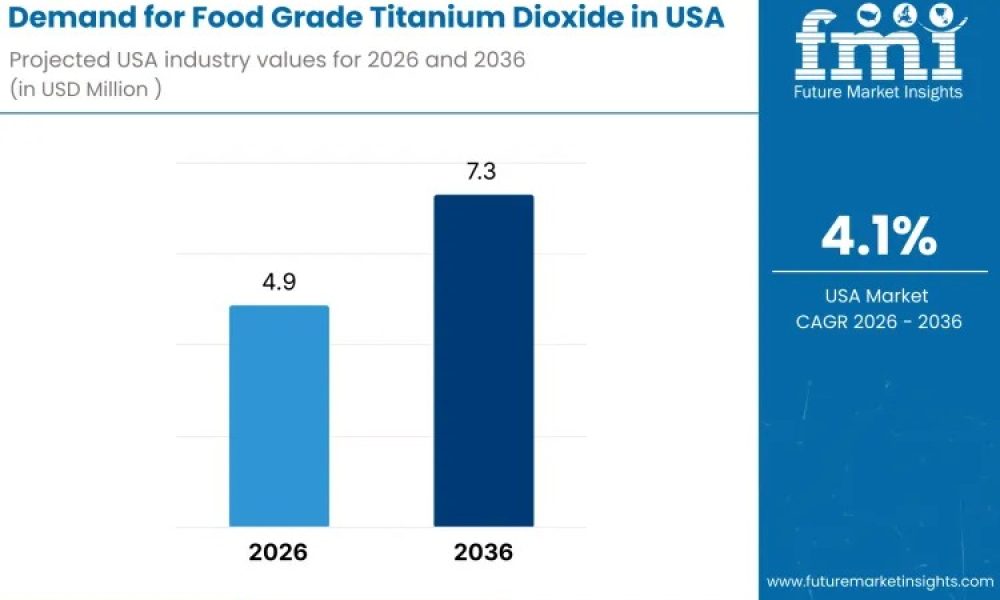
The demand for food grade titanium dioxide in the USA is valued at USD 4.9 million in 2026 and is projected to reach USD 7.3 million by 2036, expanding at a compound annual growth rate (CAGR) of 4.1%. This measured growth reflects continued reliance on titanium dioxide as a whitening and pacifying agent across confectionery, bakery decorations, sauces, dairy analogues, and processed food coatings, even as regulatory oversight intensifies.
Food manufacturers continue to prioritize visual consistency, brightness, and shelf appeal—critical factors in mass-market packaged foods. Titanium dioxide remains effective at low inclusion levels, delivering high opacity without altering taste, aroma, or texture. Demand stability is reinforced by controlled usage practices, adherence to FDA-approved specifications, and supplier alignment with food safety and purity standards.
Micro-scale pigments dominate USA demand due to their predictable processing behavior and uniform dispersion across dry and liquid food matrices. These grades enable consistent brightness and formulation stability, supporting large-scale food manufacturing environments where batch-to-batch uniformity is essential.
Get Exclusive Access To Data Tables, Market Sizing Dashboards, And Analyst Insights.
Request Sample Report!
Micro-Scale Pigments Anchor Form Demand
Micro-scale pigments account for 67.5% of total USA demand, making them the leading form segment. Their fine yet regulated particle size delivers uniform whitening and opacity across bakery icings, confectionery coatings, savory sauces, and powdered mixes. Food processors favor these pigments due to established regulatory familiarity, ease of handling, and compatibility with existing production lines.
Nano-scale objects hold the remaining 32.5% share, serving niche formulations requiring enhanced surface coverage or finer particle distribution. However, adoption remains selective, reflecting higher scrutiny and narrower application scope.
Key form insights include:
- Micro-scale pigments preferred for stable dispersion and consistent optical performance
- Established processing compatibility reduces reformulation risk
- Nano objects support specialized, formulation-driven applications
Chloride Extraction Leads on Purity and Consistency
By extraction method, the chloride process holds 57.7% of USA demand, reflecting its ability to deliver high-purity titanium dioxide with tightly controlled particle characteristics and lower impurity levels. Food manufacturers prioritize chloride-derived material for compliance with regulated food additive specifications and predictable performance.
The sulphate method, accounting for 42.3%, supports cost-sensitive and diversified sourcing strategies. While effective, it is more commonly used in secondary applications where purity thresholds are less stringent.
Bakery and Confectionery Drive Application Demand
Bakery and confectionery applications represent the largest share at 38.2%, driven by the need for brightness, coating uniformity, and decorative appeal in icings, fillings, and sugar-based products. Visual quality remains central to brand recognition and consumer acceptance.
Sauces and savory products account for 29.0%, relying on titanium dioxide to maintain consistent color and opacity across shelf-stable formulations. Dairy products contribute 12.8%, while other specialty and niche foods collectively hold 20.0%, reflecting controlled and application-specific usage.
Regional Growth Reflects Manufacturing Concentration
Demand growth varies across U.S. regions, shaped by food processing density, reformulation pace, and regulatory sensitivity.
- West USA leads with a 4.7% CAGR, supported by specialty food, nutraceutical, and supplement manufacturing.
- South USA follows at 4.2%, driven by large-scale bakery, confectionery, and pharmaceutical production.
- Northeast USA records 3.8%, reflecting cautious adoption amid regulatory reviews and reformulation timelines.
- Midwest USA posts 3.3%, sustained by packaged foods, cereals, and contract manufacturing activity.
These regional trends highlight how demand remains strongest where visual performance requirements outweigh substitution risks.
Regulatory Scrutiny Shapes, But Does Not Halt, Demand
Ongoing scientific review and consumer perception around artificial additives continue to influence formulation strategies. While some manufacturers explore alternative whitening agents, reformulation involves validation of color stability, texture, shelf life, and cost efficiency. As a result, titanium dioxide usage remains concentrated in applications where functional performance is difficult to replicate.
FDA approvals under defined conditions, combined with internal compliance oversight, continue to support industrial-scale use rather than discretionary consumer-driven demand.
Subscribe for Year-Round Insights → Stay ahead with quarterly and annual data updates.
Competitive Landscape Anchored by Compliance Capability
The U.S. market is anchored by established players including Chemours, Tronox, Kronos Worldwide, Venator Materials, and Ishihara Corporation of America. These companies compete on food-grade purification expertise, regulatory-aligned production processes, particle engineering capabilities, and reliable domestic supply networks.
Buyers emphasize documentation, traceability, and technical support to ensure formulation stability and compliance across high-throughput manufacturing lines.
As regulatory monitoring evolves, the U.S. food grade titanium dioxide market is expected to maintain steady, application-specific growth, underpinned by performance-critical uses where visual consistency and processing reliability remain non-negotiable.
About Future Market Insights (FMI)
Future Market Insights, Inc. (FMI) is an ESOMAR-certified, ISO 9001:2015 market research and consulting organization, trusted by Fortune 500 clients and global enterprises. With operations in the U.S., UK, India, and Dubai, FMI provides data-backed insights and strategic intelligence across 30+ industries and 1,200 markets worldwide.



