
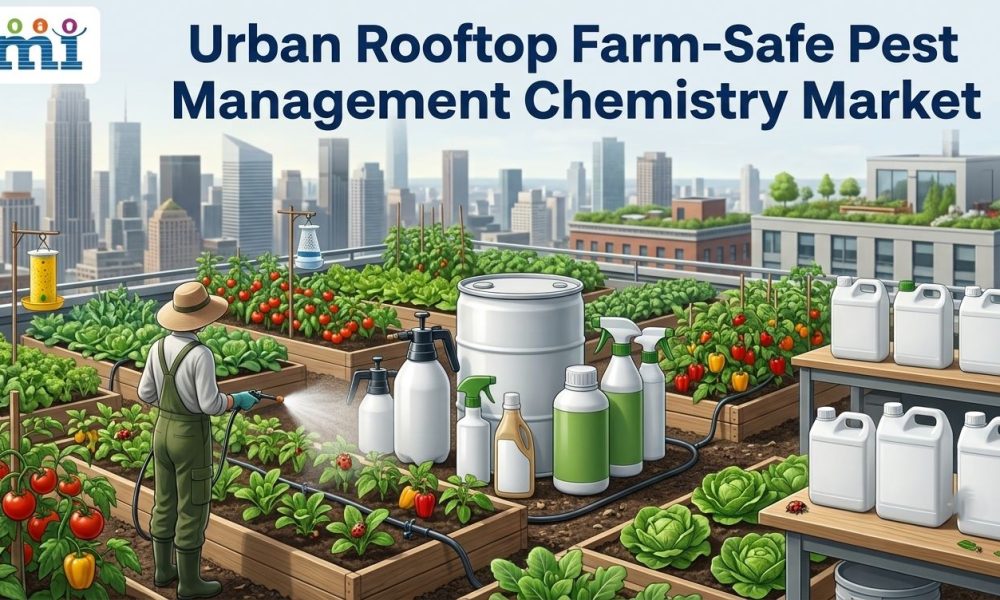
The global urban rooftop farm-safe pest management chemistry market was valued at USD 168.0 million in 2025 and is projected to reach USD 184.6 million by 2026 and USD 474.5 million by 2036, expanding at a 9.9% CAGR from 2026 to 2036. Market demand is supported by the expansion of rooftop food production, compact greenhouse formats, hydroponic roofs, and controlled urban growing systems where crop protection must align with low-residue requirements and short production cycles.
Urban rooftop farms operate under tighter space, labor, and crop-quality constraints than conventional agricultural systems. These conditions increase demand for microbial, botanical, mineral, and other selective formulations that can support integrated pest-management programs while maintaining crop quality across leafy greens, herbs, fruiting crops, and other high-value produce.
Urban Rooftop Farm-Safe Pest Management Chemistry Market: Key Growth Drivers
Rooftop food production is expanding in cities where available land is limited and local fresh-produce supply is becoming an important part of urban agriculture programs. Greenhouse roofs and hydroponic systems provide controlled environments where growers can manage crop conditions while requiring regular pest-management interventions.
Get detailed market forecasts, competitive benchmarking, and pricing trends: https://www.futuremarketinsights.com/reports/sample/rep-gb-32940
Microbials Lead Chemistry Type Demand
By chemistry type, microbials are projected to account for 29.0% of demand in 2026. Their fit with low-residue crop-protection programs and integrated pest-management routines supports use across rooftop vegetables, herbs, and other edible crops.
Foliar Sprays Remain the Leading Application Method
By application method, foliar sprays are projected to hold a 46.0% share in 2026. Direct canopy coverage, quick deployment, and low-volume dosing make foliar application practical for compact rooftop growing layouts.
Leafy Greens Represent the Leading Crop Type
By crop type, leafy greens are projected to account for 24.0% of demand in 2026. Their short production cycles and high sensitivity to visible pest injury create regular requirements for crop-protection programs.
Access the Complete Report in PDF Format: https://www.futuremarketinsights.com/reports/brochure/rep-gb-32940
Country Markets Show Different Growth Patterns
Singapore is projected to record the highest CAGR among the profiled countries at 11.8%, followed by the Netherlands at 11.2%, the United States at 10.4%, Japan at 10.1%, the United Arab Emirates at 10.0%, and India at 9.6% through 2036.
Competitive Landscape
The competitive landscape includes Koppert, Biobest, Andermatt Group, Certis Biologicals, BioWorks, BioSafe Systems, and ProFarm.
Koppert, Biobest, and Andermatt Group have established capabilities across biological crop protection and controlled growing environments.
Competition centers on protected-crop compatibility, biological portfolio depth, formulation fit, low-residue positioning, technical support, crop-specific guidance, and distribution reach. Rooftop farms typically operate on smaller footprints than conventional farms, making product economics, application efficiency, and technical guidance important factors in supplier selection.
“Our analysis indicates that dense protected-crop rooftop systems will anchor early demand for pest-management chemistry, as these operations prioritize yield stability and residue integrity to protect premium fresh-produce margins.”
— Nikhil Kaitwade, Principal Analyst, Future Market Insights
Urban Rooftop Farm-Safe Pest Management Chemistry Market: Report Scope
The report covers the market by chemistry type, pest target, formulation, application method, crop type, farm format, end user, and region. Chemistry categories include microbials, botanicals, minerals, soaps, oils, biochemicals, and selective formulations.
Pest targets include insects, mites, fungi, bacteria, nematodes, mollusks, and mixed pests. Formulations include liquids, powders, granules, baits, gels, suspensions, and concentrates. Application methods include foliar sprays, root drenches, mist sprays, bait placement, spot treatment, seed treatment, and surface wash.
The forecast period extends from 2026 to 2036, with market values presented in USD million.
Business Impact
FMI helps organizations transform market complexity into strategic clarity, enabling leadership teams to identify growth opportunities faster, optimize resource allocation, strengthen competitive positioning, and make high-stakes business decisions with confidence.
To explore how FMI Custom Research can support your strategic priorities, please connect with our team at – [email protected]
About Future Market Insights (FMI)
Future Market Insights, Inc. (FMI) is an ESOMAR-certified, ISO 9001:2015 market research and consulting organization, trusted by Fortune 500 clients and global enterprises. With operations in the U.S., UK, India, and Dubai, FMI provides data-backed insights and strategic intelligence across 30+ industries and 1200 markets worldwide.



