
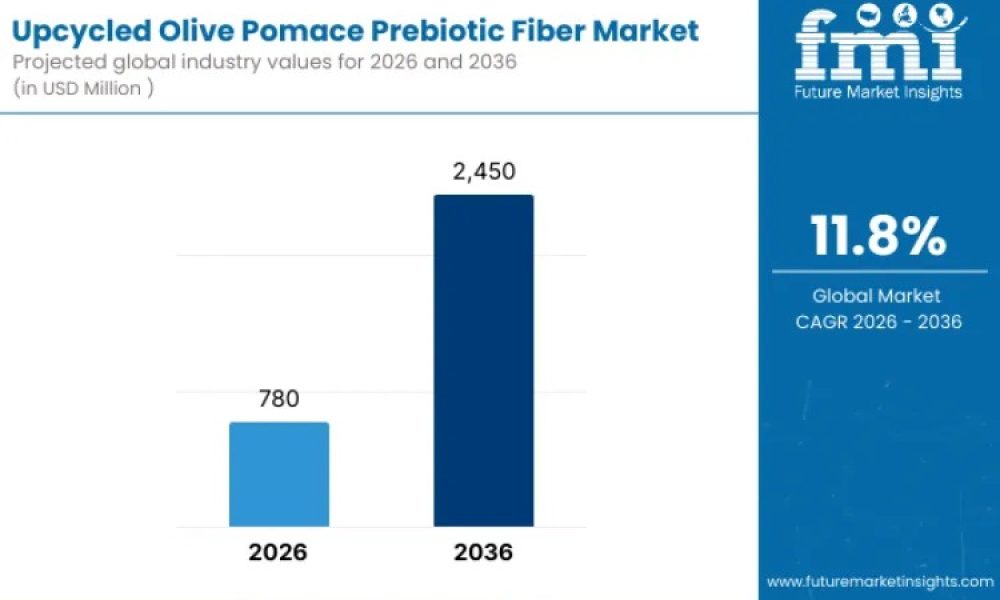
The global upcycled olive pomace prebiotic fiber market is emerging as a high-growth segment within the functional ingredients landscape, driven by rising demand for digestive health solutions and sustainable food inputs. Valued at USD 780 million in 2026, the market is projected to expand to USD 2,450 million by 2036, registering a robust CAGR of 11.8% over the forecast period. This growth reflects a powerful convergence of health, sustainability, and circular economy trends shaping modern food, beverage, and nutraceutical industries.
Upcycled olive pomace, a byproduct of olive oil production, is gaining renewed commercial relevance as manufacturers transform agricultural waste into high-value prebiotic fibers. Rich in dietary fiber and bioactive compounds, olive pomace-derived prebiotics support gut microbiome balance while aligning with environmental goals of waste reduction and resource efficiency. As consumers increasingly seek products that deliver both health benefits and sustainability credentials, the ingredient is finding expanding application across global markets.
Explore trends before investing – request a sample report today!
Powdered Prebiotic Fiber Dominates Product Form Demand
By product form, powdered prebiotic fiber accounts for 44% of the global market share, making it the most preferred format. Its dominance is underpinned by formulation flexibility, stability, and ease of integration into a wide range of products. Powdered fibers are widely used in functional foods, dietary supplements, fortified beverages, and nutrition bars, where consistent texture and dispersibility are essential.
Manufacturers value powdered olive pomace prebiotic fiber for its compatibility with clean-label and plant-based formulations. Its natural origin and upcycled positioning resonate strongly with brands looking to differentiate through sustainability narratives while meeting consumer expectations for digestive wellness.
Functional Foods and Beverages Lead End-Use Applications
Functional foods and beverages represent the largest end-use segment, accounting for 38% of total market demand. The category’s leadership reflects shifting consumer behavior toward preventive health, with digestive wellness emerging as a priority across age groups. Prebiotic fibers are increasingly incorporated into juices, smoothies, dairy alternatives, baked goods, cereals, and snack bars to enhance fiber content without compromising taste or texture.
Beyond functional foods, adoption is also expanding in dietary supplements, animal nutrition, and personal care applications. However, the everyday consumption nature of food and beverage products ensures they remain the primary growth engine for upcycled olive pomace prebiotic fiber.
Sustainability and Circular Economy Drive Market Momentum
A defining trend in the market is the emphasis on sustainability through upcycling. Olive pomace, traditionally considered waste, is now recognized as a valuable raw material that supports circular economy objectives. By converting this byproduct into functional prebiotic fiber, producers reduce environmental burden while creating new revenue streams.
Advancements in extraction and purification technologies are further improving fiber quality, consistency, and scalability. These innovations are helping overcome earlier challenges related to variability in raw material composition, enabling broader commercial adoption across regions.
Key Growth Drivers and Market Constraints
Market expansion is primarily driven by:
- Rising consumer awareness of gut health and the role of prebiotics in digestive and immune support
- Growing demand for natural, plant-based, and clean-label ingredients
- Increased focus on sustainable sourcing and waste valorization
- Expansion of functional food, beverage, and nutraceutical categories
Despite strong momentum, certain restraints persist. Variability in olive pomace composition due to differences in olive varieties and processing methods can impact standardization. Additionally, regulatory differences across regions for prebiotic claims and ingredient approvals may slow market entry in some countries. Price sensitivity in mass-market food products can also limit adoption where lower-cost fiber alternatives exist.
Country-Wise Outlook Highlights Strong Growth in Asia
The upcycled olive pomace prebiotic fiber market is witnessing rapid expansion across both developed and emerging economies. India leads with a CAGR of 15.7%, supported by a growing wellness industry, rising disposable incomes, and strong interest in plant-based nutrition. China follows at 14.1% CAGR, driven by increasing demand for functional foods and government-backed sustainability initiatives.
In the United States, the market is expected to grow at 12.5% CAGR, fueled by clean-label trends and high consumer awareness of digestive health. The UK market is projected to expand at 11.8% CAGR, reflecting strong demand for eco-conscious food ingredients. Japan, with its health-focused dietary culture, is anticipated to grow at 10.9% CAGR over the forecast period.
To Access The Full Market Analysis, Strategic Recommendations, And Analyst Support, Purchase The Complete Report Here.
Competitive Landscape Focused on Quality and Innovation
The market features a mix of established ingredient suppliers and specialized botanical extract companies. Key players include Indena S.p.A, Arjuna Natural Pvt Ltd, Cargill, BENEO GmbH, and Silvateam S.p.A. Competition centers on fiber purity, functional performance, supply reliability, regulatory compliance, and technical support for product formulation. Companies that combine scalable upcycling technologies with transparent sourcing and strong application expertise are best positioned to capitalize on rising demand.
About Future Market Insights (FMI)
Future Market Insights, Inc. (FMI) is an ESOMAR-certified, ISO 9001:2015 market research and consulting organization, trusted by Fortune 500 clients and global enterprises. With operations in the U.S., UK, India, and Dubai, FMI provides data-backed insights and strategic intelligence across 30+ industries and 1,200 markets worldwide.



