
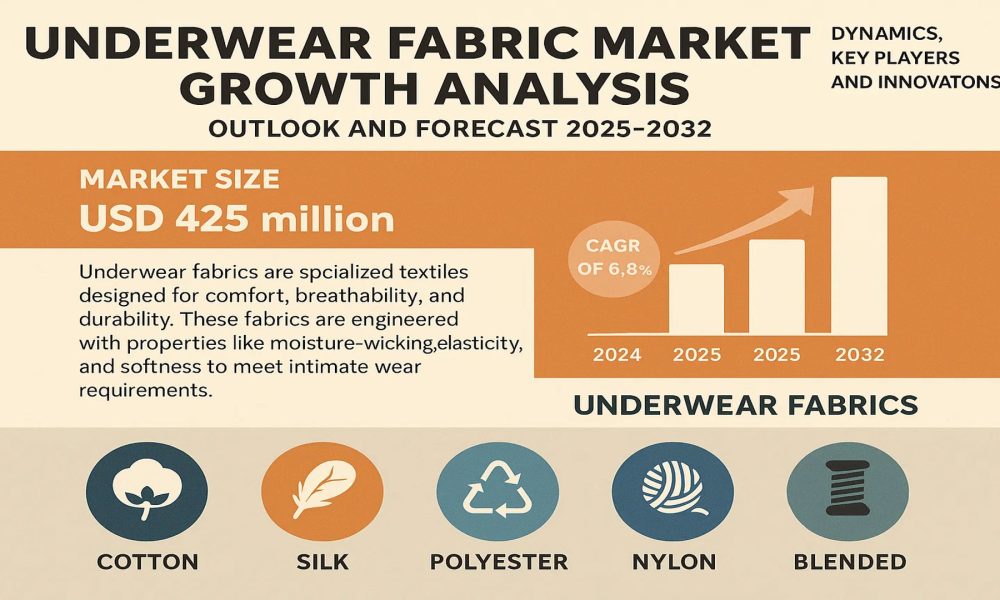
The global underwear fabric market was valued at USD 425 million in 2024 and is projected to grow from USD 456 million in 2025 to USD 667 million by 2032, exhibiting a CAGR of 6.8% during the forecast period.
Underwear fabrics are specialized textiles designed for comfort, breathability, and durability. These fabrics are engineered with properties like moisture-wicking, elasticity, and softness to meet intimate wear requirements. Key material segments include cotton, silk, polyester, nylon, and blended fabrics, each offering distinct advantages for different consumer needs.
Get the Complete Report & TOC at https://www.intelmarketresearch.com/chemicals-and-materials/8110/underwear-fabric-market
Rising Demand for Comfort-Oriented Underwear to Accelerate Market Expansion
The global underwear fabric market is experiencing robust growth, primarily driven by increasing consumer preference for comfortable, skin-friendly undergarments. With over 60% of consumers prioritizing comfort when purchasing underwear, manufacturers are increasingly investing in breathable, lightweight fabrics. Natural fibers like cotton continue dominating the market with approximately 38% share in 2024, while performance synthetics such as moisture-wicking polyester blends are gaining traction at a 12% annual growth rate. The pandemic-induced focus on comfort wear has further amplified this trend, as remote work culture boosted demand for non-restrictive undergarments suitable for extended wear.
Sustainability Initiatives Reshape Fabric Innovation Landscape
Environmental concerns are transforming the underwear fabric industry, with 72% of fashion brands now having sustainable fiber commitments. Recycled polyester has emerged as a key growth segment, projected to expand at 8.3% CAGR through 2030. Major brands are replacing conventional fabrics with alternatives like organic cotton (growing at 15% annually) and cellulose-based fibers such as Tencel, which offer superior breathability with 50% lower water consumption than cotton processing. Recent product launches include seamless underwear made from ocean plastics, capitalizing on the eco-conscious millennial demographic that represents 35% of underwear purchases.
➤ For instance, several European brands have completely transitioned to certified organic cotton underwear lines, reporting 18-22% higher sales compared to conventional counterparts despite 25% premium pricing.
Furthermore, technological advancements in fabric processing enable enhanced functionality without compromising sustainability. Antimicrobial treatments and temperature-regulating finishes are being integrated into eco-fabrics, creating new value propositions that appeal to health-conscious consumers driving the premium segment growth.
MARKET OPPORTUNITIES
Smart Fabrics and Wearable Tech Integration Opens New Revenue Streams
The convergence of apparel and wearable technology presents significant growth potential for underwear fabrics. Smart fabrics incorporating biometric sensors are projected to grow at 19.6% CAGR through 2030, with the health monitoring segment particularly promising. Recent innovations include temperature-regulating fabrics that adjust to body heat and moisture-sensitive materials that provide real-time hydration alerts. These high-value additions command 60-80% price premiums over conventional fabrics, creating attractive margin opportunities for forward-thinking manufacturers.
Asia-Pacific Expansion Offers Untapped Growth Potential
Emerging Asian markets represent the fastest-growing underwear fabric demand, with China and India collectively accounting for 38% of global population growth. Rising disposable incomes in these regions are driving premiumization, with the middle-class segment expected to double by 2030. Local production advantages including lower labor costs (35-40% below Western benchmarks) and improving technical capabilities position the region as both a manufacturing hub and consumption growth engine. Regional brands are increasingly adopting performance fabrics previously reserved for Western markets, creating new demand for technical textiles.
➤ Multiple global brands have established R&D centers in Asia to develop region-specific fabric blends, combining local silk and bamboo fibers with performance synthetics for tropical climates.
Furthermore, trade agreement benefits like the RCEP are streamlining cross-border fabric trade, reducing tariffs by 15-20% on technical textiles. This facilitates more competitive positioning for regional manufacturers in global supply chains.
By Type
- Cotton
- Silk
- Polyester
- Nylon
- Others
Cotton remains the dominant fabric due to its breathability, comfort, and hypoallergenic properties, making it ideal for daily wear.
By Application
- Women
- Men
- Kids
Women’s underwear fabric holds the largest share, driven by demand for aesthetic designs, comfort, and functional innovations like seamless and shaping fabrics.
By End User
- Mass Market Brands
- Premium Brands
- Private Label Manufacturers
Mass Market Brands lead consumption due to affordability and wide distribution, though premium brands are growing with demand for sustainable and performance-oriented fabrics.
List of Key Underwear Fabric Companies Profiled
- Marand (Slovenia)
- Lauma Fabrics (Latvia)
- Carvico (Italy)
- Nextil Group (Spain)
- Sanko Textiles (Turkey)
- Textil Vertrieb Beratungs (Germany)
- Zhejiang Huachang Textile (China)
- Huading (China)
- Best Pacific (Hong Kong)
- Sun Hing Industries Holding (Hong Kong)
- HongDa (China)
Recent Developments
- Shift to Sustainable Fibers
- Lenzing (Austria) and Birla Cellulose have expanded production of TENCEL™ Lyocell and Modal for underwear applications, with greater emphasis on traceability and FSC/PEFC-certified raw materials.
- Growing adoption of recycled polyester (rPET) and recycled nylon blends in intimate apparel, with Unifi’s REPREVE® gaining traction in global underwear brands.
- Advancements in Seamless Technology
- Investment in Santoni circular knitting machines by manufacturers in China, Vietnam, and Sri Lanka to meet rising demand for seamless underwear fabrics with engineered ventilation and compression zones.
- PFAS-Free Finishes & Chemical Compliance
- Major brands (e.g., Calvin Klein, Victoria’s Secret, Uniqlo) are requiring PFAS-free moisture/soil repellent finishes ahead of EU/US restrictions. Suppliers are introducing bio-based odor-control and waterless dyeing solutions.
- Performance & Comfort Innovation
- Hyosung’s creora® bio-based spandex and Asahi Kasei’s ROICA™ sustainable stretch yarns are gaining adoption in premium underwear lines, improving stretch recovery with reduced environmental impact.
- DSM/Avient and other players are working on phase-change and cooling knits for next-gen sports underwear.
- Digitalization & On-Demand Manufacturing
- Brands and mills adopting 3D knitting prototypes and digital fabric testing to reduce lead times and waste.
- Growth of on-demand dyeing and printing for small-batch underwear collections in D2C channels.
- Regional Supply Chain Shifts
- Ongoing China+1 sourcing strategy accelerating underwear fabric production growth in Vietnam, India, Bangladesh, and Sri Lanka.
- Investments in eco-friendly dyehouses with wastewater recycling in Southeast Asia to comply with EU Green Deal requirements.
What are the emerging trends?
-> Emerging trends include sustainable fabrics, smart textiles with moisture-wicking properties, and increased adoption of organic cotton and recycled materials.
Get the Complete Report & TOC at https://www.intelmarketresearch.com/chemicals-and-materials/8110/underwear-fabric-market
CONTACT US:
276 5th Avenue, New York , NY 10001,United States
International: (+1) 646 781 7170
Email: [email protected]
Follow Us On linkedin :- https://www.linkedin.com/company/24-market-reports




