
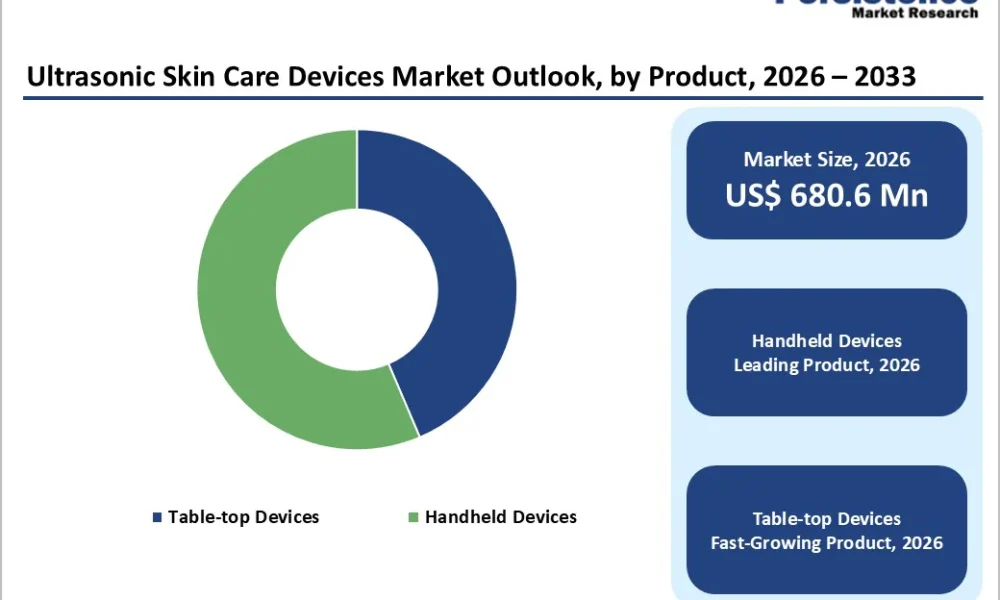
The global Ultrasonic Skin Care Devices Market is experiencing robust growth, with a projected increase from US$ 680.6 million in 2026 to US$ 1,118 million by 2033. This growth is driven by several factors, including a shift towards non-invasive beauty treatments, rising demand for anti-aging solutions, and increasing consumer preference for advanced at-home skincare technologies. The market is projected to witness a Compound Annual Growth Rate (CAGR) of 5.8% from 2026 to 2033.
In recent years, technological advancements have significantly improved the effectiveness of ultrasonic skin care devices. The combination of ultrasound with other modalities, such as LED therapy and microcurrent, is gaining traction, creating multifunctional devices that cater to a broader range of skincare needs. Furthermore, the growing presence of e-commerce platforms and increased adoption of beauty-tech gadgets have played a pivotal role in expanding market access and fostering consumer interest in at-home skincare solutions.
Key Highlights from the Report
• The global ultrasonic skin care devices market is projected to grow at a CAGR of 5.8% from 2026 to 2033.
• North America leads the market, holding a 46.8% share, driven by high consumer spending on premium beauty technologies.
• Asia Pacific is the fastest-growing region, with a CAGR of 7.8%, due to tech-savvy consumers and growing demand for non-invasive beauty tools.
• The handheld devices segment leads in terms of revenue share, contributing to 56.4% of the market in 2026.
• Skin rejuvenation dominates as the leading application, accounting for 41.8% of market revenue.
• The aesthetic clinics segment is expected to lead the market, contributing 52.8% of the revenue share.
Download Your Free Sample & Explore Key Insights: https://www.persistencemarketresearch.com/samples/27490
Market Overview and Growth Dynamics
The Ultrasonic Skin Care Devices Market has gained substantial traction in recent years, driven primarily by consumer demand for non-invasive beauty solutions. Ultrasonic technology is widely used in the beauty industry for its ability to improve skin texture, smoothness, and overall appearance. By using sound waves, these devices offer a range of skincare benefits, including deep cleansing, lifting, and anti-aging effects.
Several key factors are driving the market’s expansion:
Rising Demand for Non-Invasive Treatments: As consumers seek to avoid the risks, downtime, and high costs associated with surgical procedures, there has been an increasing preference for non-invasive options such as ultrasonic skin care devices. These tools promise to deliver effective results without requiring clinical interventions.
Technological Advancements: Continuous improvements in product designs, such as the integration of wireless connectivity, smart skin analysis, and enhanced sonophoresis performance, are contributing to the growth of the market. Consumers are becoming more confident in using advanced technologies at home due to these innovations.
Consumer Shift Toward At-Home Skincare Solutions: The growing influence of beauty-tech brands and the rising popularity of e-commerce platforms have made advanced skincare devices more accessible. With consumers increasingly embracing at-home treatments, ultrasonic devices are gaining prominence due to their affordability, portability, and convenience.
The North American region holds a dominant position in the market, accounting for 46.8% of the global market share. This is largely due to the region’s strong demand for premium beauty technologies and the widespread use of at-home ultrasonic tools. The U.S. specifically benefits from a highly developed aesthetic services sector, where ultrasonic devices are incorporated into med-spas, beauty salons, and dermatologist clinics.
Market Segmentation
The Ultrasonic Skin Care Devices Market is segmented based on product type, application, end-user, and region. These categories help break down the diverse consumer needs and preferences across various markets.
Product Type:
Handheld Devices: The handheld devices segment is the largest in terms of market share and is projected to continue dominating the market. These devices offer easy-to-use, portable solutions for consumers looking to enhance their skincare routines at home. They are especially popular due to their affordability and convenience.
Tabletop Systems: Although smaller in market share, tabletop systems are expanding rapidly. These devices, used primarily in aesthetic clinics and spas, provide stronger performance and more customizable treatment settings. They are favored for professional treatments and are expected to be the fastest-growing product category.
Application:
Skin Rejuvenation: The skin rejuvenation segment is projected to dominate the market, driven by increasing consumer interest in solutions that address texture improvement, radiance enhancement, and anti-aging. Ultrasonic devices help promote collagen production, improve blood circulation, and enhance the absorption of skincare products.
Body Contouring: The body contouring segment is witnessing rapid growth as consumers seek non-surgical alternatives to enhance body aesthetics. Ultrasonic technology is used to improve skin firmness and smoothness, and this segment is expected to continue its upward trajectory.
End-User:
Aesthetic Clinics: The aesthetic clinics segment is the largest end-user category, primarily due to the availability of advanced, high-performance ultrasonic devices. These professional-grade tools are preferred for procedures that require higher intensity and faster results compared to at-home devices.
At-Home Consumers: Although smaller in comparison, the at-home segment is rapidly growing, driven by the convenience of using handheld devices for daily skincare routines. This segment benefits from strong e-commerce penetration and increased consumer education about the benefits of ultrasonic treatments.
Get Custom Insights Designed for Your Business: https://www.persistencemarketresearch.com/request-customization/27490
Regional Insights
North America:
North America is expected to remain the largest regional market for ultrasonic skin care devices. The region’s mature aesthetic services industry, coupled with high consumer spending on premium beauty products, makes it a hotspot for advanced skincare technologies. The U.S. stands out with its highly developed med-spa and aesthetic clinic infrastructure, which helps boost the demand for professional-grade ultrasonic devices. Moreover, the widespread adoption of connected skincare devices and strong e-commerce growth continue to fuel market expansion in this region.Asia Pacific:
Asia Pacific is the fastest-growing market, driven by increasing disposable incomes, rapid urbanization, and a growing interest in non-invasive skincare treatments. Countries such as China, South Korea, Japan, and India are seeing significant demand for both at-home and professional-grade ultrasonic devices. The rise of a tech-savvy consumer base and the presence of major beauty-tech companies in this region are key drivers of growth. The region’s strong manufacturing ecosystem also supports low-cost device production, further enhancing market accessibility.Europe:
Europe is another key market, with countries such as Germany, France, and the U.K. exhibiting a growing demand for safe, effective, and clinically validated beauty devices. European consumers are increasingly leaning towards non-invasive solutions, driven by a desire for anti-aging treatments and improved skin texture. The region’s focus on high-quality, medical-grade devices that are CE-certified contributes to the growth of the market.
Market Drivers
The demand for non-invasive aesthetic care is the primary driver of growth in the ultrasonic skin care devices market. As consumers become more conscious of the risks associated with surgical procedures, they are increasingly turning to alternatives such as ultrasonic treatments. These devices are highly effective in improving skin texture, promoting collagen production, and enhancing product absorption, all without the need for invasive procedures.
Technological advancements are also playing a significant role in driving market growth. The integration of features like wireless connectivity, AI-driven personalization, and app-based skin analysis are making these devices more appealing to consumers. These innovations improve the overall user experience, providing more tailored, effective treatments and increasing consumer confidence in their purchase decisions.
Market Restraints
Despite its growth, the ultrasonic skin care devices market faces several challenges. One of the primary restraints is heightened regulatory scrutiny. As ultrasonic devices fall under the category of energy-based aesthetic technologies, they are subject to strict safety regulations, which can delay product approvals and increase costs for manufacturers. The lack of consistent clinical validation across different indications also limits the claims that companies can make, potentially hindering market expansion.
Additionally, competition from established technologies such as laser and radiofrequency (RF) treatments poses a significant challenge. These modalities have stronger clinical evidence supporting their efficacy, which makes it difficult for ultrasonic devices to differentiate themselves in premium markets where results-backed treatments are preferred.
Market Opportunities
The rise of AI-powered personalization presents a key opportunity for growth. By integrating smart technologies into ultrasonic devices, manufacturers can offer consumers customized skincare routines based on their unique skin conditions. App-connected devices that provide real-time feedback, treatment guidance, and progress tracking are becoming increasingly popular.
Moreover, the expansion of med-spas and professional aesthetic centers is also fueling growth. These centers are increasingly adopting ultrasonic technologies as part of their treatment offerings, providing consumers with a safer, quicker, and more affordable alternative to invasive procedures.
Checkout Now & Download Complete Market Report: https://www.persistencemarketresearch.com/checkout/27490
Company Insights
• Alma Lasers
• Cynosure Lutronic
• Solta Medical Inc.
• Cutera, Inc.
• Candela Corporation
• Canfield Scientific, Inc.
• Aesthetics Biomedical
• AESTHETIC SCIENCE, LLC
• Fotona
• Alvi Prague
• Hapilin
• OSANO
Market Segmentation
By Product
- Table-top Devices
- Handheld Devices
By Application
- Body Contouring
- Skin Tightening
- Skin Rejuvenation
- Others
By End-user
- Hospitals
- Aesthetic Clinics
- Spa and Salon
- Home Care Settings
By Region
- North America
- Europe
- East Asia
- South Asia and Oceania
- Latin America
- Middle East and Africa
Recent Market Developments
Cynosure Lutronic introduced the eCO2 3D system in October 2025, a next-generation fractional CO2 laser platform that enhances precision and treatment customization.
In March 2025, Alma Lasers launched an upgraded version of its Alma Harmony aesthetics platform, featuring modernized designs and enhanced functionality to improve user experience.
Conclusion
The Ultrasonic Skin Care Devices Market is set to grow significantly in the coming years, driven by the increasing consumer demand for non-invasive, effective skincare solutions. With innovations in technology and the growing popularity of at-home skincare treatments, the market is expanding across regions and product segments. Although regulatory challenges and competition from established technologies exist, the rise of AI-powered personalization and professional adoption of ultrasonic technologies presents significant growth opportunities for market players. As the market continues to evolve, companies must focus on enhancing user experience, improving product efficacy, and expanding their consumer base to capitalize on these opportunities.




