
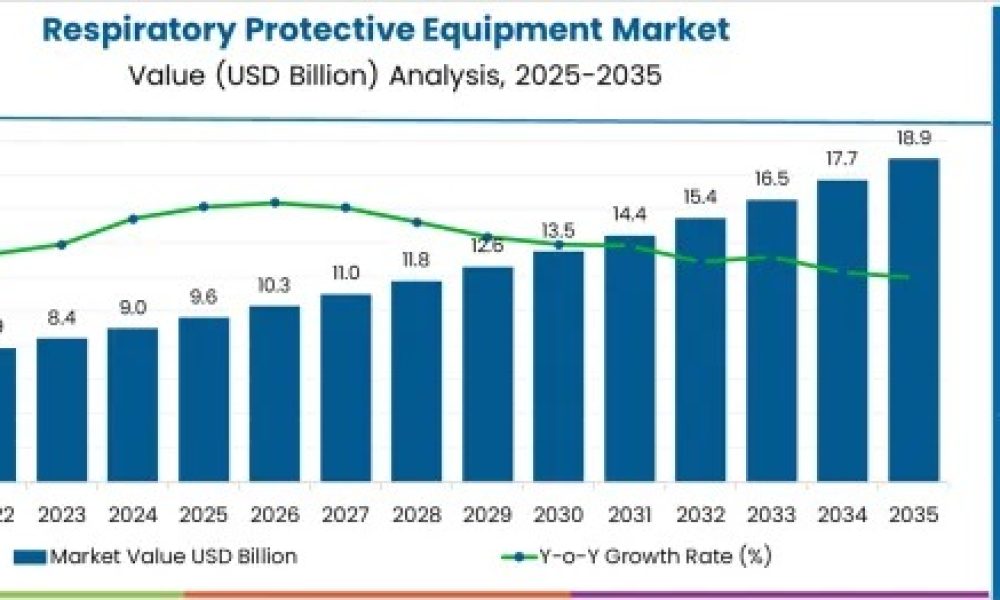
The global Respiratory Protective Equipment Market is entering a decade of accelerated expansion, supported by stronger workplace safety enforcement, steady procurement cycles, and rising adoption of advanced filtration technologies. Valued at USD 9.6 billion in 2025, the market is projected to reach USD 18.9 billion by 2035, growing at a CAGR of 7.0%. The absence of downturns or seasonal fluctuations across the timeline highlights a structurally stable market shaped by regulatory mandates, institutional procurement, and year-round industrial operations.
Subscribe for Year-Round Insights → Stay ahead with quarterly and annual data updates
https://www.futuremarketinsights.com/reports/sample/rep-gb-23518
Procurement patterns indicate that respiratory protective equipment (RPE) is purchased based on operational necessity rather than seasonal influences. Steady annual increments—ranging between USD 0.7 billion and USD 1.2 billion—reflect predictable behavior across industries, particularly manufacturing, construction, mining, oil & gas, and emergency services. This stability enables suppliers and distributors to maintain consistent production schedules, optimize inventory, and support long-term contractual supply arrangements.
Market momentum remains strong as industries continue to elevate worker protection standards. Post-pandemic awareness has normalized regular use of RPE in healthcare settings, while industrial sectors remain the largest consumers, representing an estimated 35% share in 2025. Increasing exposure to airborne hazards in industrial environments, combined with stricter enforcement of OSHA, EU, and regional safety policies, continues to drive adoption.
Technological improvements are reshaping product portfolios across key players. Next-generation devices incorporate smart sensors, advanced nanofiber filtration, ergonomic materials, and enhanced compatibility with communication systems. These innovations improve reliability in toxic and oxygen-deficient environments, especially in sectors such as firefighting, industrial manufacturing, pharmaceuticals, and hazardous material handling.
Market Leadership and Segmental Insights
Self-contained breathing apparatus (SCBA) is expected to dominate with a 29% share in 2025 due to its critical use in emergency response and hazardous operations. Integration of lightweight frames, connected displays, and improved harness systems has strengthened its adoption across fire departments, industrial rescue units, and chemical processing plants.
Regionally, North America, Europe, and Asia-Pacific remain key demand centers, collectively driving the majority of global growth. China and India lead with CAGRs of 9.5% and 8.8%, respectively—well above the global average—supported by expanding industrial infrastructure and stricter employee safety legislation. Germany, the UK, and the US maintain steady adoption due to regulatory compliance and replacement cycles within mature industries.
Drivers and Emerging Trends
Stricter safety regulations: Compliance with occupational health rules is the strongest growth driver, pushing companies toward certified, high-efficiency respirators.
Material and design innovation: New filtration media, nanofiber layers, wearable sensors, and reusable configurations are improving efficiency and reducing lifecycle cost.
Supply chain restructuring: The pandemic shifted RPE manufacturing toward regional hubs, improving resilience but keeping cost sensitivity high for SMEs.
Growing industrialization: Emerging markets in Asia, the Middle East, and Latin America are witnessing rapid demand as construction, mining, and chemicals expand.
Competitive Landscape
Leading manufacturers—3M, Honeywell, MSA Safety, Bullard, Alpha Pro Tech, Delta Plus Group, RPB Safety LLC, and The Gerson Company—are focusing on elevated comfort, better filtration endurance, and digital monitoring systems. Market strategies prioritize eco-friendly respirators, advanced PAPRs, rugged SCBAs, and systems engineered for high-risk industrial conditions. Companies are also expanding capacity in developing regions to meet rising demand for affordable, compliant equipment.
Forward Outlook
The decade ahead is expected to deliver steady, multi-regional growth driven by regulatory updates, expanding industrial sectors, and rising awareness of occupational hazards. With no indicators of cyclical decline, the respiratory protective equipment market remains a resilient, strategically critical segment for global safety infrastructure.
Get data that aligns with your strategic priorities — ask for report customization today:
https://www.futuremarketinsights.com/customization-available/rep-gb-23518
Have a specific Requirements and Need Assistant on Report Pricing or Limited Budget please contact us – [email protected]
About Future Market Insights (FMI)
Future Market Insights, Inc. (FMI) is an ESOMAR-certified, ISO 9001:2015 market research and consulting organization, trusted by Fortune 500 clients and global enterprises. With operations in the U.S., UK, India, and Dubai, FMI provides data-backed insights and strategic intelligence across 30+ industries and 1200 markets worldwide.
Contact Us:
Future Market Insights Inc.
Christiana Corporate, 200 Continental Drive,
Suite 401, Newark, Delaware – 19713, USA
T: +1-347-918-3531



